Training a psychiatric service dog involves three phases: foundation obedience, public access training, and disability-specific task training, typically spanning 12 to 24 months. You can legally self-train your PSD under the ADA without any professional trainer or certification. The process costs anywhere from $500 for self-training to $25,000+ for a program-trained dog. About half of all service dog candidates wash out before completing training, so choosing the right dog and using positive reinforcement methods are critical to success.
Training a psychiatric service dog is one of the most practical, life-changing projects a person with a mental health disability can undertake. It’s also one of the most misunderstood. The terminology alone can be overwhelming: What counts as a “task” versus “comfort”? What’s the difference between proofing and generalization? Do you actually need certification?
This guide works as both a glossary and a roadmap. Every key term you’ll encounter during PSD training is defined here, organized from foundational concepts through advanced tasks and training methods. Whether you’re considering self-training or hiring a professional, understanding these terms is the first step toward building a reliable working partnership with your dog.
If you’re still figuring out whether your condition qualifies, our overview of conditions a service dog helps with is a good starting point.
Before you start training, you need to speak the language. These definitions form the legal and practical foundation for everything that follows.
A psychiatric service dog is a service dog individually trained to perform specific tasks that mitigate symptoms of a psychiatric disability. Qualifying conditions include PTSD, major depressive disorder, generalized anxiety disorder, bipolar disorder, schizophrenia, obsessive-compulsive disorder, and others.
The key distinction: the dog must be trained to take a specific action in response to a command or a signal it has learned to detect. A dog that simply makes you feel calmer by being present does not meet the legal definition. The ADA defines a service animal as “any dog that is individually trained to do work or perform tasks for the benefit of an individual with a disability, including a physical, sensory, psychiatric, intellectual, or other mental disability” (28 CFR § 36.104).
For a deeper look at what a PSD is and how it’s documented, see our guide on psychiatric service dog documentation.
An ESA provides comfort through companionship but is not trained to perform specific tasks related to a disability. This distinction matters enormously.
ESAs are not service animals under Title II or Title III of the ADA. They have no public access rights, meaning businesses, restaurants, and stores are not required to allow them entry. ESAs do receive some protections under the Fair Housing Act for housing accommodations, but those rights are narrower than what PSDs receive.
If you’re unsure which category your animal falls into, our article on the difference between ESA and service dog breaks it down clearly.
The person with a disability who works with the service dog. In owner-training, the handler is also the primary trainer. This dual role creates a unique challenge that most guides gloss over.
A 2019 Purdue University study published in Frontiers in Veterinary Science found that handler symptoms of depression and PTSD actually predicted the development of behavioral problems in their service dogs. Your mental health affects your dog’s training outcomes. This doesn’t mean people with psychiatric disabilities can’t train their own dogs. It means you should plan for bad days, have backup training support, and be honest about your capacity during flare-ups.
A dog actively undergoing training to become a service dog but not yet fully trained. SDIT legal protections vary by state. Some states grant SDITs the same public access rights as fully trained service dogs. Others do not. Check your state’s specific laws before taking an SDIT into non-pet-friendly businesses.
The federal law that protects the rights of people with disabilities, including the right to be accompanied by a service dog in public places. Under the ADA, there is no requirement for a PSD to be professionally trained, certified, registered, or wear identifying gear.
A service dog trained by its handler rather than by a professional trainer or program. This is the most common path for psychiatric service dog handlers, and it’s completely legal. The ADA explicitly states that owner-trained service dogs receive the same legal protections as professionally trained ones.
Practitioners on Reddit’s r/service_dogs community frequently discuss the realities of owner training. The consensus: it’s entirely viable but significantly harder than most people expect, particularly for individuals managing active psychiatric symptoms during the training process.
Under the ADA, when a disability is not obvious, a business may ask only two questions:
Is this a service animal required because of a disability?
What work or task has the dog been trained to perform?
They cannot ask about the nature of your disability, request documentation, or demand a demonstration of the task. Understanding these boundaries protects you from illegal questioning and helps you navigate public access with confidence.
For more detail on what businesses can and cannot ask, read our article about ADA rules on service dog identification.
A fully trained PSD has the right to accompany its handler in all areas where the public is allowed, including restaurants, stores, hospitals, hotels, and public transit. The dog must be under the handler’s control and housebroken. A business can only remove a service dog if the dog is out of control and the handler does not take effective action, or if the dog is not housebroken.
Understanding how to train a psychiatric service dog means understanding the phases. Every experienced trainer and owner-trainer community converges on the same basic structure, though timelines vary.
The bedrock of all service dog training. Your dog must reliably perform sit, down, stay, come, heel, leave it, drop it, and place in low-distraction environments before anything else can happen. “Reliably” means the dog responds on the first cue even when bored, hungry, or tired.
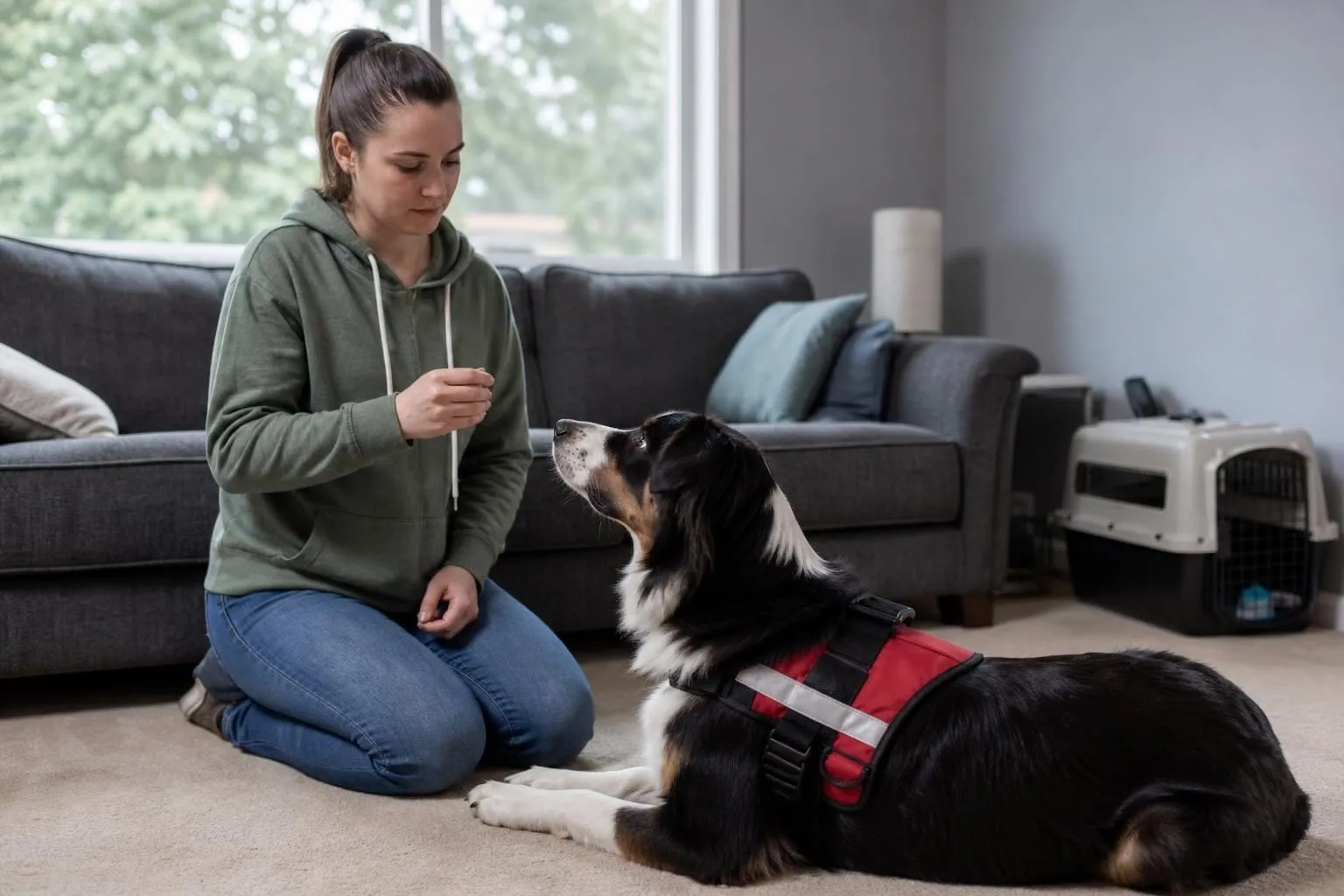
The recommended approach: enroll in a structured group class with a positive-reinforcement trainer and add 15 to 20 minutes of daily home practice. By the end of this phase, your dog should respond consistently in your home, on walks, and in moderately distracting public spaces.
Foundation obedience is where you discover whether your dog has the temperament for service work. Not every dog does.
Systematic, positive exposure to the environments, sounds, people, surfaces, and situations a service dog will encounter throughout its working life. Socialization is most critical during puppyhood (8 to 16 weeks) but continues throughout training.
Good socialization means the dog can encounter a wheelchair, a crying child, an elevator, a crowded farmers’ market, or a sudden loud noise without panic, aggression, or excessive excitement. The goal is neutrality, not friendliness.
This phase overlaps with foundation obedience and represents the bridge between a well-trained pet and a service dog. The dog must learn to be unobtrusive in public: calm in restaurants, quiet in stores, settled on public transit.
Professional trainers recommend a graduated approach. Start in quiet, familiar environments where the dog responds to every command on the first ask. Then move to dog-friendly retail spaces like hardware stores, which offer wide aisles and neutral smells. These environments provide a controlled bridge between home training and high-traffic public areas.
This is where many owner-training efforts fail. A dog that performs beautifully at home may fall apart in a busy grocery store. The gap between those two settings requires deliberate, progressive work.
A standardized evaluation of whether a service dog can behave appropriately in public settings. The PAT typically includes walking through a crowd, ignoring food on the floor, remaining calm around other dogs, settling under a table in a restaurant, and riding an elevator.
No federal law requires passing a PAT. But it serves as a useful self-assessment benchmark. If your dog can’t pass a PAT, it’s not ready for public access work, regardless of how well it performs tasks at home.
Once your dog demonstrates solid obedience and public access readiness, training shifts to the disability-specific tasks that make it a psychiatric service dog. This is the phase that separates a PSD from a well-behaved companion.
Most psychiatric service dog tasks follow a recognition-and-response pattern: the dog identifies a cue (a command from the handler, a change in the handler’s behavior, or a physiological signal) and immediately performs a trained action.
Professional task training typically requires 25 to 40 hours of focused work, with ongoing maintenance throughout the dog’s career.
Learn more about which specific behaviors qualify in our detailed guide on tasks that qualify a psychiatric service dog.
Testing trained behaviors against increasing levels of distraction, duration, and distance. A dog that sits on cue in your quiet kitchen needs to also sit on cue in a noisy airport. Proofing is what turns a trained behavior into a dependable one.
Proofing involves systematically varying three variables: the level of distraction present, the duration the dog must maintain the behavior, and the distance between you and the dog. Change one variable at a time, not all three at once.
The ability of a dog to perform a trained behavior in any environment, not just the one where it was learned. Generalization is the most underappreciated concept in service dog training.
Dogs are context-specific learners. A dog trained to perform deep pressure therapy on your living room couch may not automatically do it on an airplane seat. You have to explicitly train the same behavior in multiple locations, on different surfaces, at different times of day, and under varying conditions.
Experienced owner-trainers consistently report that generalization is where the real work happens. Your dog isn’t truly trained until it can perform in places it’s never been before.
A “wash-out” occurs when a dog fails to complete training or is retired early from service work. Reasons include fear reactivity in public, loss of interest in task work, health problems, or temperament issues that only emerge under the pressures of public access.
The service dog industry has a wash-out rate of roughly 50%. Half of all dogs that begin training never become working service dogs. This number applies across professional programs and owner-trained dogs alike. It’s a hard truth that anyone learning how to train a psychiatric service dog should understand before investing months of time and emotional energy into a specific dog.
Wash-out doesn’t mean you failed. It means that specific dog wasn’t suited for that specific job. Many washed-out dogs go on to be wonderful pets or therapy dogs.
These are the specific, trained behaviors that give a psychiatric service dog its legal status. Each task must be directly related to mitigating a symptom of the handler’s disability. Understanding what these tasks actually look like, in concrete terms, is essential for anyone planning to train a PSD.
One of the most commonly trained psychiatric service dog tasks. The dog lies across the handler’s lap, chest, or legs, applying sustained pressure with its body weight (typically 20 to 30+ pounds). This pressure activates the parasympathetic nervous system, reducing heart rate and cortisol levels during panic attacks, anxiety episodes, or emotional dysregulation.
DPT is not the same as a dog curling up next to you for comfort. The dog is trained to apply weight deliberately, hold position for a sustained period, and respond to a specific cue or to recognized signs of distress.
Research has confirmed the physiological benefits of service dog interactions, including measurable changes in stress hormones and heart rate.
The dog is trained to lick, nuzzle, or place its paw on the handler to interrupt a dissociative episode, a panic attack, or a harmful repetitive behavior like skin-picking or hair-pulling. The physical sensation redirects the handler’s attention to the present moment, grounding them in their body and surroundings.
This task is particularly valuable for handlers with PTSD, dissociative disorders, or OCD-related behaviors. The dog essentially becomes a sensory anchor.
Broader than tactile grounding, behavior interruption covers any trained response where the dog interrupts a harmful or unproductive pattern. This might include persistent self-harm behaviors, compulsive rituals, or spiraling thought patterns that manifest in observable physical behaviors like pacing or rocking.
The dog learns to recognize specific behavioral cues and respond with a pre-trained action: nudging, pawing, bringing a toy, or initiating physical contact.
The dog is trained to go to a specific location and retrieve a small canvas bag, pouch, or container holding the handler’s medication. This task is particularly useful during episodes where the handler has limited mobility or executive function, such as severe depressive episodes where getting out of bed feels impossible.
Training involves teaching a reliable “fetch” to a designated spot, with the dog bringing the item directly to the handler’s hands.
For handlers with PTSD or other conditions that cause night terrors, the dog is trained to detect signs of distress during sleep (vocalizations, thrashing, elevated breathing) and wake the handler using a persistent trained behavior. Methods include face licking, nuzzling, or pawing, and the dog is trained to continue until the handler sits up and is fully awake.
This task can be genuinely life-changing. One veteran profiled in our coverage of how a service dog helped overcome PTSD described nightmare interruption as the single most important task their dog performs.
The dog positions itself between the handler and other people to create a physical buffer zone. In a “block” position, the dog stands in front of the handler facing outward. In a “cover” position, the dog stands behind the handler.
This task is critical for handlers with PTSD, social anxiety, or agoraphobia who experience heightened distress when crowded or approached unexpectedly. The dog creates predictable personal space without the handler needing to verbally confront anyone.
Dogs can be trained to recognize the physiological and behavioral cues that precede a panic attack or anxiety episode. When the dog detects these signals, it performs a pre-trained alert behavior, giving the handler advance warning to use coping strategies, take medication, or move to a safer environment.
There are two distinct methods for training this alert:
Association method: Starting as early as 8 weeks old, the handler calls the dog over every time anxiety begins and provides high-value rewards (special treats, favorite toys). Over time, the dog learns that the handler’s pre-episode state predicts rewards, so it begins approaching unprompted when it detects those cues.
Responding to tells: The handler identifies a specific observable behavior they exhibit before an episode (fidgeting, a change in breathing, a particular posture). The dog is trained to notice that specific tell and respond with a designated alert behavior.
PsychDogPartners, a respected non-profit in the PSD community, recommends training the alert behavior separately from the anxiety association. First, teach the dog a reliable behavior (nudge, paw, spin) through standard positive reinforcement. Then, once the dog is already running over during anxious moments, delay the reward until the dog performs the trained behavior. This chains the recognition to a specific, useful response.
The dog is trained to enter a room ahead of the handler and check it, or to lead the handler to a pre-designated exit on command. This task helps handlers with PTSD or severe anxiety who experience hypervigilance in unfamiliar spaces. Knowing the room has been “cleared” or that the dog can guide them out reduces the cognitive burden of navigating new environments.
Some PSDs are trained to prompt daily routines: eating meals, drinking water, taking medication at specific times, going to bed, or getting out of bed. These reminders are particularly valuable for handlers whose depression, ADHD, or anxiety disrupts the basic structure of daily life.
The dog learns to perform a specific behavior (bringing a food bowl, nudging the handler, going to the door) at set times or in response to environmental cues.
The dog positions itself behind the handler, facing away, to reduce the handler’s need for hypervigilant scanning. For someone with PTSD who cannot relax unless they know what’s happening behind them, this task allows the handler to focus forward while the dog covers the rear.
The dog is trained to orient outward and remain alert in that position until released.
How you train a psychiatric service dog matters as much as what you train. Research is clear on which approaches produce the best outcomes.
Adding something the dog wants (treat, toy, praise) immediately after a desired behavior to increase the likelihood of that behavior happening again. This is the foundation of modern evidence-based dog training.
The 2019 Purdue University study surveying 111 veterans with PTSD service dogs found that positive reinforcement methods were associated with reporting more positive outcomes, while positive punishment (adding something unpleasant) was associated with more negative outcomes. Positive reinforcement has also been independently associated with lower fear and aggression in dogs compared to other training methods.
For psychiatric service dog training specifically, R+ methods are not just preferable, they’re practically necessary. A dog that associates its handler with punishment will not voluntarily approach during a crisis.
Reinforcing successive approximations of a desired behavior. Instead of waiting for the dog to perform a complete task perfectly, you reward small steps toward the goal. If you’re training deep pressure therapy, you might first reward the dog for putting its front paws on the couch, then for lying partially across your lap, then for settling its full weight.
Shaping is essential for complex psychiatric service dog tasks that can’t easily be prompted or lured.
Waiting for the dog to offer a desired behavior naturally, then marking and rewarding it. Capturing is particularly useful for alerting behaviors. If your dog naturally comes to check on you when you’re anxious, you capture that behavior by rewarding it consistently, then put it on cue.
Using a treat or toy to guide the dog into position. Luring works well for teaching basic obedience (guiding the dog into a sit, down, or heel position) and for initial positioning in tasks like blocking or DPT. The lure should be faded quickly so the dog responds to the cue alone, not just the visible reward.
Linking multiple trained behaviors into a sequence. Many PSD tasks are actually chains: the dog detects a cue, orients toward the handler, approaches, and performs a specific action. Each link in the chain is trained separately first, then connected.
Medication retrieval is a good example: go to the designated spot, pick up the bag, carry it to the handler, release it into the handler’s hands. Four distinct behaviors chained into one task.
Modern training language distinguishes between a “cue” (a signal that tells the dog an opportunity for reinforcement is available) and a “command” (an instruction implying consequences for noncompliance). The shift in terminology reflects the shift toward positive reinforcement methods. You’ll encounter both terms in PSD training resources. They refer to the same thing functionally, but “cue” aligns with R+ philosophy.
A specific technique where the handler pairs their pre-episode state with high-value rewards for the dog, teaching the dog that the handler’s anxiety cues predict good things. Over many repetitions, the dog begins to actively seek out the handler when it detects those cues, which becomes the foundation for a trained alert behavior.
Training the dog to respond to a specific physical behavior (a “tell”) that the handler exhibits before or during a psychiatric episode. Unlike the association method, which relies on the dog detecting subtle physiological changes, this approach targets an observable behavior the handler has identified, such as a specific type of fidgeting, a change in voice pitch, or a posture shift.
Both methods can work. Many experienced handlers report that combining them, starting with association and refining with tell-based training, produces the most reliable alerts.
How do you train a psychiatric service dog on a budget? Understanding the three main paths, and what each costs, helps you make a realistic plan.
The handler trains the dog independently, using group classes, books, online resources, and possibly occasional professional guidance for specific tasks. Self-training is the most common path for psychiatric service dog handlers.
Typical cost: $500 to $3,000 over 12 to 18 months. This covers group obedience classes, optional private sessions for task-specific work, training treats, and gear.
Time commitment: 5 to 10 hours per week for active training, plus daily maintenance throughout the dog’s working life.
Pros: Most affordable, allows you to build a deep bond from the start, fully legal under the ADA.
Cons: High wash-out risk if dog selection is poor, requires significant time and consistency, harder to maintain training momentum during psychiatric flare-ups.
For a broader view of costs across all paths, our psychiatric service dog cost guide provides detailed breakdowns.
A professional trainer guides the handler through the training process with regular sessions. The handler does the daily work, but a professional provides structure, troubleshooting, and accountability.
Typical cost: $5,000 to $12,000 over 12 to 24 months. Professional hourly rates typically range from $150 to $250 per hour.
Pros: Professional guidance reduces mistakes, higher success rate than pure self-training, handler still builds direct bond with the dog.
Cons: More expensive than self-training, requires finding a trainer experienced with psychiatric service dogs specifically (not all dog trainers are).
A professional organization trains the dog from puppyhood through full task training, then matches and places it with a handler. Some non-profit programs, particularly those serving veterans, place dogs at no charge.
Typical cost: $15,000 to $25,000+ for the dog and training. Wait times are typically 12 to 36 months.
Pros: Highest completion rate, professionally socialized and task-trained, handler receives transition training.
Cons: Most expensive, longest wait, handler has less control over the training process, dog may need adjustment period to bond with new handler.
Some organizations are working to make this path more accessible. Our profile of a veteran training service dogs at no cost highlights one such effort.
The dog lives with a professional trainer for an extended period (typically 2 to 6 weeks at a time) for intensive training, then returns to the handler. This hybrid approach can accelerate specific training phases.
Caution: Board-and-train works better for obedience foundations than for psychiatric task training. Tasks that depend on the handler’s specific symptoms, scent, or behaviors need to be trained with the handler present. A dog that learns DPT with a trainer may not generalize it to the handler without additional work.
Training the dog is only part of the process. Understanding the documentation around psychiatric service dogs helps protect your rights.
A letter from a licensed mental health professional confirming that the handler has a psychiatric disability and that a psychiatric service dog is part of their treatment plan. While the ADA does not require any documentation for public access, a PSD letter can be useful or required in other contexts, particularly housing and air travel.
A valid PSD letter should include the clinician’s name, license type and number, the state of licensure, and contact information, all on professional letterhead. Learn more about what a PSD documentation should include.
Under the FHA, landlords must provide reasonable accommodation for tenants with disabilities, including allowing a psychiatric service dog regardless of pet policies or breed restrictions. No pet deposit can be charged, though the tenant remains liable for any damage the animal causes.
To request a housing accommodation, you typically need documentation from a licensed mental health professional establishing your disability-related need for the animal.
For air travel, the U.S. Department of Transportation requires airlines to allow trained psychiatric service dogs in the cabin. Airlines may require handlers to complete a DOT Service Animal Air Transportation Form attesting that the dog is trained for specific tasks and will behave appropriately.
Service dog registration in the United States is entirely voluntary. No federal law requires it. No registry grants additional legal rights. The ADA does not recognize any registry as official.
That said, some handlers find that having a visible ID card, vest, or registration certificate reduces confrontations and speeds interactions with businesses, landlords, and security personnel. These are practical tools for smoother daily life, not legal requirements. Be wary of any service that claims registration is mandatory or that it provides special legal status. Our guide on avoiding fake ESA letter scams covers common red flags to watch for.
To put all these terms into practical context, here’s a condensed month-by-month overview of how to train a psychiatric service dog from scratch:
Months 1 to 3: Foundation obedience in low-distraction environments. Basic cues (sit, down, stay, come, heel, leave it). Start socialization immediately with positive exposure to varied environments, people, and sounds. Begin anxiety association training if you’re starting with a puppy.
Months 3 to 6: Advance obedience to moderate distractions. Begin public access training in dog-friendly stores with wide aisles and low pressure. Practice settle and down-stay during meals. Introduce vest or harness desensitization.
Months 6 to 12: Transition to higher-distraction public environments. Begin formal task training for 2 to 3 primary tasks. Practice generalization by training the same behaviors in multiple locations. Evaluate whether the dog is a viable candidate; this is the most common wash-out window.
Months 12 to 18: Refine task reliability under real-world conditions. Add secondary tasks. Practice public access test scenarios. Begin integrating the dog into your daily routine as a working partner.
Months 18+: Ongoing maintenance training. Reinforce tasks regularly. Address any behavioral drift. A working service dog needs consistent maintenance training throughout its career, typically 6 to 10 years.
Understanding these terms and phases won’t help if you undermine your training with common mistakes. Experienced owner-trainers consistently flag these issues:
Allowing social interaction while vested. Never let your dog sniff or greet people while wearing its vest or harness. This creates an expectation of play that breaks the dog’s professional mindset and makes it harder to maintain focus during actual working situations.
Skipping the neutrality standard. Your dog must view the world as background noise. Professional trainers describe training for “active engagement,” where the dog checks in with the handler every 30 to 60 seconds without being prompted. If your dog is more interested in the environment than in you, it’s not ready for public access.
Training only at home. This circles back to generalization. A dog that performs perfectly in your living room but has never worked in a noisy food court is not a trained service dog. It’s a trained house dog.
Pushing too fast during handler crises. This is the hard, honest truth about training a psychiatric service dog while managing the condition that makes you need one. Bad handler days produce bad training sessions, and bad training sessions can set your dog back weeks. It’s better to skip a session than to train frustrated, impatient, or dissociated.
No. The ADA does not require certification, registration, or professional training for any service dog, including psychiatric service dogs. Owner-trained dogs have identical legal protections to program-trained dogs.
Yes, under the ADA. There are no breed restrictions for service dogs. However, some breeds are temperamentally better suited to service work. Labs, golden retrievers, poodles, and their mixes are popular choices because of their trainability, calm temperament, and comfort in public. Smaller breeds can also work well for tasks like DPT (for lighter handlers) and alerting.
Most handlers report 12 to 24 months from starting obedience to having a fully task-trained, public-access-ready dog. The timeline varies based on the dog’s temperament, the handler’s consistency, and the complexity of the tasks being trained.
A PSD is trained to perform specific tasks that mitigate symptoms of a psychiatric disability and has full public access rights under the ADA. An ESA provides comfort through companionship but is not task-trained and does not have public access rights. For a full comparison, read our breakdown of ESA vs. service dog differences.
Yes. Many handlers with psychiatric disabilities successfully self-train their PSDs. The Purdue study found that 58% of service dogs in their veteran sample came from shelters or rescues, meaning they were not selected by a professional program. The key is using positive reinforcement methods, planning for difficult days, and having a support system (trainer, mentor, or community) to lean on during setbacks.
About 50% of service dog candidates wash out. If your dog doesn’t complete training, it becomes a pet, a therapy dog candidate, or may be rehomed to a situation better suited to its temperament. Wash-out is not a failure. It’s a reality of the process, and experienced handlers plan for it from the start.
Not for public access under the ADA. However, a PSD letter from a licensed clinician is typically required for housing accommodations under the Fair Housing Act and may be requested for air travel. Having proper documentation prepared in advance saves significant stress. Our guide on getting a PSD letter in California covers state-specific requirements, and our broader PSD housing letter guide applies nationally.
Self-training costs $500 to $3,000. Trainer-assisted owner training runs $5,000 to $12,000. Program-trained dogs cost $15,000 to $25,000 or more. Some non-profit programs place dogs with veterans at no charge, though wait times can reach 2 to 3 years.

Copyright © 2020 USA Service Dog. All rights reserved.