


A wish shared by most canine guardians is for their beloved companion to defy the odds and achieve eternal life. Regrettably, our four-legged friends are not endowed with immortality. Moreover, it has come to light that we have been miscalculating the actual ages of our cherished pets for countless years. The commonly employed method of multiplying a dog’s age by seven to ascertain their human equivalent has been conclusively disproven. As revealed by the American Animal Hospital Association, the first year of a dog’s existence is in fact equivalent to 15 human years. Furthermore, the process of canine aging varies among breeds and sizes. Let us now delve into the intricacies of how dogs age and explore the measures one can undertake to promote their longevity and well-being.
The flawed myth that 1 dog year is equivalent to 7 human years has an unclear origin;
Dr. Wendy Hauser, D.V.M., the founder of Peak Veterinary Consulting and advisor to ASPCA Pet Health Insurance, explains that one reason this myth is flawed is because it does not consider the size differences among dogs. Smaller breeds tend to have longer lifespans compared to larger breeds.
A study conducted in 2013 analyzed 74 different dog breeds and their mortality rates. The research revealed that larger dogs have shorter lifespans due to faster aging compared to smaller dogs.
Nicole Ellis, a certified professional dog trainer and pet lifestyle expert with Rover, states that dog aging is not a precise process and varies from dog to dog. Dogs tend to mature rapidly in their early years, but their aging slows down in later years. As a result, not all years can be considered equal in terms of dog age.
Ellis believes that this myth emerged to illustrate the importance of annual veterinary visits for pet owners. It serves as a reminder that dogs age much faster than humans, and a lot can change within a year, emphasizing the significance of routine check-ups with a veterinarian.
Dogs’ Aging Process: An Overview
Dog Years to Human Years by Size
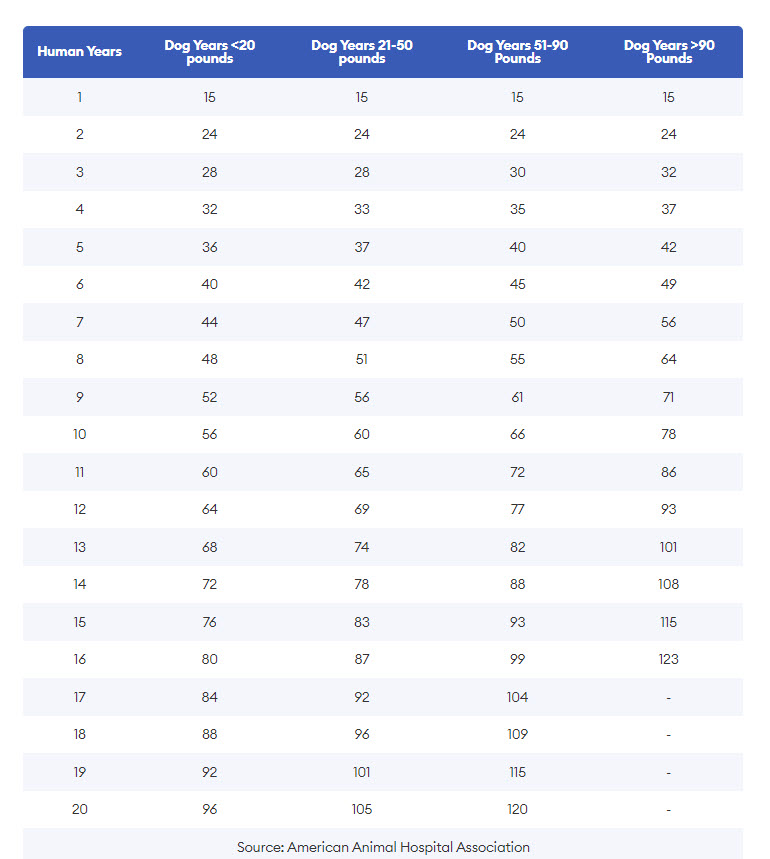
The life cycle of a dog, according to the American Animal Hospital Association, comprises five stages that are closely associated with age:
– Puppyhood: From birth to 6-9 months, depending on the breed and size, this stage marks the end of rapid growth.
– Young Adulthood: Spanning from 6-9 months to 3-4 years, this stage denotes the completion of physical and social maturation.
– Mature Adulthood: Taking place between 3-4 years and the beginning of the last quarter of the estimated life span, this stage differs depending on the breed and size.
– Senior Stage: In the last 25% of the estimated life span, this stage signifies the progression towards the end-of-life phase.
– End-of-life: This terminal stage is characterized by specific pathologies and varies in duration.
Dr. Heather Berst, D.V.M., the medical lead at Zoetis, a producer of medicine and vaccines for pets and livestock, explains the aging process of dogs as comparable to humans but occurring at an accelerated pace.
Within a single year, noticeable changes can be observed in a dog’s behavior, from running and playing to experiencing difficulties getting up due to osteoarthritis. Visible signs of aging usually include the graying of the muzzle, alterations in vision, and reduced mobility.
In the pursuit of a better understanding of how dogs age, scientists and researchers are dedicated to further exploration. Recently, a team of medical and veterinary experts from across the country introduced a more precise method of measuring the physiological age of Labrador retrievers by analyzing their genetic information. Nonetheless, the applicability of this formula to different breeds and sizes of dogs remains uncertain, as noted by the scientists themselves.
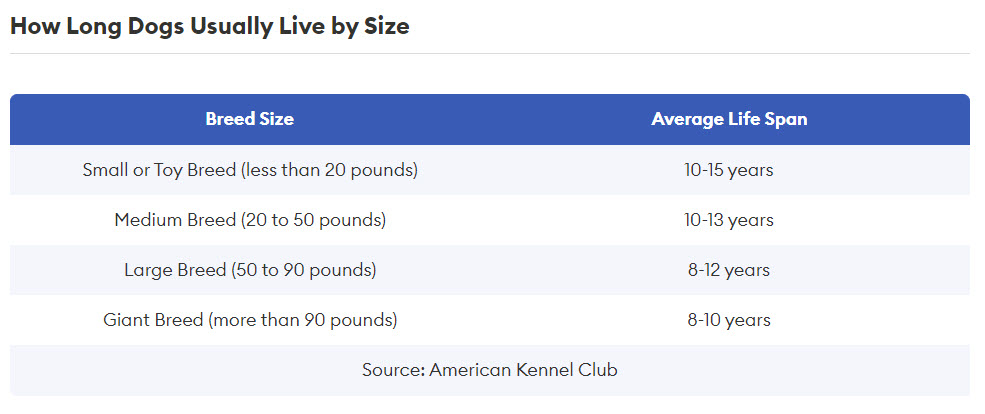
How long a dog lives depends on a great number of factors, including:
- Breed and size
- Diet
- Healthcare provided
- Lifestyle
- Activity level
The current oldest dog on record is Bobi, a purebred Rafeiro do Alentejo, a Portuguese breed of livestock guardian dog. Bobi turned 31 in May 2023.
The time when dogs are categorized as seniors varies depending on their breed and size.
According to Dr. Jeanne-Pierre Lautier, D.V.M., a veterinarian and consultant for pet care company AB7 Group/Alzoo, the life expectancy of dogs greatly depends on their breed. Large and giant breeds, in particular, have a relatively short life expectancy of around 8 years. These breeds are considered seniors when they reach 7 years of age, requiring closer veterinary supervision.
In order to determine when a dog is considered senior, the American Animal Hospital Association (AAHA) suggests looking at the last 25% of their estimated life span for their specific breed. The following age ranges apply:
– Small or toy breeds (less than 20 pounds): 8 to 11 years
– Medium breeds (20 to 50 pounds): 8 to 10 years
– Large breeds (50 to 90 pounds): 8 to 9 years
– Giant breeds (more than 90 pounds): 6 to 7 years
How Owners Can Help Their Dogs Live Long, Healthy Lives
To help ensure your dog lives a long and healthy life, owners should practice the following:
- Regular physical exams: Puppies and young adult dogs should receive a complete physical exam at least once a year. Healthy mature adult and senior dogs should be taken to the vet at least twice a year.
- Preventative care: This includes vaccinations and parasite control. It’s important to stay up to date on vaccinations to keep your dog safe.
- Dental care: Poor oral health can lead to chronic pain and infection. Dogs need regular at-home teeth brushing, as well as periodic professional dental cleanings.
- Exercise: All dogs need proper exercise that goes beyond short walks around the backyard.
- High-quality diet: Be sure to feed your dog a high-quality diet that is appropriate for their age and breed to ensure they are receiving the proper nutrition for their growth.
- Weight control: Canine obesity has reached epidemic proportions. Canine obesity can lead to skin infections, orthopedic conditions, respiratory disease, diabetes and hypothyroidism.
- Pet insurance: Many dog owners purchase pet insurance to help offset the cost of regular vet visits, and cover the costs of any accidents or major illnesses that should arise.
