
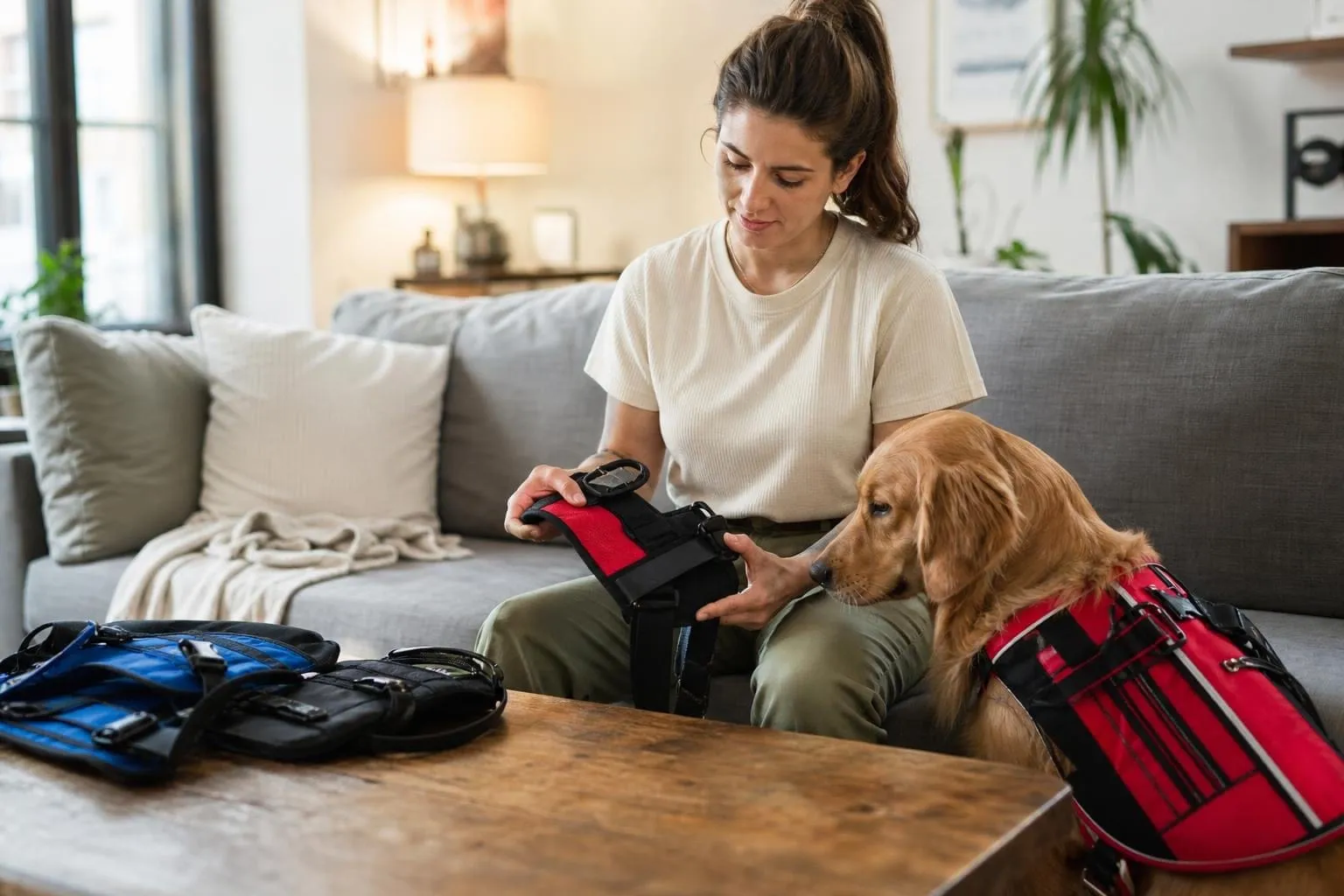
No federal law requires service dog registration, vests, or ID cards, but these products reduce daily confrontations and make public access smoother. Registration packages range from free (digital ID number only) to about $125 for deluxe vest bundles. The difference between tiers is more gear and documentation, not stronger legal standing. This guide breaks down every component so you can compare service dog registration packages and vest bundles without guessing what you’re actually paying for.
Here is the uncomfortable reality: 93% of service dog handlers have encountered poorly trained or uncontrolled dogs in public, according to a 2022 Canine Companions survey of over 1,500 respondents. That same survey found 66% of handlers felt fraudulent service dogs negatively impacted their independence and quality of life. The flood of fake service animals has made store employees, restaurant managers, and landlords suspicious of everyone, including legitimate handlers.
That suspicion is why the market for service dog gear and documentation exists. A vest and an ID card won’t grant you any legal rights you don’t already have. But they serve as a visual shorthand that tells the world, “This is a working dog, and I’m prepared to prove it.”
One verified purchaser on eBay put it plainly: “Nothing is more stressful than to have a disability and a service dog and have to argue with a person or store owner. It’s easier to just show them the card and go on. Without the card I had to call the police 3 times to get my service dog into stores.”
That’s the practical case for these products. Now let’s define what’s actually inside them.
Compare vest and ID options to find the right combination for your situation.
Before comparing any packages, understand this: the ADA does not require service dogs to be registered, certified, or wear any identifying gear. The ADA’s official guidance states that “service animals are not required to wear vests” and that “a dog that is wearing a vest is not necessarily a service animal.”
Under federal law, staff in public places can only ask two questions when it isn’t obvious a dog is a service animal: “Is the dog a service animal required because of a disability?” and “What work or task has the dog been trained to perform?” That’s it. No ID card, certificate, or registration number is required.
This matters because higher price tiers buy more documentation and equipment, not stronger legal status. Every package, from free to $125, produces the same legal effect: zero additional rights beyond what the ADA already provides. What you’re buying is convenience, speed in daily interactions, and peace of mind. Understanding the rules about service dog ID helps you shop with clear expectations.
Practitioners on Reddit’s r/service_dogs consistently emphasize this point. Threads in the community regularly note that no registry is “official” in a government sense, and the most upvoted advice is always to understand your rights first, then decide if gear helps you exercise them more smoothly.
When you compare service dog registration packages and vest bundles, you’ll encounter the same handful of items mixed and matched across tiers. Here’s what each one actually is.
The entry point. A free registration gives you an online profile and a USA Service Dog ID number at $0. You get a printable registration certificate you can show on your phone or print at home. This is a starting point for handlers who want a record on file but aren’t ready to invest in physical gear.
A wallet-sized card showing your dog’s name, photo, and registration number. Think of it like a gym membership card: it doesn’t grant legal authority, but it’s a quick visual reference that can defuse a tense conversation at a store entrance. Standalone ID cards are priced at $29.99. Some registries include a scannable QR code on the back that links to the dog’s profile.
An electronic version of your registration certificate that lives on your phone. Useful when you’ve left physical documents at home or when a landlord asks for documentation over email. Digital certificates are included in most mid-tier bundles.
A metal or durable tag that clips to your dog’s collar or vest D-ring. It provides at-a-glance identification without requiring you to pull out a card or phone. Tags are included in bundles priced at $59.99 and above.
A formal document listing your dog’s registry ID, your name as handler, and the registration date. Handlers find this most useful during housing conversations with landlords, where having a printed document to accompany a conversation can help streamline the process. If you’re navigating housing specifically, know the difference between registration and an ESA letter, because they serve very different legal purposes.
Velcro-backed labels that attach to a vest. The most common options are “Service Dog,” “Do Not Pet,” “Psychiatric Service Dog,” and “In Training.” Patches serve two audiences: they tell strangers not to approach or pet your working dog, and they give your dog a visual cue that it’s time to work. Understanding proper service dog etiquette helps explain why “Do Not Pet” patches exist in the first place.
This is where most handlers get confused. The names sound similar, and it’s not always obvious what separates a $59.99 bundle from a $124.99 one. Here’s a straightforward breakdown to help you compare service dog registration packages at every price point.
The entry-level documentation bundle. Includes an ID card, digital certificate, and collar tag. No vest, no patches. This is for the handler who already owns a vest and just wants updated paperwork and identification.
A step up. Includes an ID card, two patches, an ID tag, and a digital certificate. Still no vest, but you get patches to attach to gear you already own. This is the sweet spot for experienced handlers replacing worn-out identification materials.
Includes an ID card, certificate, patches, and tag. No vest. This is the most popular documentation-only option for handlers who want a complete paper trail without bundled gear.
Everything in the basic registration package plus a vest and handle. This is the one-stop option for new handlers who need gear and documentation in a single order. If you’re weighing whether a full gear bundle or just an ID card makes sense, this is the decision point.
Adds more items over the basic: extra ID card, digital certificate, and additional patches. Still no vest. Aimed at handlers who want backup copies of everything.
The all-inclusive option. Combines the deluxe registration package with a vest. This is the top tier for handlers who want maximum documentation and gear in one purchase.
Nobody in the current search results actually calculates this, so here it is. An ID card alone costs $29.99. A basic vest bundle at $94.99 includes that card plus a vest, patches, certificate, and tag. Buying those items separately would cost significantly more. The bundle discount is real, typically saving $20 to $40 compared to a la carte purchasing.
When you compare vest bundles for service dogs, the vest itself matters as much as the documentation. Three main styles exist, and each fits different situations.
Breathable and lightweight. Best for warm climates, smaller breeds, and indoor work. These vests have embroidered patches and a D-ring for leash attachment. They’re comfortable for dogs who wear gear all day but don’t need heavy-duty support. The trade-off is durability; Reddit’s r/service_dogs community frequently warns that cheap mesh vests can fall apart within weeks, so material quality matters more than brand name.
A structured vest with a rigid top handle. Designed for mobility assistance dogs or larger breeds where the handler needs physical support or guidance. The handle adds weight and bulk, so this isn’t ideal for small dogs or handlers who don’t need physical contact with the vest.
A MOLLE-style harness with saddle bags, reinforced stitching, and multiple attachment points. Built for large breeds and handlers who need pocket storage for medication, treats, or supplies. Some vendors describe these as an upgrade option for handlers whose dogs outgrow a basic vest.
The right choice depends on three factors: your climate, your dog’s size, and whether you need the vest to do anything beyond identification (like carry supplies or provide physical support).
This is the single most misunderstood distinction in the service animal world. Registration is a convenience product. An ESA letter is a clinical document from a licensed mental health professional that creates legal protection under the Fair Housing Act for emotional support animals. Registration does not substitute for a letter when it comes to housing accommodations.
ESA letters are $149 each and involve a connection with a licensed therapist for evaluation. To understand what makes a letter legitimate and avoid fake ESA letter scams, look for clinician license details and professional letterhead.
One Colorado couple was awarded $50,000 after their HOA refused to allow their emotional support animal, a case that illustrates exactly why proper documentation (not just registration) matters for housing.
Since the 2021 DOT rule change, airlines require service dog handlers to complete a DOT attestation form before flying. Emotional support animals lost cabin access under this rule and must travel as standard pets. The DOT form is what airlines actually check, not a registration card. If you fly frequently, confirm whether your package includes this form or if it’s a separate item.
Different from both ESA letters and registration. A PSD is a service animal trained to perform specific tasks related to a psychiatric disability, and it has full ADA public access rights. PSD letters ($199 for the housing/travel package) document the clinical relationship and the dog’s trained tasks. Learn more about what qualifies a psychiatric service dog and how its documentation differs from ESA paperwork.
When evaluating any package from any vendor, ask these six questions:
1. What physical items are included? Count the cards, tags, patches, and vest. Make sure the listing specifies each item rather than using vague terms like “full kit.”
2. Is the registration one-time or recurring? Some registries charge annual renewal fees ($29.99/year in some cases), while others offer lifetime registration as a one-time cost. This difference compounds over years of ownership.
3. Does it include a vest? What material and style? A “vest bundle” that includes a flimsy mesh vest isn’t the same as one with a structured handle vest. Check the material description.
4. Are digital documents included or extra? Some packages include digital certificates, others charge separately. If you want both physical and digital copies, verify before buying.
5. Is a DOT form included for airline travel? Frequent flyers should prioritize this. If the package doesn’t include it, budget for obtaining it separately.
6. Does the vendor connect you to a licensed therapist for ESA/PSD letters, or is that separate? Registration and clinical letters are different products. Some vendors offer both, others only sell gear.
Not everyone needs a vest bundle. Here’s how to decide.
Choose registration-only if: You already own a quality vest that fits your dog well, you just need updated documentation, or you prefer to select vest and gear separately for better fit and material control.
Choose a vest bundle if: You’re a new handler starting from scratch, you want the convenience of a single order, or your current vest is worn out and you’d save money buying gear together.
For frequent travelers: Prioritize packages with digital ID and DOT form inclusion. A wallet card is nice at the airport, but the DOT form is what the gate agent actually needs.
Across the broader market, service dog registration products range from free to about $349 for premium kits. Here’s where common price points fall:
| Item | Typical Price Range |
|---|---|
| Free digital registration | $0 |
| ID card only | $20 to $30 |
| Documentation bundle (no vest) | $59 to $85 |
| Vest bundle | $94 to $150 |
| Deluxe package with vest | $115 to $200 |
| ESA letter (clinical) | $100 to $250 |
For perspective, a fully trained service dog costs $18,000 to $40,000 on average. Even self-training runs $500 to $3,000 over 12 to 18 months. A $125 vest bundle is a small fraction of the total investment in a service dog, but it represents your primary public-facing signal that the dog is working.
Explore current package options and pricing to find the tier that fits your needs.
The primary frustration handlers describe isn’t cost. It’s confrontation fatigue. Every piece of gear gets judged by one criterion: “Does this make my daily errands faster and less stressful?”
Handlers on Reddit report that vests dramatically reduce “no pets allowed” confrontations with store staff. At the same time, some handlers skip vests entirely because visible labels can attract unwanted attention, petting attempts from strangers, or aggressive questioning from people who feel entitled to interrogate service dog teams. Real-world access denials happen regularly. A Days Inn denied a veteran access with his service animal, illustrating exactly the kind of confrontation that visible identification helps prevent.
On TikTok, service dog owners frequently post about registration sites and the fact that no “official” government registry exists. This awareness is growing among the general public, which means transparency about what registration does and doesn’t do builds more trust than overclaiming ever could.
No. There is no federal law requiring service dogs to be registered, certified, or carry identification. Registration is a voluntary convenience product that can make daily interactions smoother but creates no additional legal rights under the ADA.
No. The ADA explicitly states service animals are not required to wear vests, and a dog wearing a vest is not necessarily a service animal. Handlers choose vests for practical reasons: reducing confrontation, signaling to strangers, and giving the dog a “work mode” cue.
A registration package includes documentation items like an ID card, certificate, patches, and tag but no vest. A vest bundle includes all of that plus a vest (and sometimes a handle). Choose based on whether you already own gear.
Prices range from $0 for a basic free registration to around $125 for a deluxe vest bundle. Individual ID cards start at about $29.99. Across the broader market, full kits can run up to $349 at some vendors.
No. An ESA letter is a clinical document from a licensed mental health professional that provides legal protection under the Fair Housing Act. Registration is voluntary documentation with no legal weight for housing accommodations. They are separate products serving different purposes.
Consider your climate (mesh for warm weather, padded for cold), your dog’s size (tactical harnesses for large breeds), and whether you need functional features like a handle for mobility support or pockets for supplies. Quality matters more than brand. Cheap vests often fall apart quickly.
Yes. A free registration gives you a digital ID number and printable certificate. You can then purchase a vest from any vendor. This approach gives you maximum flexibility on vest quality and fit, though you may spend more total than a bundled package.
Airlines require the DOT Service Animal Air Transportation Form, not a registration card. While an ID card may help at the gate, the DOT form is the actual document airlines need under the Air Carrier Access Act. ESAs no longer have cabin access under the 2021 rule change and must fly as standard pets.

Copyright © 2020 USA Service Dog. All rights reserved.