Service dogs fall into nine widely recognized categories, including guide dogs, hearing dogs, mobility assistance dogs, psychiatric service dogs, diabetic alert dogs, seizure dogs, autism service dogs, allergy detection dogs, and FASD assistance dogs. The ADA does not maintain an official list of types of service dogs. Any dog trained to perform a specific task related to a handler’s disability qualifies as a service animal with full public access rights. These categories are industry conventions, not legal classifications.
Before breaking down the different types of service dogs, it helps to understand the legal foundation. Under the Americans with Disabilities Act, a service dog is any dog individually trained to perform a task directly related to a person’s disability. That’s it. There’s no approved breed list, no government registry, no mandatory vest or ID card, and no official catalog of recognized types.
This is a point that nearly everyone gets wrong. The categories you’ll see below are useful shorthand developed by trainers, nonprofits, and the disability community. They are not legal classifications created by any government agency. The ADA’s standard is simple: the dog must perform a specific trained task that mitigates a disability.
When it’s not obvious that a dog is a service animal, businesses and staff may ask only two questions: (1) Is this a service animal required because of a disability? (2) What work or task has the dog been trained to perform? They cannot ask about the nature of the disability, demand documentation, or require the dog to demonstrate its task.
One more thing worth noting: while dogs are the standard, miniature horses can also qualify as service animals under the ADA in certain situations. No other species qualifies.
There are roughly 500,000 service dogs working in the United States today, serving a population of over 61 million adults with some type of disability.
Learn about conditions a service dog can help with
Guide dogs are the most recognized type of service dog, and for many people, the only type they’ve encountered. These dogs serve as navigation partners for individuals who are blind or have severe visual impairments. They guide their handlers around obstacles, stop at curbs and stairs, judge the height and width of spaces to keep their handler safe, and navigate complex environments like busy intersections.
Despite their visibility, guide dogs serve a relatively small population. An estimated 10,000 guide dog teams currently work in the United States, and only about 2% of all blind and partially sighted people use one. California alone accounts for nearly 20% of all guide dog handlers in the country, with close to 2,000 teams.
Common breeds include Labrador Retrievers, Golden Retrievers, and German Shepherds. The “Seeing Eye Dog” name is actually a trademark of The Seeing Eye, Inc., one of the oldest guide dog schools in the world, though the term is widely used as a generic label.
Hearing dogs, sometimes called signal dogs, are trained to alert people who are deaf or have significant hearing loss to important sounds. A knock on the door, a fire alarm, a ringing phone, a crying baby, an oven timer, someone calling the handler’s name: the dog detects the sound and communicates it through physical contact like nudging or pawing, then leads the handler to the source.
These dogs are often smaller breeds, since the work doesn’t require physical strength. Cocker Spaniels, Miniature Poodles, and mixed breeds from shelters frequently excel in this role. You’ll sometimes spot hearing dogs wearing bright orange vests, as orange is the color associated with hearing assistance.
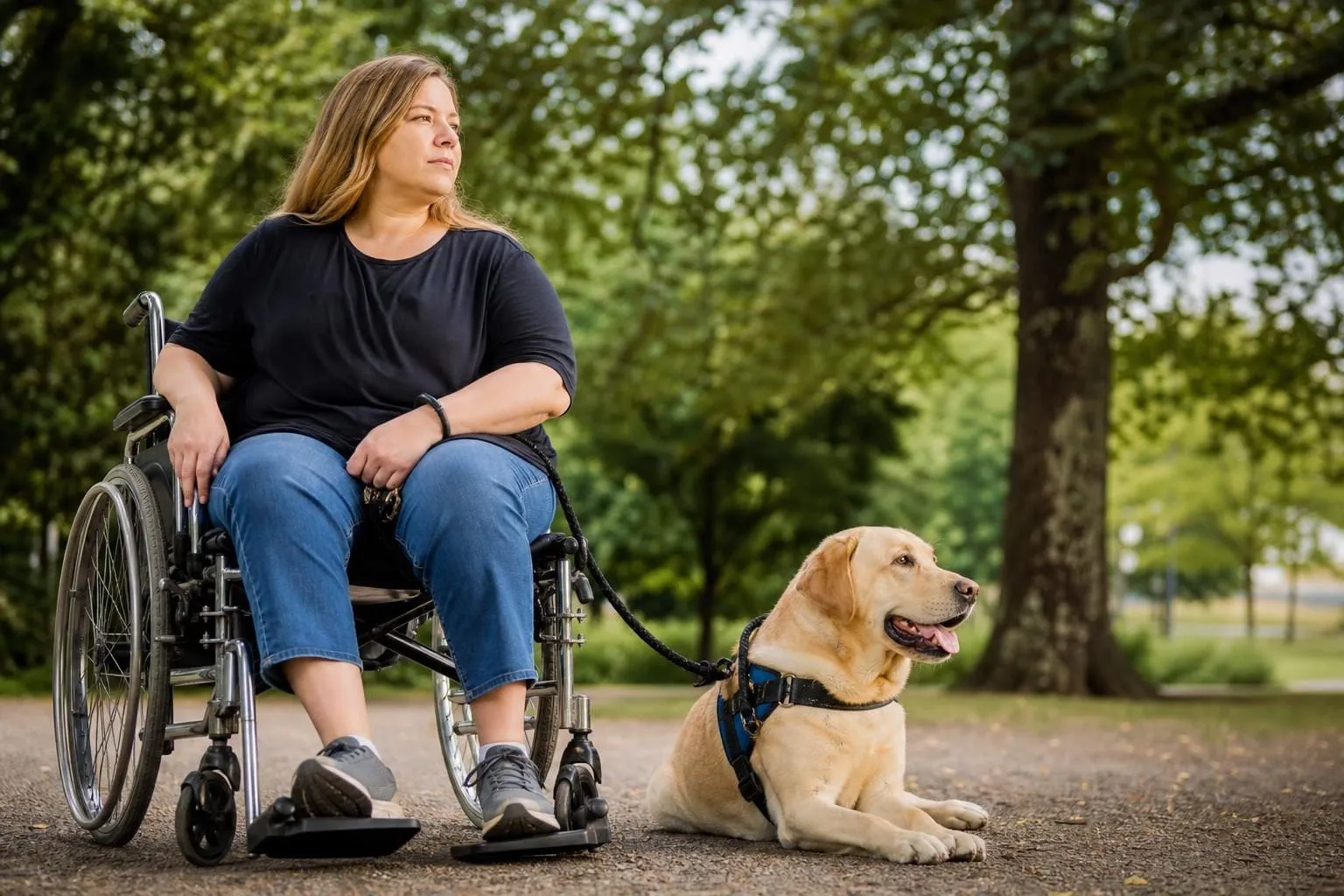
Mobility assistance dogs perform physical tasks for people with conditions affecting movement, including spinal cord injuries, muscular dystrophy, arthritis, cerebral palsy, and other orthopedic or neurological conditions. Their tasks are some of the most varied among the types of service dogs:
Bracing and balance support for handlers who are unsteady on their feet
Pulling wheelchairs up ramps or across difficult terrain
Retrieving dropped items like keys, phones, or medication
Opening and closing doors, drawers, and cabinets
Pressing elevator buttons or light switches
Helping handlers dress or undress
Size matters here more than in any other category. A Chihuahua can’t brace a 180-pound person during a transfer, so mobility dogs tend to be larger breeds: Labrador Retrievers, Golden Retrievers, Standard Poodles, and Bernese Mountain Dogs are common choices. Research confirms the physiological benefits of service dogs for handlers with mobility-related disabilities, including reduced pain and improved independence.
Psychiatric service dogs (PSDs) are the fastest-growing and most misunderstood category. They assist individuals with mental health conditions, including PTSD, anxiety disorders, depression, OCD, bipolar disorder, and schizophrenia. What makes them legally distinct from emotional support animals is one critical requirement: they must perform specific trained tasks, not just provide comfort through their presence.
The range of trained PSD tasks is broad and concrete:
Deep pressure therapy (DPT): Lying across the handler’s body during a panic attack to provide calming pressure
Room searches: Entering a space ahead of the handler and giving an “all clear” signal, which eases the hypervigilance common in PTSD
Crowd buffering/blocking: Positioning their body between the handler and other people to create physical space
Nightmare interruption: Waking the handler during night terrors
Grounding during dissociation: Nudging, licking, or pawing to bring the handler back to the present moment
Medication reminders: Alerting at specific times
Interrupting anxiety or self-harm behaviors
The American Psychiatric Association has documented how PTSD service dogs perform tasks like applying pressure to reduce anxiety and nudging to interrupt flashbacks. A Purdue University study found measurable benefits for veterans paired with PTSD service dogs, including reduced symptom severity and improved social interactions. Additional research confirms the value of service dogs for PTSD treatment specifically.
Here’s the distinction that trips people up constantly: a friendly dog that sits on your lap when you’re sad is not performing a trained task. A PSD must respond to a cue or a triggering condition with a specific learned behavior. That’s what separates a psychiatric service dog (full ADA public access rights) from an emotional support animal (no public access rights under the ADA).
Practitioners on Reddit’s r/service_dogs frequently report that handlers with invisible disabilities, particularly psychiatric conditions, face the most public access challenges. People assume only guide dogs are “real” service dogs. As one professional trainer who uses a wheelchair noted, “Unfortunately, if you have invisible disabilities you face more questions than I do.”
German Shepherds, Labrador Retrievers, Golden Retrievers, and Standard Poodles are popular PSD breeds, though any breed can serve in this role if it has the right temperament.
Diabetic alert dogs (DADs) detect dangerous changes in blood sugar levels and alert their handlers before the situation becomes a medical emergency. They serve people with both Type 1 and Type 2 diabetes, providing an early warning system that works around the clock, including during sleep, when continuous glucose monitors might go unheard.
The mechanism behind their ability is more nuanced than most people realize. The common myth is that dogs smell blood sugar directly. What actually happens, according to DiaTribe, is that dogs detect chemical compounds released by the body when blood sugar drops rapidly or spikes. Scientists believe dogs are sensing ketones during hyperglycemia and possibly isoprene during hypoglycemia.
How accurate are they? A 2019 NIH study of 27 diabetic alert dogs found that four dogs achieved 100% accuracy in detecting abnormal glycemic levels. The remaining dogs averaged 81% accuracy, which is still remarkably high.
DADs alert through behaviors like pawing, nudging, staring, or retrieving a testing kit. Labrador Retrievers and Golden Retrievers are common choices, though smaller breeds can also excel since the work relies on scent detection rather than physical strength.
This is an important distinction that most articles about types of service dogs gloss over, often lumping both into a single category.
Seizure response dogs are trained to act during and after a seizure. Their tasks include barking to alert others, activating a medical alarm, positioning their body to protect the handler from injury during convulsions, retrieving medication, clearing space around the handler, and providing physical support as the handler recovers. These dogs can be trained reliably because the tasks are triggered by observable events.
Seizure alert dogs do something different and more remarkable: they detect seizures before they happen, sometimes up to an hour in advance. This gives the handler time to move to a safe location, sit or lie down, take medication, or alert someone nearby.
How do they do it? The evidence points to scent. Medical Mutts, a training organization that has been training seizure alert dogs using scent since 2013, partnered with researchers at the University of Rennes in France and confirmed that epileptic patients release a distinct scent before and during seizures that dogs can recognize.
Not every dog can learn seizure alert work. Some dogs develop the ability naturally after living with a handler who has epilepsy, while others are trained from the start using scent samples. Seizure response training, by contrast, is more straightforward and widely available.
Autism service dogs support individuals on the autism spectrum, often children, by helping manage the sensory, social, and safety challenges that come with the condition. Their tasks include:
Interrupting self-harming behaviors like head-banging or skin-picking
Providing deep pressure during sensory overload or meltdowns
Assisting with disorientation in unfamiliar environments
Preventing wandering or bolting, a serious safety concern for children with autism
Serving as a social bridge, making it easier to initiate and navigate interactions with peers
Many people with autism struggle with unpredictability. A service dog provides a consistent, calming presence that adds structure to the handler’s day. Dogs also function as natural icebreakers in social settings, which can be transformative for someone who finds social cues difficult to read.
Golden Retrievers and Labrador Retrievers are the most common breeds for this work due to their calm temperaments and trainability.
With up to 300 million olfactory receptors, dogs can detect trace amounts of allergens that are invisible to the human nose. Allergy detection dogs are trained to sniff out specific allergens, most commonly peanuts, tree nuts, gluten, and shellfish, and alert their handlers before exposure occurs.
These dogs are particularly valuable for individuals with severe anaphylactic allergies, Mast Cell Activation Syndrome (MCAS), or Alpha-Gal Syndrome. They can screen food, surfaces, and environments, providing a layer of protection that goes beyond reading ingredient labels.
This is a newer and less common category among the various types of service dogs, but a growing one as awareness of severe allergic conditions increases.
Fetal Alcohol Spectrum Disorder (FASD) assistance dogs represent one of the newest categories of service dogs. They are trained to support children with FASD using many of the same techniques as autism service dogs: interrupting repetitive behaviors, providing calming pressure, anchoring the child in public spaces, and promoting routine.
FASD affects executive function, emotional regulation, and social behavior, making it a condition where a trained assistance dog can meaningfully improve quality of life for both the child and the entire family. Very few service dog organizations currently train specifically for FASD, but the category is gaining recognition.
Facility dogs deserve mention because they’re often confused with other types of service dogs. These are professionally trained dogs that work alongside professionals in healthcare, education, criminal justice, and rehabilitation settings. A courthouse facility dog might comfort a child witness during testimony. A hospital facility dog might assist physical therapists with patient motivation.
The key difference: facility dogs work in a specific facility under the guidance of a professional handler, not a person with a disability. They don’t have public access rights outside their workplace, and they don’t fall under the ADA’s service animal definition. But they are highly trained, often by the same organizations that train service dogs.
This comparison generates more confusion than almost any other topic in the service animal space. Here’s a clear breakdown:
Feature | Service Dog | Emotional Support Animal (ESA) | Therapy Dog | Facility Dog |
|---|---|---|---|---|
Training required | Yes, task-trained for specific disability | No task training required | Basic obedience + handler training | Extensive professional training |
Who they help | Their individual handler | Their owner | Multiple people in various settings | Clients in a specific facility |
Public access rights | Yes, under ADA | No | No | Only in their assigned facility |
Housing protections | Yes, under FHA | Yes, under FHA | No | N/A |
Air travel rights | Yes, under ACAA (with DOT forms) | No (since 2021 rule change) | No | No |
Governing law | ADA, FHA, ACAA | FHA only | None (federal) | Varies by facility |
The critical distinction: service dogs perform trained tasks. ESAs provide comfort through companionship alone. Both have housing protections under the Fair Housing Act, but only service dogs have public access rights.
For housing specifically, the FHA uses the broader term “assistance animal” rather than “service animal.” Under this law, the animal doesn’t need to be a dog, doesn’t need task training, and only needs to meet a disability-related need documented by a licensed professional.
For a deeper explanation, read about distinguishing service animals from ESAs. And if you’re navigating ESA documentation, make sure you know how to avoid fake ESA letter scams.
The ADA does not restrict which breeds can be service animals. A service dog cannot be excluded simply because of its breed. That said, certain breeds appear more frequently in certain roles for practical reasons.
Service Dog Type | Common Breeds | Why |
|---|---|---|
Guide dogs | Labrador Retrievers, Golden Retrievers, German Shepherds | Steady temperament, good stamina, appropriate height for harness work |
Hearing dogs | Cocker Spaniels, Miniature Poodles, mixed breeds | Alertness, responsiveness to sound, smaller size works fine |
Mobility dogs | Labs, Goldens, Standard Poodles, Bernese Mountain Dogs | Large frame for bracing and pulling, strong retrieval instincts |
Psychiatric service dogs | German Shepherds, Labs, Goldens, Standard Poodles | Bonding ability, trainability, calm in crowded environments |
Diabetic alert dogs | Labs, Goldens, Poodles | Strong scent detection, biddable temperament |
Seizure dogs | Labs, Goldens, German Shepherds | Reliability, size for physical protection during seizure |
Autism service dogs | Golden Retrievers, Labrador Retrievers | Gentle nature, patience, child-friendly demeanor |
Allergy detection dogs | Poodles, Labs, Spaniels | Keen nose, manageable size for screening environments |
Mixed breeds and rescue dogs absolutely can become service dogs. What matters is the individual dog’s temperament, health, and aptitude for the work, not its pedigree.
As one breeder and trainer put it: “Not every ‘good dog’ should become a working dog. A puppy can have all the right genetics, all the right socialization, incredible training, and still decide that public access work, medical work, or emotionally demanding environments are simply not what they enjoy.”
Understanding the practical side of obtaining a service dog matters just as much as knowing the types of service dogs available.
Professional training typically costs between $15,000 and $50,000, and the process takes an average of 1 to 2 years. Waitlists at established service dog organizations often run 1 to 5 years. And here’s a sobering statistic: an estimated 70% of service dogs in training don’t graduate due to behavioral issues, health problems, or temperament mismatches.
Owner-training is fully legal under the ADA. Many handlers choose this path to reduce costs and wait times dramatically, though it requires significant time, knowledge, and commitment. Not every handler has the ability or resources to owner-train successfully, and not every dog is cut out for public access work.
Whether professionally trained or owner-trained, no certification, registration, or ID is legally required for a service dog under the ADA. Some handlers choose to carry identification or use vests to reduce confrontations in public, but these are optional tools, not legal requirements.
Explore proper etiquette when approaching a service dog
At least 23 states have now passed laws addressing the misrepresentation of pets as service animals. This isn’t an abstract policy debate. It has real consequences for legitimate handlers.
A peer-reviewed survey published in PMC found widespread misconceptions about definitions, rules, and rights associated with different types of assistance dogs. In general, service dogs are more likely to be perceived as helping with a “legitimate need,” which creates a hierarchy that hurts handlers with less visible disabilities.
One guide dog handler told CBC News about encounters with untrained dogs passed off as service animals: “They really don’t have the right training or temperament to be in public. They misbehave, they growl, and their humans let them do things that a guide dog handler never would. It happens everywhere now.”
Handlers on Reddit’s r/service_dogs consistently identify fake service dogs as one of their top frustrations. When an untrained dog lunges at a working service dog in a grocery store, it can set back months of training and create lasting fear responses in the working animal. Beyond individual incidents, the pattern erodes public trust and makes life harder for every legitimate handler.
A real case of a veteran being denied access with a service animal shows how the confusion cuts both ways, with businesses sometimes turning away legitimate teams.
No. The ADA does not require registration, certification, or any form of documentation for service dogs. There is no government-run registry. Some handlers voluntarily register or carry ID to reduce friction during daily interactions, but no business can legally require it.
Staff can ask only two questions: (1) Is this a service animal required because of a disability? (2) What work or task has the dog been trained to perform? They cannot ask about the nature of your disability, request medical records, or demand a demonstration of the task.
A service dog that is out of control (barking excessively, jumping on people, growling, not being housebroken) can be asked to leave, even if it is a legitimate service animal. The handler must be given the option to return without the dog. This standard applies equally to all types of service dogs.
Yes. The ADA explicitly states that no breed restrictions apply to service dogs. A service animal cannot be excluded from a public place simply because of its breed. Breed-specific legislation at the state or local level does not override ADA protections for service animals.
A psychiatric service dog is trained to perform specific tasks related to a mental health disability, like deep pressure therapy during panic attacks or interrupting dissociative episodes. An ESA provides comfort through companionship alone and requires no task training. PSDs have full public access rights under the ADA. ESAs have housing protections under the Fair Housing Act but cannot accompany their owners into businesses, restaurants, or other public spaces. Learn more about what HUD requires for assistance animals in housing situations.
Yes. Owner-training is fully legal under the ADA. You do not need to use a professional trainer or organization, though working with an experienced trainer is strongly recommended. The dog must still be trained to perform at least one specific task related to your disability and must behave appropriately in public.
If going through a professional organization, expect a 1 to 5 year waitlist, plus 1 to 2 years of training before the dog is placed. Owner-training timelines vary but typically take 1 to 2 years of consistent work. The total investment, whether measured in time or money, is substantial, which is why understanding the different types of service dogs and which one matches your needs is such an important first step.
Under the ADA, service dogs are permitted in virtually all public places, including restaurants, hotels, stores, hospitals, schools, and public transportation. The few exceptions include sterile environments like operating rooms. Religious organizations and private clubs that are exempt from the ADA may also restrict access in some cases. Airlines have their own framework under the Air Carrier Access Act, which requires DOT service animal forms.

Copyright © 2020 USA Service Dog. All rights reserved.