The ADA does not require service dogs to wear vests or carry ID cards, but the right gear combination acts as a social signal that answers questions before they’re asked, cutting down on verbal challenges and access denials. Choosing a vest with clear “Service Dog” and “Do Not Pet” patches, selecting colors that match your dog’s breed perception, and carrying a printed or digital ID card will reduce most public confrontations. This glossary covers every term you need to understand so you can pick gear that actually works.
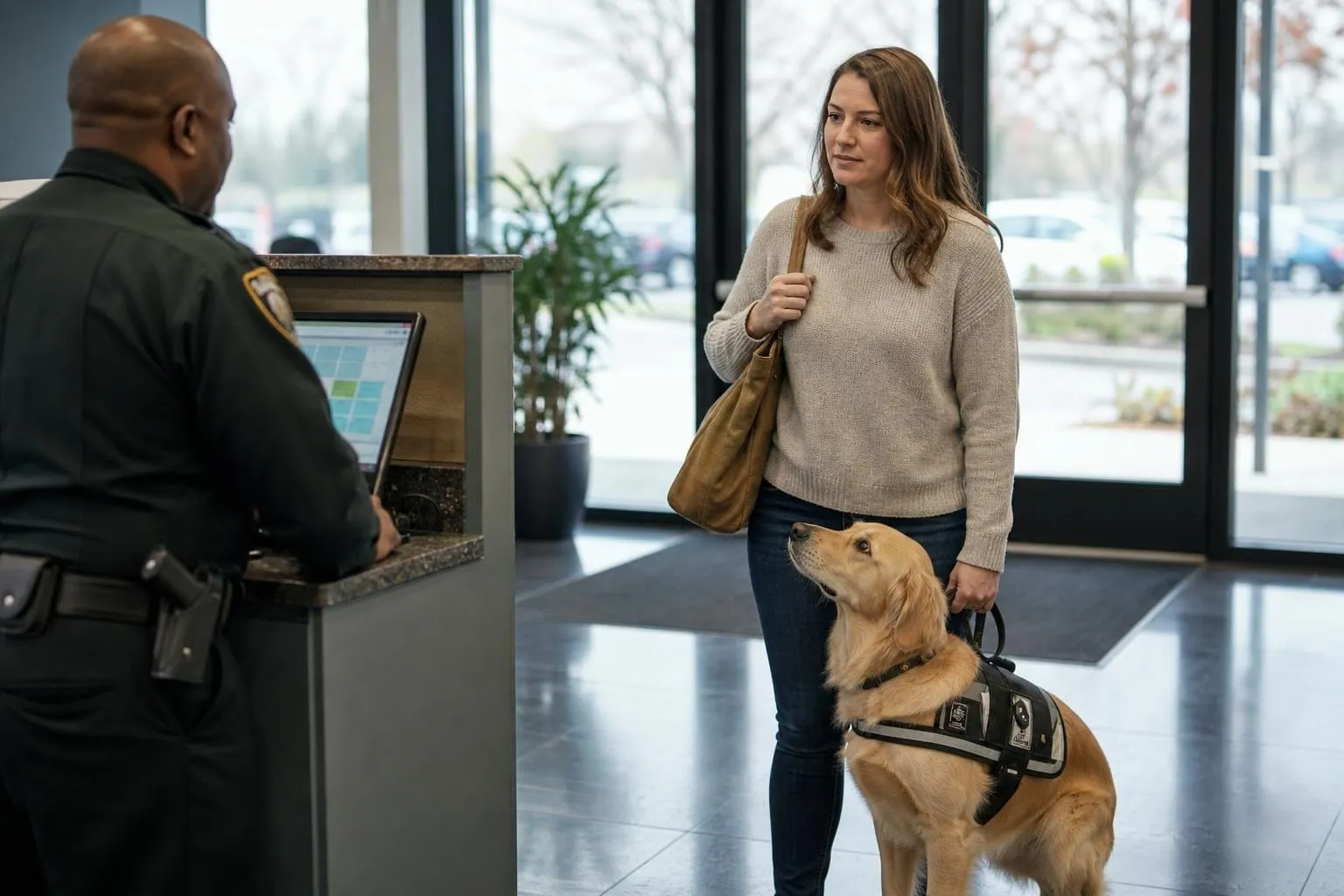
Every service dog handler has a story about being stopped, questioned, or flat-out denied entry somewhere. A handler at a King Soopers in Colorado was verbally assaulted for bringing her dog into the grocery store, even though her dog was wearing a vest. “She had her vest on,” the handler told reporters. “I don’t think any dog in that man’s world is of service.” Another handler, a guide dog user named Sarah, walked into a grocery store and was immediately stopped by a manager who said, “Service dogs wear vests. Where’s hers?” Her dog was calm, properly harnessed, and performing perfectly. It didn’t matter.
These stories illustrate why learning how to choose a service dog vest or ID that reduces public confrontation is not a luxury but a practical necessity. The gear doesn’t give your dog legal rights (the ADA already does that), but it communicates your dog’s working status at a glance, which is often enough to prevent a confrontation from starting.
This glossary defines every term you’ll encounter when selecting gear, explains the legal context behind each one, and connects it all to the real goal: fewer interruptions, fewer challenges, and more peaceful outings with your working partner.
If you’re exploring types of service dogs and want to understand what gear best fits your situation, this guide will walk you through it.
Before you spend a dollar on gear, you need to understand the legal foundation that shapes every confrontation you’ll face in public.
Under the ADA, businesses may ask only two questions when a service dog’s role is not obvious: (1) Is the dog required because of a disability? (2) What work or task has the dog been trained to perform? They cannot demand documentation, ask about the nature of your disability, or require the dog to demonstrate its task. This rule, codified in 28 CFR § 36.302©(6), is the single most important concept for understanding how vests reduce confrontation.
Here’s the connection: a well-labeled vest with a “Service Dog” patch and a task-specific patch (like “Medical Alert Dog”) answers both questions passively. Staff see the vest, read the patches, and move on. Without that visual shortcut, they’re more likely to stop you and start asking questions, which is when confrontations begin.
Under the ADA, a service animal is a dog that has been individually trained to do work or perform tasks for a person with a disability. The tasks must be directly related to the person’s disability. Dogs that provide only emotional comfort without performing a specific trained task do not qualify as service animals under this definition.
Understanding common conditions a service dog helps with can clarify what types of tasks qualify.
An ESA provides therapeutic comfort through companionship but is not trained to perform specific disability-related tasks. ESAs are protected under the Fair Housing Act for housing but do not have public access rights under the ADA. A service dog, by contrast, is allowed in virtually all public spaces. This distinction matters for gear selection because ESA vests and service dog vests look similar, and the growing confusion between the two has increased scrutiny on all handlers. For a deeper breakdown, read about the differences between these categories.
Any privately owned business or facility that serves the public: restaurants, hotels, grocery stores, theaters, hospitals, taxis, rideshare vehicles. Under the ADA, these places must allow service animals to accompany their handlers. When they don’t, that’s an access challenge, and it’s illegal. An Uber driver was suspended for refusing to accept a service animal, illustrating that this protection extends beyond brick-and-mortar businesses.
The legal right of a service dog handler to enter and remain in any public accommodation with their service animal. Staff may not charge extra fees, isolate the handler, or treat them less favorably than other patrons. The only exceptions: if the dog is out of control and the handler doesn’t take effective action, or if the dog isn’t housebroken.
This is the gear itself. Each type serves a different function, and choosing the right one is the core of how to choose a service dog vest or ID that reduces public confrontation effectively.
A wearable garment, typically made of mesh, nylon, or padded fabric, placed on a service dog to visually identify it as a working animal. Most vests include Velcro (hook-and-loop) panels where patches can be attached and swapped. The ADA does not require service animals to wear a vest, ID tag, or specific harness. But in practice, a vest significantly reduces confrontations and access challenges in stores, restaurants, and other public settings.
A lightweight fabric piece that drapes over the dog’s back and clips around the chest. Cape-style identification vests are widely used when clear communication is the priority. They’re simple, professional, and provide ample space for patches on both sides and the top. They don’t include handles or harness hardware, making them the lightest and least restrictive option. Best for: handlers whose dogs don’t perform mobility or guiding tasks, and who want maximum patch visibility.
Combines identification panels with a functional body harness, including a built-in handle, leash attachment points, and sometimes padded straps. Working dog harness vests blend identification with function. The handle can be used for guiding or steadying the handler. These are common for mobility assistance dogs and guide dogs. The harness structure also communicates “working animal” more strongly than a simple cape because it looks functional, not decorative.
A heavy-duty vest, often MOLLE-compatible, with multiple pockets, D-rings, and attachment points. Originally designed for military and police K9 units. For high-demand situations, tactical vests carry medication, emergency supplies, or task-related equipment. The downside: they can look intimidating. If your dog is already a large or “scary-looking” breed, a tactical vest may increase anxiety in bystanders rather than reduce it.
A vest specifically designed for psychiatric service dogs, often featuring pockets for medication, medical alert cards, or emergency contact information. The best PSD vests include high-visibility Velcro patches labeled “Psychiatric Service Dog” and a “Do Not Pet” patch. Handlers who are learning about psychiatric service dog costs should factor in vest and gear expenses alongside training.
Because psychiatric disabilities are invisible, handlers of PSDs often face more skepticism in public. A clearly labeled PSD vest preempts the most common challenge: “You don’t look disabled.”
Mesh vests are breathable and lightweight, ideal for warm climates or dogs that overheat easily. Padded vests offer more structure, better patch adhesion, and a more “official” appearance. Padded vests tend to look more substantial, which can signal “working animal” more effectively. In hot weather, though, an overheated dog is a distracted dog, so comfort matters for both the animal and for maintaining a calm public presence.
A vest with reflective strips or panels for visibility in low-light conditions. Useful for handlers who walk at night, navigate parking garages, or travel through dimly lit areas. The reflective element also adds a layer of “official” appearance that can deter casual approaches.
Patches are where most of the confrontation-reduction magic happens. They are the silent communication layer of your gear setup, and choosing the right combination matters more than most handlers initially realize.
The most straightforward patch. It makes it clear your dog is a working service animal. This is the baseline, the patch every handler should consider. It addresses the first of the ADA’s two questions (“Is this a service animal?”) without you saying a word.
This patch may be more powerful than the “Service Dog” patch itself when it comes to preventing confrontation. Practitioners on Reddit’s r/service_dogs report that “most of the time when you have a working dog, a vest helps to reduce the speed of oncoming individuals, sometimes even turning them away completely if there is a ‘Do Not Pet Me’ patch on it.” The “Do Not Pet” patch is especially valuable for handlers with communication impairments or social anxiety, because it establishes boundaries without requiring verbal interaction.
Broader than “Do Not Pet.” This patch covers eye contact, calling out to the dog, making kissy noises, and other behaviors that can break a service dog’s focus. For medical alert dogs or psychiatric service dogs that need to maintain constant attention on their handler, “Do Not Distract” is the better choice. Understanding proper etiquette around service dogs explains why this distinction is so important.
A patch that reads “Medical Alert Dog,” “Diabetic Alert Dog,” “Seizure Alert Dog,” or similar. This is strategically important because it satisfies the second part of the two-question rule (what task does the dog perform?) without forcing the handler to disclose personal medical information verbally. A “Medical Alert Dog” patch answers the question before it’s asked.
Signals that the dog is still learning. This sets expectations in public, and most people give training dogs wider berth. Some states have specific laws about service dogs in training and their public access rights, so check your local regulations. The “In Training” patch also explains minor behavioral imperfections that might otherwise invite scrutiny.
Where patches sit on the vest affects how quickly people read them. Side patches are visible from a distance as you walk past. Top patches are visible from above (useful in crowded spaces where people look down at the dog). Front patches face approaching people head-on. The most effective setup uses patches on both sides and at least one on top.
The attachment system that lets you swap patches on and off a vest. Quality hook-and-loop panels grip firmly so patches don’t peel off during an outing. Cheap panels lose adhesion after repeated washing. When evaluating vests, check the size and coverage of the Velcro panels, as they determine how many patches you can display and how securely they stay in place.
Carrying identification isn’t legally required, but it’s one of the most practical things you can do. The ID doesn’t give your dog rights. The ADA does. But the conversation goes faster when staff can see something written down.
A laminated or plastic card displaying the dog’s name, the handler’s name, a photo of the dog, and often a registration number. There is no federal certification body, no official ADA registry, and no government-issued service dog ID. Every ID card you see comes from a voluntary registry. That said, many handlers carry one because it speeds up interactions with gatekeepers, hotel front desks, and airline staff.
A credential stored on your phone in Apple Wallet, Google Wallet, or as a saved PDF. It typically shows the same information as a printed card plus a QR verification code. Digital IDs are gaining ground because they’re always with you (you already have your phone) and they look current and technology-forward, which lends credibility in many people’s eyes. When a hotel clerk or restaurant manager sees a QR code they can scan, the conversation often ends right there.
A document confirming that a service dog has been voluntarily registered with a registry. It typically includes the handler’s name, the dog’s details, a registration number, and the date of registration. Again, mandatory registration of service animals is not permissible under the ADA, but voluntary registries are legal and many handlers find them useful for reducing friction.
A scannable code on an ID card or digital pass that links to an online profile verifying the dog’s registration. This adds a layer of perceived legitimacy because it’s interactive: the person checking can pull up information instantly rather than just taking a card at face value.
Airlines follow Department of Transportation rules, not just the ADA. Carriers may require the DOT Service Animal Air Transportation Form, which attests to your dog’s health, behavior, and training. Vests and ID cards are optional for air travel, but they can help signal the animal’s role to gate agents and flight attendants. They are not a substitute for the required DOT paperwork.
Vest color is one of those areas where convention matters more than law. No vest color is federally codified. The ADA is completely silent on color. But public perception is real, and color choices carry weight.
Red is the most common service dog vest color and reads as “working service animal” to most people. Multiple sources confirm red as the default convention. Blue signals a softer role and is sometimes associated with emotional support animals, though service dogs wear blue too. Bright orange commonly signals service dogs in training. Black is low-visibility, which can be desirable for handlers who want to minimize attention but less effective at preventing confrontations at a distance.
A vest in a bright, saturated color (red, orange, lime green) that stands out in a crowd. High-visibility vests are better at deterring approaches because people notice them from further away. The earlier someone registers “that’s a working dog,” the less likely they are to walk up and try to pet it.
This is the term no competitor page addresses, and it’s one of the most practical considerations when learning how to choose a service dog vest or ID that reduces public confrontation. Your dog’s breed affects how people react to the vest color.
One handler on a German Shepherd forum explained their reasoning for choosing blue over red: “A big black and tan GSD is scary-looking enough to some people. Put a bright red vest on him and it might make him terrifying!” This is a real concern. Handlers with breeds that trigger fear in some people (German Shepherds, pit bulls, Rottweilers, Dobermans) should consider warmer, friendlier colors like light blue, yellow, orange, or even pink. The goal is to enhance goodwill toward your dog, not amplify existing breed anxieties.
For smaller or traditionally “friendly” breeds (Labs, Golden Retrievers, Poodles), the conventional red works well because there’s no fear factor to counteract.
These terms describe the problem your gear is designed to solve.
Any unwanted verbal challenge, questioning, denial of access, or physical interference experienced by a service dog handler in a public place. This ranges from a cashier saying “no dogs allowed” to a stranger grabbing your dog, to a manager demanding paperwork the ADA doesn’t require. One family with a diabetic alert dog reported leaving the dog home sometimes just to avoid confrontation, which means the handler goes without their medical equipment because the social cost feels too high.
When confrontations escalate, they can cross legal lines. A veteran was denied access at a Days Inn with his service animal, and a Colorado couple received $50,000 after their HOA refused to allow their assistance animal.
A specific type of confrontation where a handler is questioned or stopped at the point of entry to a business, venue, or vehicle. Access challenges are the most common form of confrontation and the one most directly addressed by visible gear.
The core mechanism by which vests and IDs work. They don’t create legal rights. They reduce social friction by communicating your dog’s status to strangers before any conversation begins. A vest with clear patches “answers” the ADA’s two permitted questions passively, minimizing the need for handlers to explain their situation repeatedly.
Think of it this way: the vest is a social contract. It says, “This dog is working, I have a right to be here, please don’t interfere.” Most people accept that contract at a glance and move on.
A vest makes the dog visible as a working animal, but it also makes the handler visible as a person with a disability. Some handlers experience this as a loss of privacy. Others find it attracts the very attention they’re trying to avoid, as curious people approach to ask about the dog, the vest, or the handler’s condition.
Practitioners on Reddit describe being split on this: some vest heavily to prevent access challenges, while others minimize gear to stay “invisible.” A handler at Total K9 Focus noted that they try to “stay on the invisible side in public.” This is a legitimate approach, especially for handlers whose disabilities are not visible and who prefer privacy. The tradeoff is more frequent verbal questioning from staff.
The growing number of people putting vests on untrained pets to gain public access, which erodes trust in legitimate service dog teams. One handler summed up the frustration: people faking service dogs “are cheating the system and they’re cheating all of us and it causes this man to act this way.” This problem is a major reason why legitimate handlers face increasing scrutiny and why choosing professional, clearly labeled gear matters more than ever. To protect yourself from related scams, learn how to avoid fake ESA letters.
After defining all these terms, here’s the practical framework. The gear setup that most effectively reduces public confrontation includes:
A visible vest in a color appropriate to your dog’s breed (red or orange for friendly breeds, blue or yellow for breeds that trigger fear).
A “Service Dog” patch on both sides of the vest, answering the first ADA question.
A “Do Not Pet” or “Do Not Distract” patch on the top or front of the vest, setting behavioral boundaries with strangers.
A task-specific patch like “Medical Alert Dog” if applicable, answering the second ADA question.
An ID card (printed or digital) in your pocket or on your phone, ready to show if questioned but not displayed by default.
This combination addresses the two-question rule visually, deters unwanted approaches, and gives you a backup credential for stubborn gatekeepers. It won’t eliminate every confrontation. Nothing will. But handlers consistently report it reduces both the frequency and intensity of challenges.
Some handlers choose to vest minimally or not at all. This is perfectly legal and sometimes the better choice for handlers who prioritize privacy, have dogs that attract less attention without gear, or find that vests invite more curiosity than they prevent. If you go this route, carrying a digital ID on your phone gives you a fast de-escalation tool when you do get questioned.
One term worth knowing before you gear up: vest desensitization is the process of gradually introducing your dog to wearing a vest so it doesn’t cause stress, distraction, or behavioral changes. A dog that’s uncomfortable in its vest will fidget, scratch, or act distracted, all of which invite scrutiny from bystanders and staff. Start with short sessions at home and work up to full outings.
No. The ADA does not require service animals to wear a vest, ID tag, or specific harness. No state law mandates it either, though some states (like California) allow local animal control departments to issue optional ID tags. A vest is a practical tool, not a legal requirement.
Under the ADA, they can ask: (1) Is this dog required because of a disability? (2) What work or task has the dog been trained to perform? They cannot ask about your specific disability, demand documentation, or require the dog to demonstrate its task.
Handlers consistently report that a “Do Not Pet” or “Do Not Distract” patch does more to prevent unwanted approaches than a “Service Dog” patch alone. The “Service Dog” label sometimes invites curiosity, while directive patches set clear behavioral boundaries that most people respect.
Consider softer, non-threatening colors like blue, yellow, orange, or pink. Handlers with German Shepherds, pit bulls, and similar breeds report that bright red or black tactical vests can amplify breed-related fears in bystanders, working against the goal of reducing confrontation.
For most situations, yes. A digital ID on your phone with a QR verification code can be even more effective than a printed card because it looks current and scannable. Hotel front desks, airline gate agents, and restaurant managers often respond well to the technology-forward format.
No. Some people approach service dogs out of curiosity regardless of gear. Some staff members don’t know the ADA rules. And some confrontations happen because the fake service dog problem has made gatekeepers skeptical of all handlers. The right gear reduces confrontation frequency and intensity, but it doesn’t eliminate it entirely.
Not in any federally recognized sense. There is no government-issued service dog certification or mandatory registry. Voluntary registration is legal and many handlers use it, but the card is a conversation tool, not a license. Your rights come from the ADA itself.
It depends on your dog’s tasks. If your dog performs mobility support or guiding tasks, a harness vest with a handle provides both identification and functional support. If your dog performs alert tasks, psychiatric tasks, or other non-mobility work, a lighter identification vest or cape gives you patch space without unnecessary bulk. For handlers exploring psychiatric service dogs specifically, a vest with PSD-specific features and clear labeling is the way to go.

Copyright © 2020 USA Service Dog. All rights reserved.