
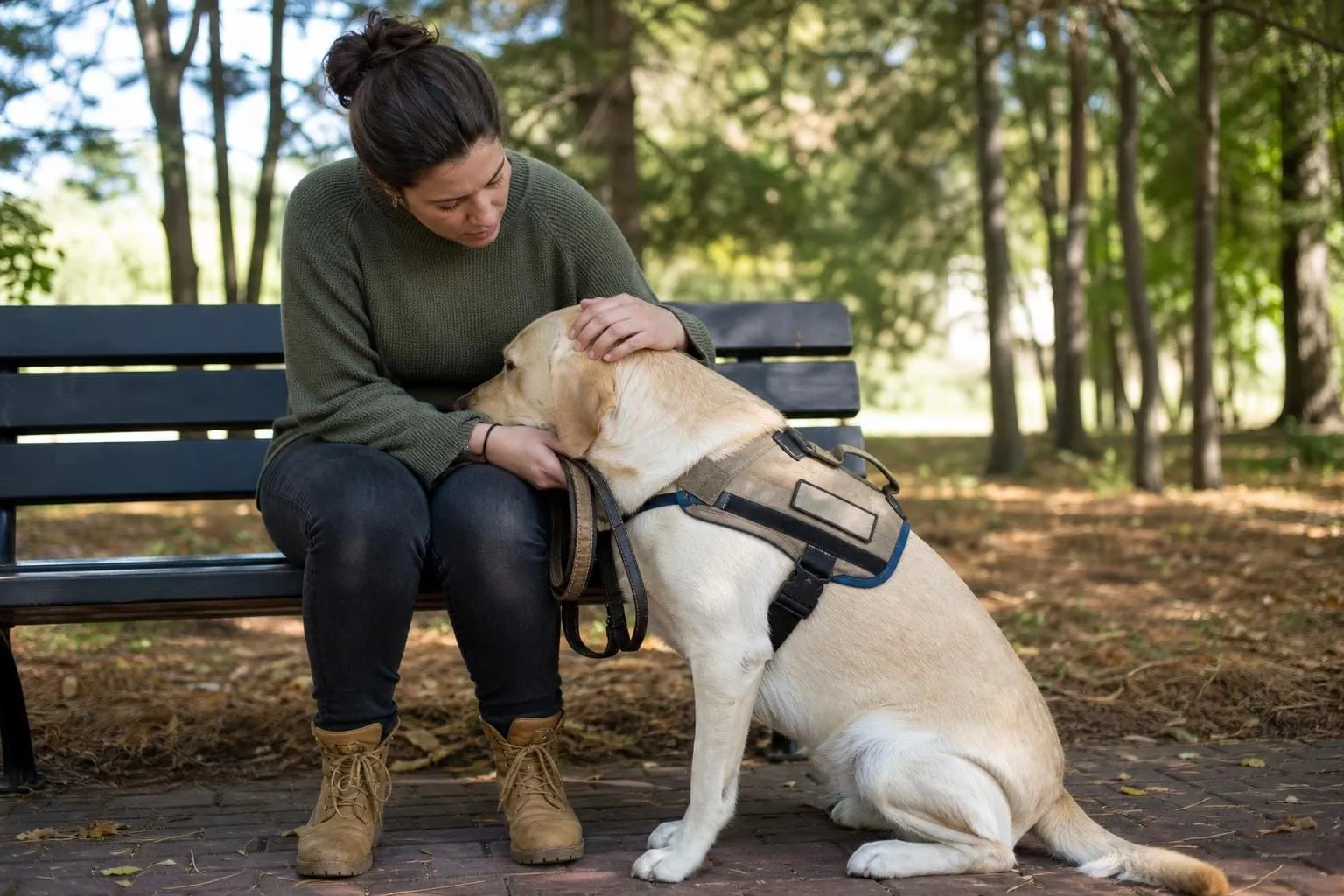
A psychiatric service dog (PSD) for PTSD is individually trained to perform specific tasks that mitigate symptoms like flashbacks, nightmares, hypervigilance, and panic attacks. The single most important concept: the trained task is what separates a service dog from an emotional support animal under the ADA. No certification or registration is legally required. Training takes 12 to 24 months whether you self-train or work with a program, and the science backing these dogs is now stronger than ever, with a 2024 clinical trial showing 66% lower odds of PTSD diagnosis for veterans partnered with service dogs.
Psychiatric service dog training for PTSD sits at the intersection of mental health treatment, animal behavior science, and federal disability law. Understanding it requires getting comfortable with terminology that spans all three areas. This guide breaks down every term you need to know, organized from foundational definitions through specific tasks, training methods, legal rights, qualification criteria, and costs.
Whether you’re a veteran weighing your options, a civilian with PTSD exploring alternatives to traditional treatment, or a family member trying to help, this is the reference you’ll keep coming back to.
If you’re still deciding whether a psychiatric service dog is the right path, our PSD training guide walks through the process step by step.
Before getting into tasks and training methods, you need a solid grasp of five foundational terms. Getting these wrong creates confusion that follows you through every other decision.
A psychiatric service dog is a dog specifically trained to assist a handler with a psychiatric disability as defined by the Americans with Disabilities Act. Qualifying conditions include PTSD, major depressive disorder, anxiety disorders, bipolar disorder, schizophrenia, and others recognized in the DSM-5.
The word “trained” is doing heavy lifting in that definition. A dog that makes you feel calmer just by being nearby does not meet the legal standard. The dog must be trained to take a specific action, either on command or in response to a signal it has learned to detect. This is the single most important distinction in the entire PSD framework.
A PTSD service dog is a psychiatric service dog individually trained to perform tasks that mitigate the specific symptoms of post-traumatic stress disorder. These tasks include interrupting flashbacks and dissociative episodes, applying deep pressure therapy during panic attacks, waking the handler from nightmares, performing perimeter checks in unfamiliar spaces, and creating physical buffer space in crowds.
About 23% of post-9/11 veterans have been diagnosed with PTSD, making this one of the most common conditions driving psychiatric service dog training for PTSD. But PTSD service dogs are not limited to veterans. Anyone with a qualifying PTSD diagnosis can train and use one.
An emotional support animal provides comfort through its presence but is not trained to perform specific disability-related tasks. ESAs have some housing protections under the Fair Housing Act, but they do not qualify as service animals under the ADA and have no public access rights.
This distinction is not just legal. It’s clinical. Research shows that participants with service dogs had a 3.7-point greater reduction in PTSD symptoms compared to those with emotional support dogs. Veterans with service dogs also showed a 10 percentage point increase in antidepressant adherence compared to those with ESAs.
For a deeper breakdown, see our article on distinguishing service animals from emotional support animals.
The handler is the person with the disability who works with the service dog. In psychiatric service dog training for PTSD, the handler-dog relationship is especially important because many PSD tasks require the dog to detect physiological changes (elevated heart rate, changes in breathing, cortisol shifts) unique to that specific person. This is why owner-training is more common for PSDs than for other types of service dogs.
A task is a trained behavior that directly mitigates a symptom of the handler’s disability. Under the ADA, the task is what makes a dog a service dog. Without at least one trained task, the dog is not a service animal regardless of any vest, ID card, or registration.
Practitioners on Reddit’s r/service_dogs community emphasize this point repeatedly: a dog providing comfort by presence alone is not performing a task. The behavior must be something the dog was trained to do (or trained to recognize and respond to), and it must be connected to the handler’s disability.
This section covers the core tasks used in psychiatric service dog training for PTSD. A 2020 study published in Frontiers in Psychology found that veterans spent an average of 82% of their time with their service dogs and most frequently used the anxiety calming task. Understanding what each task does, and which PTSD symptoms it addresses, helps you build a training plan that actually matches your needs.
Deep pressure therapy is one of the most widely taught PTSD service dog tasks. On cue, or when the dog senses rising anxiety, the dog applies its body weight by lying across the handler’s lap, chest, or legs. This pressure creates a calming, grounding sensation that can interrupt a panic attack, ease a flashback, and help the handler return to the present moment.
Symptom match: Panic attacks, acute anxiety episodes, flashback onset.
DPT is often the first task new handlers teach because it’s relatively straightforward to train and produces immediate, tangible relief.
When the dog detects signs of distress during sleep (moaning, thrashing, rapid breathing), it is trained to wake the handler by nudging, pawing, or licking. After waking the handler, the dog provides physical contact until the person is calm.
Symptom match: PTSD nightmares, night terrors, sleep disruption.
For many handlers, nightmare interruption is the task that most dramatically improves quality of life. Chronic sleep disruption compounds every other PTSD symptom, so breaking that cycle has outsized effects.
In a “block” position, the dog stands in front of the handler facing outward to create a physical buffer between the handler and approaching people. This task is critical for handlers who experience heightened distress when crowded or approached unexpectedly. The dog creates predictable personal space without the handler needing to verbally confront anyone.
Symptom match: Hyperarousal in crowds, social anxiety, agoraphobia.
The dog is trained to enter a room ahead of the handler and check it for other people, or to lead the handler to a pre-designated exit on command. For someone with PTSD who experiences hypervigilance in unfamiliar spaces, knowing the room has been “cleared” reduces the cognitive burden of navigating new environments.
Symptom match: Hypervigilance, avoidance of new spaces, re-entry anxiety.
The dog positions itself behind the handler, facing away, to reduce the handler’s need for constant hypervigilant scanning. For someone with PTSD who cannot relax unless they know what’s happening behind them, this task allows the handler to focus forward while the dog covers the rear.
Symptom match: Hypervigilance, inability to sit with back to a room, constant scanning.
The service dog is trained to recognize when the handler’s anxiety is rising, whether through increased heart rate, changes in breathing, or other physical cues. The dog then alerts the handler (typically by nudging or pawing) before the anxiety escalates into a full episode.
Research from Frontiers in Psychology confirms that calming and interrupting anxiety was perceived as the most important trained task by veterans, the most frequently used in a typical day, and as helping the most PTSD symptoms. This makes anxiety alert the cornerstone of most PTSD service dog training programs.
Symptom match: Generalized anxiety, panic onset, dissociative triggers.
Dogs trained in tactile interruption nudge, paw, or lean on cue to interrupt flashback onset or dissociative episodes. The physical sensation redirects the handler’s focus back to the present. This is distinct from DPT: tactile interruption is a quick, targeted contact, while DPT involves sustained body pressure.
Symptom match: Flashbacks, dissociation, emotional numbing.
The dog retrieves a specific container on command during an episode when the handler may be unable to get up or think clearly enough to locate medication. Simple to teach, but potentially important during severe episodes.
The dog leads the handler to the nearest exit when overwhelmed. This task gives the handler a reliable escape route in triggering environments without having to process spatial information while in distress.
Symptom match: Panic in enclosed spaces, feeling trapped, crowd overwhelm.
If you want to learn which tasks specifically qualify a dog as a psychiatric service dog under the ADA, this breakdown of qualifying tasks covers the legal requirements.
Understanding how psychiatric service dog training for PTSD actually works, what methods are used, what routes are available, and what to realistically expect, is where many people get stuck. This section covers the terminology you’ll encounter when planning your training path.
Positive reinforcement means rewarding the dog for performing a desired behavior, typically with food, play, or praise. This is not just a philosophical preference. It’s backed by measurable outcomes.
A Purdue University study of 111 veterans found that more frequent use of positive reinforcement was associated with higher closeness to the service dog, increased attachment behavior, and more playfulness. By contrast, more frequent use of positive punishment was associated with less closeness, more fear, less eye contact, and lower trainability.
For handlers with PTSD, the bond between handler and dog is not optional. It’s therapeutic. Training methods that damage that bond undermine the entire purpose. For more on what the Purdue study revealed, we’ve covered it in detail.
The ADA expressly allows handlers to train their own service dogs. Many people do, especially for psychiatric and medical alert animals where the dog needs to imprint deeply on one person’s specific physiology. Most PSD handlers choose owner training because psychiatric service dog tasks must be individualized to their specific symptom profile.
Typical timeline: 12 to 18 months.
Typical cost: $500 to $3,000 (books, treats, equipment, occasional professional consults).
Owner training is the most common path for psychiatric service dogs specifically. It is harder than most guides admit, but it is entirely doable with consistency and the right resources.
A middle path: the handler does daily training, but works regularly with a professional trainer who provides structure, evaluates progress, and troubleshoots problems. Professional trainers typically charge $150 to $250 per hour for this kind of work.
Typical timeline: 12 to 24 months.
Typical cost: $5,000 to $12,000.
Organizations that breed, raise, and train service dogs from puppyhood before matching them with handlers. Some programs specialize in PTSD service dogs for veterans. Northwest Battle Buddies, for example, reports that it costs a total of $35,000 to raise a dog from puppy to trained service dog working with a veteran handler. Many nonprofit organizations place dogs at low or no cost to the handler through donations and grants.
Typical timeline: 12 to 36 month waitlist, plus matching and bonding period.
Typical cost to handler: $15,000 to $50,000+ (or free through nonprofits).
For a full cost comparison across all training routes, our psychiatric service dog cost guide breaks it down.
A washout is a dog that is removed from service dog training because it cannot meet behavioral, temperamental, or health standards. This is the reality most training guides skip. Even in professional breeding programs specifically designed to produce service dogs, the washout rate is roughly 50%. One dog training podcast highlighted this “staggering 50% washout rate, even with service dog breeding programs,” noting that temperament is the hardest variable to control.
For owner-trainers, the rate may be higher. This is not discouraging. It’s planning. Not every dog, no matter how beloved, has the temperament to be a service dog. Recognizing a wash early saves both the handler and the dog months of frustration. A survey of 111 veterans found their service dogs were predominantly Labrador Retriever purebreds or mixes, and 58% were obtained from shelters or rescues, which means successful service dogs can come from anywhere, but success is never guaranteed.
A structured evaluation where the dog demonstrates reliable behavior in public settings: stores, restaurants, public transit, and other real-world environments. The PAT is not legally required under the ADA, but it is widely used as a benchmark for readiness. Many trainers and programs use some version of it before declaring a dog “public access ready.”
Exposing the dog to a wide variety of environments, people, sounds, surfaces, and situations during early development (ideally between 3 and 16 weeks, continuing through the first year). Proper socialization is the foundation of all service dog training. A poorly socialized dog will struggle with public access regardless of task training.
Practicing trained behaviors in increasingly distracting or challenging environments until the dog performs reliably regardless of context. A dog that performs DPT perfectly at home but falls apart in a busy grocery store has not been proofed.
The legal framework around psychiatric service dog training for PTSD is simpler than most people think. The confusion comes from misinformation, not from the law itself.
The federal law that defines service animals and establishes their public access rights. Under the ADA, a service animal is a dog individually trained to do work or perform tasks for a person with a disability. Psychiatric service dogs trained for PTSD meet this definition and have the same rights as any other service dog, including full public access to restaurants, stores, hospitals, and anywhere else the public is allowed.
Under the ADA, businesses may ask only two questions when it is not obvious what service the dog provides:
Is this a service animal required because of a disability?
What work or task has the dog been trained to perform?
They cannot ask about the nature of the disability, request documentation, require the dog to demonstrate a task, or ask for certification or registration papers.
For more detail on what businesses can and cannot ask, we’ve covered the ADA rules separately.
No federal law requires psychiatric service dog certification, registration, or professional training. The ADA does not mandate any of these things. A handler who trains their own dog to perform tasks that mitigate their PTSD has a legal service dog, period. Any website or entity claiming that certification is required is either confused or trying to sell something.
That said, many handlers voluntarily choose identification gear (vests, ID cards) to reduce confrontations in public. These items are convenience tools, not legal requirements. For guidance on the service dog training requirements under the ADA, our requirements guide explains what the law actually says.
The federal law that requires landlords to make reasonable accommodations for tenants with disabilities, including allowing service dogs and emotional support animals in no-pet housing without charging pet deposits or pet rent. For psychiatric service dog handlers, the FHA provides housing protections that complement ADA public access rights.
The Department of Transportation (DOT) regulates service animals on airlines. Since 2021, airlines may require handlers to complete a DOT form attesting that their service dog is trained for specific tasks and behaves appropriately in an aircraft cabin. Emotional support animals lost cabin access under these updated rules. Psychiatric service dogs retain full flight access.
Signed by President Biden in August 2021, the PAWS Act allows the Department of Veterans Affairs to provide service dogs and provisions for their care to assist veterans with PTSD. The $10 million pilot program limits grant money to $25,000 per eligible veteran. This is directly relevant for any veteran exploring psychiatric service dog training for PTSD through the VA system.
A psychiatric service dog qualifies a handler when two conditions are met: the handler has a DSM-5-recognized psychiatric condition that substantially limits one or more major life activities, and the dog is individually trained to perform tasks that mitigate that disability. Both halves matter. A diagnosis without trained tasks does not produce a service dog under the ADA. Trained tasks without a qualifying disability don’t either.
PTSD is one of the most common qualifying conditions. For a broader list, see conditions a service dog can help with.
A PSD letter is a document from a licensed mental health professional (LMHP) stating that the handler has a psychiatric disability and that a psychiatric service dog is part of their treatment plan. While not required for ADA public access, a PSD letter is often needed for housing accommodations under the FHA and for airline travel under DOT rules.
A legitimate PSD letter should be on the clinician’s professional letterhead, include their license number and contact information, and be based on an actual clinical evaluation. Be cautious of services offering instant letters without any clinical interaction. For guidance on spotting illegitimate documentation, this article on avoiding fake letters is worth reading.
A clinician licensed to diagnose and treat mental health conditions in your state. This includes psychiatrists, psychologists, licensed clinical social workers (LCSWs), licensed professional counselors (LPCs), and licensed marriage and family therapists (LMFTs). Only an LMHP can write a PSD letter that holds up to scrutiny.
This is the ADA’s threshold for “disability.” Your condition must substantially limit at least one major life activity, such as sleeping, concentrating, working, or interacting with others. For many people with PTSD, multiple major life activities are affected. The limitation does not need to be total. It needs to be substantial.
The cost of psychiatric service dog training for PTSD varies dramatically depending on the path you choose.
Training Route | Cost Range | Timeline |
|---|---|---|
Self-training (owner-trained) | $500 to $3,000 | 12 to 18 months |
Trainer-assisted owner training | $5,000 to $12,000 | 12 to 24 months |
Program-trained | $15,000 to $50,000+ | 12 to 36 month waitlist |
Many nonprofit organizations train and place PTSD service dogs at no cost to veterans and sometimes to civilians with PTSD. These programs are funded by donations and grants. Waitlists can be long (often one to three years), but the financial barrier is removed entirely. Some programs, like mentoring-based approaches, pair handlers with trainers throughout the process.
Beyond initial training, handlers should budget $1,000 to $2,000 per year for veterinary care, food, grooming, and equipment replacement. A service dog’s working lifespan is typically 8 to 10 years, so total lifetime cost of care is significant regardless of how you acquire the dog.
The science supporting psychiatric service dog training for PTSD has reached a turning point. Two landmark studies published in 2024 provide the strongest evidence to date.
A clinical trial published in JAMA Network Open found that veterans with service dogs had 66% lower odds of a PTSD diagnosis based on expert clinician assessment compared to a wait-listed control group. Participants partnered with service dogs also had significantly lower anxiety and depression, significantly higher quality of life, and lower isolation. The study’s dropout rate was substantially lower than rates seen in both trauma-focused and non-trauma-focused treatments, suggesting that service dog partnership may be a particularly sustainable intervention.
A separate 2024 study published in Scientific Reports found that veterans with service dogs had a higher, less blunted cortisol awakening response compared to veterans receiving usual care alone. This is significant because a blunted cortisol response is a physiological hallmark of chronic PTSD. For additional coverage of what research shows about service dogs and PTSD, we’ve summarized the key findings.
These are not anecdotal reports. They are controlled studies published in top-tier journals. The evidence base for PTSD service dogs is now stronger than it has ever been.
No. The ADA allows handlers to train their own service dogs. Many psychiatric service dog handlers self-train because the tasks need to be tailored to their specific symptom profile. That said, working with a professional trainer (even occasionally) improves outcomes and helps catch problems early.
Most handlers spend 12 to 24 months on training, depending on the dog’s age, temperament, and the complexity of the tasks being taught. Basic obedience typically takes 4 to 6 months, with task-specific training and public access proofing filling the remaining time.
Yes. The ADA does not restrict service dogs by breed. Research shows that Labrador Retrievers and Lab mixes are the most common, but successful PTSD service dogs come from many breeds and backgrounds. Temperament matters far more than breed. Over half of the service dogs in one large study came from shelters or rescues.
A PSD letter documents that a handler has a psychiatric disability and uses a trained psychiatric service dog as part of their treatment. An ESA letter documents that a person has a mental health condition that benefits from an emotional support animal’s presence. The PSD letter supports both ADA public access and FHA housing rights. The ESA letter supports FHA housing rights only.
No certification is required or recognized by the ADA. Any website selling a “PSD certification” is offering something with no legal standing. What matters is that your dog is trained to perform specific tasks that mitigate your disability. Documentation from a licensed mental health professional (a PSD letter) is a separate matter and is useful for housing and travel.
Under the Fair Housing Act, landlords must make reasonable accommodations for tenants with disabilities, including allowing psychiatric service dogs in no-pet housing without pet fees. There are narrow exceptions (buildings with four or fewer units where the owner lives in one, for example), but outright refusal is generally illegal.
It happens to roughly half of all dogs, even in professional breeding programs. A washout is not a failure of the handler. Some dogs simply lack the temperament for service work. Many handlers who experience a wash adopt the dog as a pet and begin the process again with a new candidate.
The PAWS for Veterans Therapy Act (2021) authorized the VA to provide service dogs to veterans with PTSD through a pilot grant program. Eligibility and availability vary. Contact your local VA facility or a VA-accredited nonprofit for current options.
Psychiatric service dog training for PTSD is a real, evidence-backed path to managing symptoms that resist conventional treatment alone. The terminology can feel overwhelming at first, but it comes down to a few core principles: trained tasks define a service dog, positive reinforcement produces the best outcomes, and the legal framework is simpler than the internet makes it seem.
Ready to take the next step? Compare service dog registration packages to find the identification gear and documentation support that fits your situation.

Copyright © 2020 USA Service Dog. All rights reserved.