
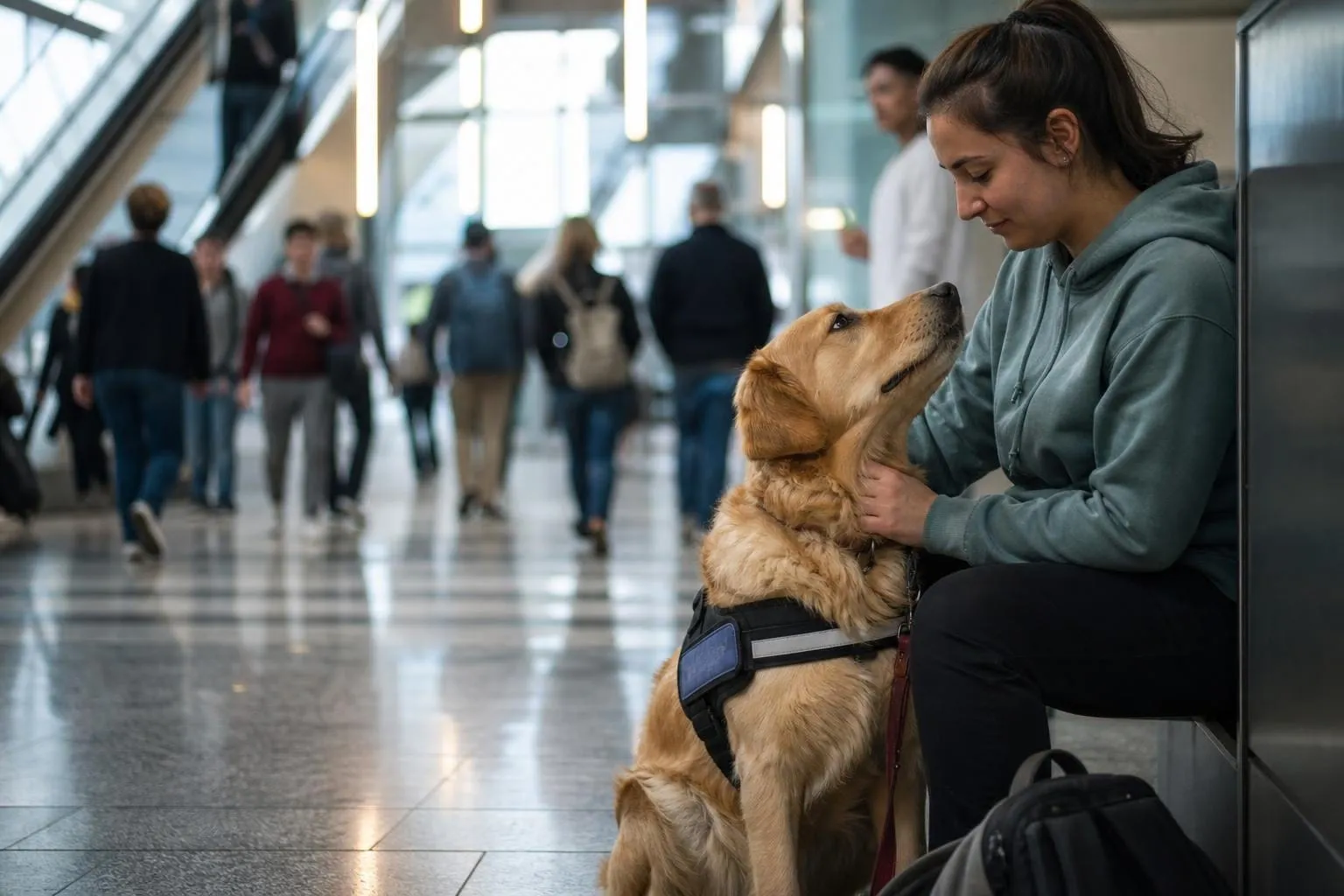
A service dog is individually trained to perform specific tasks for a person with a disability and has broad public access rights under the ADA. An emotional support animal (ESA) provides comfort through its presence alone, requires no task training, and is primarily protected only in housing under the Fair Housing Act. A psychiatric service dog (PSD) bridges the two categories, offering full service dog rights for people with mental health disabilities. In May 2026, HUD changed its enforcement posture on ESA complaints, making legitimate documentation more important than ever.
The difference between an emotional support animal and a service dog comes down to one thing: training. A service dog is trained to perform a specific task tied to a handler’s disability. An ESA provides comfort simply by being there. That single distinction creates a cascade of different legal rights, access privileges, and documentation requirements that affect where each animal can go, what protections apply, and what paperwork you need.
This guide breaks down every dimension of the difference so you can make informed decisions about which category applies to your situation.
Explore your options for service dog registration and ESA letters.
Under the Americans with Disabilities Act, a service animal is defined as “a dog that is individually trained to do work or perform tasks for a person with a disability.” That definition comes directly from ADA.gov, the federal government’s own resource, and it’s the legal bedrock for everything that follows.
The disability can be physical, sensory, psychiatric, intellectual, or any other mental disability. The key is that the dog must be trained to do something specific in response to the handler’s condition. Guide work for someone who is blind. Alerting to an oncoming seizure. Performing deep pressure therapy during a panic attack. Reminding a handler to take medication. These are all recognized tasks.
A few important points that surprise many people:
Species is limited. Only dogs qualify as service animals under the ADA. There is a narrow exception for miniature horses that have been individually trained, but that’s it.
No certification or registration is required. Federal law does not require service dogs to carry ID cards, wear vests, or appear in any registry. Staff at businesses cannot demand documentation or ask the dog to demonstrate its tasks. While voluntary identification can reduce day-to-day friction, it grants no additional legal rights.
You can train your own service dog. The ADA gives individuals the right to train their own service animal. Formal programs exist but are expensive, and the law does not require them. There are many conditions a service dog can help with, ranging from mobility impairments to seizure disorders to PTSD.
An emotional support animal is an animal that provides therapeutic benefit to a person with a disability through its presence. Unlike a service dog, an ESA does not need to be trained to perform any specific task. It provides companionship, relieves loneliness, and can help with depression, anxiety, and certain phobias.
The differences from a service dog start stacking up fast:
Any species qualifies. Dogs, cats, rabbits, birds. There is no species restriction for emotional support animals under federal law. This is one of the most visible differences between an emotional support animal and a service dog.
No task training is required. An ESA letter from a licensed mental health professional explaining the animal’s therapeutic value is the core requirement, not training.
No public access rights. ESAs are not service animals under the ADA and are not entitled to accompany their owners into restaurants, stores, hotels, or other public spaces.
Primary legal protection is housing. The Fair Housing Act requires landlords to make reasonable accommodations for tenants with disabilities, and that includes allowing emotional support animals. Owners with valid ESA documentation are exempt from pet fees, deposits, and breed or weight restrictions in covered housing.
For those navigating the ESA process, understanding what a therapist should include in an ESA letter is critical to getting a document that landlords will actually accept.
This table covers the four categories of assistance animals that people most commonly confuse. Bookmark it.
Dimension | Service Dog | Emotional Support Animal | Psychiatric Service Dog | Therapy Dog |
|---|---|---|---|---|
Training | Task-trained for handler’s disability | No training required | Task-trained for psychiatric disability | Trained to comfort groups/individuals |
Species | Dogs only (miniature horse exception) | Any animal | Dogs only | Typically dogs (varies by program) |
Public Access (ADA) | Yes, all public areas | No | Yes, all public areas | No |
Housing (FHA) | Protected | Protected | Protected | Not protected |
Air Travel (DOT) | Flies free in cabin | Treated as pet since 2021 | Flies free in cabin | No special rights |
Documentation Required | None under ADA | ESA letter from licensed mental health professional | None under ADA; letter for housing; DOT form for flights | Facility-specific credentials |
Who Benefits | The handler | The owner | The handler | Others (patients, students, etc.) |
This comparison table captures the practical difference between an emotional support animal and a service dog across every dimension that matters in daily life.
This is where most guides fall short, and it’s the category that matters most to people caught between an ESA and a service dog.
A psychiatric service dog (PSD) is a dog individually trained to perform specific tasks for a person with a psychiatric disability, such as PTSD, severe anxiety, major depression, or bipolar disorder. Under the ADA, a PSD is a service dog. It has the same public access rights as a guide dog for someone who is blind.
The distinction between a PSD and an ESA is task performance. Consider this example adapted from legal guidance: A person with social phobia might only feel safe leaving home with their dog. That dog provides emotional support through its presence, making it an ESA. But if that same person is prone to dissociative episodes, and the dog is trained to recognize the onset of an episode and guide the person to safety, nudge them, or interrupt harmful behavior, the dog qualifies as a psychiatric service dog.
Specific PSD tasks include:
Performing room searches or safety checks for individuals with PTSD
Blocking a handler in a dissociative episode from walking into traffic
Interrupting self-harm behaviors through trained physical intervention
Waking a handler from night terrors
Creating physical space between the handler and others in crowded settings
A PSD is protected under all three major federal laws: the ADA (public access), the FHA (housing), and the ACAA (air travel). An ESA, by contrast, is only protected under the FHA for housing. For veterans and others dealing with PTSD, research confirms the benefits. A Purdue study on service dogs and PTSD found measurable physiological improvements in veterans paired with trained service dogs.
If you’re in California and considering a PSD, be aware that specific state rules apply. You can learn more about California PSD laws and rights before starting the process.
Service dogs (including PSDs) can accompany their handlers into any area where the public is allowed: restaurants, hotels, theaters, grocery stores, hospitals, government buildings. This is a Title II and Title III ADA protection.
ESAs have no public access rights under the ADA. A restaurant or store is within its rights to refuse entry to an ESA. This is one of the most frequently misunderstood aspects of the difference between emotional support animals and service dogs.
When a service dog enters a business, staff are permitted to ask only two questions under 28 CFR § 36.302©(6): (1) Is the dog a service animal required because of a disability? (2) What work or task has the dog been trained to perform? They cannot ask about the person’s disability, demand medical records, or require the dog to demonstrate its task. These two questions do not apply to ESAs because ESAs have no right to be there in the first place.
Real-world access denials still happen to legitimate service dog handlers. A 9/11 first responder recounted being surrounded by five counterterrorism police officers and removed from a public area because a security guard didn’t believe his dog was a real service dog. Cases like a hotel denying a veteran with a service dog illustrate why knowing your rights matters. Understanding proper etiquette when approaching a service dog can also reduce these confrontations.
Both service dogs and ESAs are protected in housing under the Fair Housing Act. Landlords must make reasonable accommodations for tenants with disabilities. That means no pet fees, no breed restrictions, and no weight limits for assistance animals.
For ESAs, the landlord may request documentation when the disability or the need for the animal isn’t obvious. This typically means an ESA letter from a licensed mental health professional. For those going through this process, understanding what landlords can legally request helps you prepare the right documentation.
Colleges and universities are increasingly adopting ESA policies for student housing. The Fair Housing Act applies to campus housing in many cases, and students are bringing ESAs to campus in growing numbers.
Real enforcement happens. A Colorado couple was awarded $50,000 after their HOA refused to allow their emotional support animal, demonstrating that the FHA has real teeth.
This is where the rules shifted dramatically. In January 2021, the U.S. Department of Transportation finalized a rule that narrowed the definition of “service animal” under the Air Carrier Access Act to dogs trained to perform tasks for a person with a disability. ESAs were excluded entirely.
The backstory explains the change. Delta alone reported an 84% increase in animal-related incidents onboard between 2016 and 2019, driven largely by the surge in ESAs on flights. All major U.S. carriers, including Delta, United, American, and Southwest, stopped accepting ESAs in-cabin after the rule took effect.
Service dogs (including PSDs) still fly in-cabin at no charge. Airlines may require 48 hours advance notice and a completed DOT Service Animal Air Transportation form. For people with psychiatric disabilities, the PSD designation preserves full cabin rights at no charge, which is a significant practical reason to pursue PSD status rather than relying on an ESA.
This is the most important recent development affecting ESA owners, and most online guides haven’t caught up.
In May 2026, the U.S. Department of Housing and Urban Development rescinded its 2020 guidance on assistance animals and announced that it would no longer accept complaints from individuals whose emotional support animals are not “individually trained to perform work or tasks directly related to the person’s disability.” In practical terms, HUD adopted something close to the ADA’s training standard for its own enforcement priorities.
HUD is less likely to investigate or pursue complaints when a tenant’s ESA is denied and the animal has no task training. The agency’s reasoning was partly about workload: by 2026, over 20% of the Fair Housing and Equal Opportunity office’s caseload involved untrained ESAs, much of it driven by an online “certification” industry that had exploded in the preceding years.
The Fair Housing Act itself is unchanged. Congress did not amend the statute. Section 3604(f) still prohibits discrimination against people with disabilities in housing, and the reasonable accommodation standard still applies. A landlord who denies an untrained ESA could still face liability in a private civil action if the tenant demonstrates a disability-related need.
State laws also remain intact. States like California, New York, and Illinois have their own fair housing statutes that may provide broader ESA protections entirely unaffected by HUD’s federal enforcement shift.
The 2026 HUD shift makes legitimate ESA documentation more important, not less. If HUD won’t pursue your complaint, you may need to rely on state agencies or private legal action. Having a properly formatted letter from a licensed mental health professional, one that includes the clinician’s name, license number, state of licensure, and a clear statement of your disability-related need, is no longer just recommended. It’s essential.
Learn how to verify your clinician’s credentials before relying on any ESA letter.
Under the ADA: nothing. No ID card, vest, certificate, or registration is legally required. The law is explicit that businesses cannot demand documentation.
That said, many handlers voluntarily carry identification or use service dog vests because it reduces confrontation. Practitioners on Reddit’s r/service_dogs frequently note that while IDs aren’t required, they make daily interactions smoother and cut down on the number of times you get stopped and questioned.
An ESA letter from a licensed mental health professional is required for housing accommodations. A valid letter should include:
The clinician’s full name and professional title
License number and state of licensure
Date of issuance
A statement that you have a disability-related need for the animal
The clinician’s contact information on professional letterhead
Letters typically need annual renewal. California has a specific rule requiring a 30-day provider relationship before an ESA letter can be issued.
For public access, a PSD needs no documentation (same as any service dog under the ADA). For housing, the same ESA letter standards apply. For air travel, you’ll need to complete the DOT Service Animal Air Transportation form.
The online ESA letter industry has attracted bad actors. Watch for these warning signs:
No evaluation required, just fill out a form and get an instant letter
No provider details (missing license number, state, or contact info)
Out-of-state providers not licensed in your state
“Lifetime” letter promises (legitimate letters need regular renewal)
Claims that the ESA has public access rights (it doesn’t)
To protect yourself, read more about how to avoid fake ESA letters.
Therapy dogs are often mistaken for ESAs because both provide a therapeutic benefit. But they serve fundamentally different purposes.
A therapy dog is trained to provide comfort to groups of people, typically in hospitals, schools, nursing homes, or disaster relief settings. The owner of a therapy dog does not need to have a disability. The dog serves others, not its owner.
Therapy dogs have no ADA public access rights and no FHA housing protections. They enter facilities by invitation, not by right. When people say “therapy dog” and mean an animal that helps them personally with anxiety, they’re almost always describing an ESA or a psychiatric service dog.
Federal law sets the floor, not the ceiling. Individual states can and do add their own rules.
There are 22 different titles used across state laws to describe assistance animals, according to researchers at the University of Georgia. That inconsistency creates confusion for handlers who travel or relocate. Nineteen states still don’t address service dog misrepresentation at all. States that do, like Texas, Florida, and Oklahoma, have made it a misdemeanor to falsely claim a pet is a service animal, with fines up to $1,000.
On the ESA side, states like California, New York, and Illinois have their own fair housing protections that may go beyond what federal law requires. This is especially relevant after the 2026 HUD enforcement shift, because state agencies may still investigate ESA complaints that HUD now declines.
No. Emotional support animals have no public access rights under the ADA. Only service dogs (including psychiatric service dogs) can enter public accommodations. A business is within its rights to refuse entry to an ESA.
Not legally. The ADA does not require vests, ID cards, or any identifying gear. However, many handlers use them voluntarily because it signals to staff and the public that the dog is working, which reduces questions and confrontations.
Under the Fair Housing Act, landlords generally cannot deny a reasonable accommodation request for an ESA if you have a valid letter from a licensed mental health professional. After the 2026 HUD enforcement shift, HUD itself is less likely to pursue complaints involving untrained ESAs, but the FHA statute is unchanged. Landlords who deny legitimate requests still face potential liability through private lawsuits or state agencies. Understanding whether a landlord can legally deny your ESA depends on the specific circumstances and your state’s laws.
Yes. The ADA explicitly permits individuals with disabilities to train their own service animals. There is no requirement to use a professional trainer or a formal program.
No. There is no government-run registry for service dogs or ESAs in the United States. Any website claiming to offer “official” registration is a private service, not a government entity.
This is the most confusing comparison. Both serve people with mental health conditions. The difference is task training. If a dog is trained to perform a specific task related to a psychiatric disability (interrupting a panic attack, performing safety checks for PTSD, preventing self-harm), it’s a psychiatric service dog with full ADA rights. If the dog simply provides comfort through its presence, it’s an ESA with housing protections only.
Not as an ESA. Since January 2021, major U.S. airlines no longer accept emotional support animals in the cabin. Your ESA will be treated as a pet, subject to carrier-specific policies and fees. If your animal is trained to perform tasks for a psychiatric disability, it may qualify as a psychiatric service dog, which does fly free in-cabin.
Most legitimate ESA letters are valid for one year and need to be renewed annually. Be skeptical of any provider offering a “lifetime” letter, as that’s a common red flag for fraudulent services.
Understanding the difference between an emotional support animal and a service dog isn’t just an academic exercise. It determines where your animal can go, what documentation you need, and which laws protect you. With the 2026 HUD changes reshaping the enforcement picture, getting the right documentation from the right provider matters more than ever.
Get started with legitimate ESA or service dog documentation today.

Copyright © 2020 USA Service Dog. All rights reserved.