A psychiatric service dog in California is a dog trained to perform specific tasks for a handler with a psychiatric disability. It has full public access rights under both the ADA and California state law. California’s 30-day waiting period (AB 468) applies only to ESA letters, not PSD letters. After HUD’s May 2026 guidance shift, a PSD letter is now the strongest housing protection available at the federal level, while California’s FEHA continues to protect ESA holders independently at the state level.
California layers more legal protections on top of federal law than any other state. That sounds like good news, and it is, but it also creates a maze. At any given moment, a psychiatric service dog handler in California operates under the ADA, the Fair Housing Act, California’s FEHA, the Disabled Persons Act (Civil Code §§ 54.1–54.2), AB 468, Penal Code § 365.7, and, as of May 2026, a completely rewritten HUD enforcement standard.
Practitioners on Reddit’s r/asksandiego regularly express confusion about whether California’s 30-day rule applies to PSD letters or just ESA letters. That single question ranks as a top-three Google result for this topic, proof that the confusion is widespread and the answer matters.
This glossary breaks down every term you need to understand. Each entry gives you a plain-language definition, the relevant law, and one practical takeaway.
Learn how to get a PSD letter in California
A psychiatric service dog is a dog individually trained to perform specific tasks that directly mitigate a handler’s psychiatric disability. Common qualifying conditions include PTSD, major depressive disorder, severe anxiety disorders, OCD, panic disorder, bipolar disorder, and autism spectrum disorder, though the legal test is functional, not a fixed list. Both halves must be present: a qualifying disability and trained tasks. A dog that only provides comfort through its presence is not a PSD.
Under federal law, a PSD holds the exact same legal status as a mobility service dog or a guide dog for the blind. There is no second-class category. Research published in the Journal of Consulting and Clinical Psychology found that psychiatric service dogs reduced PTSD symptom severity and improved mental health and social interactions in military veterans, confirming these are not just feel-good companions but functional medical interventions.
An emotional support animal provides therapeutic benefit through companionship alone. ESAs do not need task training. That distinction is everything: without trained tasks, the animal cannot qualify for ADA public access rights. ESAs are limited to housing accommodations (under the Fair Housing Act and California’s FEHA) and, since the 2021 DOT rule change, are no longer guaranteed cabin access on flights.
If you’re unclear on where the line falls, the article on distinguishing service and support animals walks through the comparison in detail.
California Civil Code §§ 54.1 and 54.2 define a service dog as one “individually trained to the requirements of the individual with a disability.” This includes but is not limited to protection work, rescue work, pulling a wheelchair, or fetching dropped items. California does not maintain a separate legal definition for “psychiatric service dog.” A dog trained to perform tasks for a psychiatric disability simply falls under the broader service dog definition.
One important nuance: California’s disability standard is broader than the ADA’s. The ADA requires a disability that “substantially” limits a major life activity. California’s law omits the word “substantially,” which means more people may qualify under state law than under federal law alone.
The person with the disability who uses the psychiatric service dog. Under both federal and California law, the handler has the legal right to be accompanied by their PSD in public places, housing, and on flights.
This is the legal hinge that separates a psychiatric service dog from an emotional support animal. A task must be a specific, learned behavior the dog performs in response to the handler’s disability-related need. Natural comfort, like a dog curling up next to you when you’re sad, does not count. The dog must be trained to do something deliberate and identifiable.
Effective January 1, 2022, AB 468 added Health & Safety Code § 122318 to California law. It requires a licensed mental health professional to maintain a therapeutic relationship with a client for at least 30 days before issuing an ESA letter. The law was enacted to crack down on fraudulent “instant approval” ESA letters sold by online mills.
The critical point: AB 468’s 30-day requirement does not apply to psychiatric service dog letters. Multiple legal sources confirm this, because PSDs are service animals under the ADA, not emotional support animals. This is the single most confused-about issue in California PSD law, and the answer is unambiguous.
Practical takeaway: If you qualify for a psychiatric service dog in California, your clinician can issue a PSD letter without waiting 30 days. If you only qualify for an ESA, the waiting period applies.
The ADA is the federal law that grants psychiatric service dogs full public access rights. Under the ADA, a service animal is defined as a dog individually trained to do work or perform tasks for a person with a disability. PSDs fit this definition completely. The ADA applies to businesses, government facilities, nonprofits, and transportation. It does not apply directly to housing (that’s the Fair Housing Act).
The federal Fair Housing Act prohibits disability discrimination in housing, including denying reasonable accommodations for assistance animals. PSDs are fully protected under the FHA. After HUD’s May 2026 guidance shift, PSD holders actually gained relative strength because the new enforcement standard now favors trained-task animals.
California’s FEHA, codified in Government Code Section 12955, mirrors and extends FHA protections at the state level. FEHA independently protects both ESAs and PSDs in housing. This matters enormously after the HUD 2026 shift: even if federal ESA enforcement weakened, California state law still prohibits landlords from discriminating against tenants who need an ESA or PSD.
For psychiatric service dog handlers in California, FEHA provides a second, independent layer of housing protection on top of the federal FHA.
On May 22, 2026, HUD’s Office of Fair Housing and Equal Opportunity permanently rescinded its longstanding emotional support animal guidance. The agency announced a new enforcement standard that aligns federal housing law with the ADA’s service animal definition, meaning HUD now uses the trained-task requirement when assessing reasonable accommodation complaints.
What this means in practice: psychiatric service dogs are completely unaffected because they already meet the trained-task standard. The change primarily impacts ESA owners at the federal level. Multiple practitioner sources have noted that this shift makes a PSD letter “the strongest housing protection available,” a significant change from even six months ago when ESA letters carried equal federal weight.
Practical takeaway: If you have a psychiatric disability and your dog is task-trained, a PSD letter now provides stronger, more portable protection than an ESA letter at the federal level. In California specifically, FEHA still backstops ESA holders at the state level.
The Air Carrier Access Act, as updated by the DOT’s 2021 final rule, governs airline cabin access. Only trained service dogs qualify, which means psychiatric service dogs are guaranteed cabin access under the same regulations as any other service animal. ESAs lost airline cabin access in 2021.
Representing a pet as a service dog is a misdemeanor in California. Anyone who knowingly and fraudulently claims to be the owner or trainer of a service dog faces up to six months in jail and a $1,000 fine. A court may also require community service with an organization that serves people with disabilities.
This law exists to protect legitimate handlers. It also signals that California takes service dog fraud seriously. If a real enforcement example helps: the California Department of Fair Employment and Housing settled a disability discrimination case against a Bay Area property owner after a prospective tenant alleged her rental offer was withdrawn when the landlord learned she had a service animal.
These sections establish state-level public access rights. California law allows people with disabilities to bring trained service dogs, including psychiatric service dogs and service dogs in training, to all public places. This goes slightly beyond the ADA, which does not explicitly cover dogs in training.
A PSD letter is a document from a licensed mental health professional confirming that the handler has a psychiatric disability and uses a task-trained service dog. Unlike an ESA letter, a PSD letter is not subject to California’s 30-day waiting period under AB 468.
A legitimate PSD letter should include the clinician’s name, license type, license number, contact information, the state of licensure, and a statement that the patient has a disability-related need for a psychiatric service dog. It should be on professional letterhead. Landlords can verify the clinician’s license, but they cannot ask about your specific diagnosis.
An ESA letter documents that a tenant has a disability-related need for an emotional support animal in housing. In California, the issuing clinician must have maintained a therapeutic relationship with the patient for at least 30 days before writing the letter (per AB 468). The letter must include the clinician’s license details and be on professional letterhead.
See what a therapist should include in an ESA letter
Both PSD and ESA letters must come from a licensed mental health professional. In California, this includes psychiatrists, psychologists, licensed clinical social workers (LCSWs), licensed marriage and family therapists (LMFTs), and licensed professional clinical counselors (LPCCs). A licensed therapist who actually issues PSD letters ranks in Google’s top five results for this topic, which underscores the E-E-A-T signal: real clinical authority matters.
This is shorthand for AB 468’s requirement that a licensed mental health professional maintain a therapeutic relationship with a patient for at least 30 days before issuing an ESA letter. California is one of several states (alongside Arkansas, Iowa, Louisiana, and Montana) with this type of mandate.
To repeat because it bears repeating: this rule does not apply to psychiatric service dog letters. If you qualify for a PSD, there is no mandatory waiting period.
California permits psychiatric service dog evaluations via phone or video consultation. The clinician must hold an active California license. Telehealth evaluations are legitimate and legally accepted for both PSD and ESA documentation, provided the clinician meets all other AB 468 and professional standards.
You can verify a clinician’s license through California’s licensing board databases before or after your evaluation.
Airlines may require handlers to complete a DOT-standard form attesting that the dog is a trained service animal, is in good health, and has been trained for appropriate behavior. This form applies equally to psychiatric service dogs and other service dogs. Most airlines make the form available on their websites and require it 48 hours before departure.
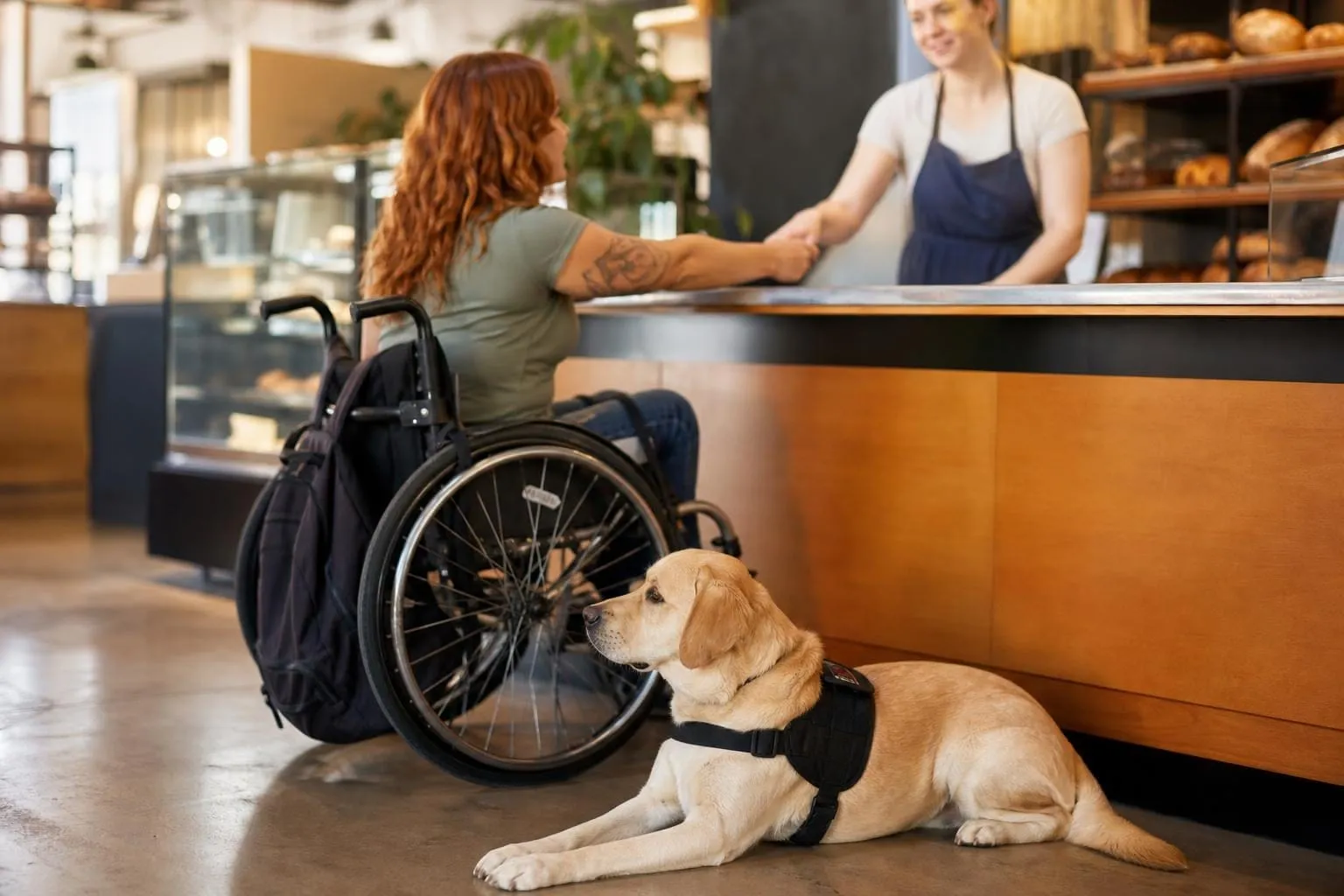
Psychiatric service dogs are allowed in all public places in California: restaurants, retail stores, hospitals, public transit, hotels, theaters, government buildings, and more. This right comes from both the federal ADA and California Civil Code §§ 54.1–54.2. Emotional support animals do not have public access rights.
When a business wrongly denies access, the handler can file a complaint with the Department of Justice (federal) or the California Civil Rights Department (state). Both avenues carry real consequences for the business.
When it’s not obvious that a dog is a service animal, businesses and their staff may ask only two questions: (1) Is this a service animal required because of a disability? (2) What task has the dog been trained to perform? They cannot ask about the handler’s specific disability, require documentation, or demand a demonstration of the task.
Knowing proper etiquette around service dogs helps both handlers and the public navigate these interactions smoothly.
Under both the federal FHA and California’s FEHA, landlords must provide reasonable accommodations for tenants with disabilities who use assistance animals. For a psychiatric service dog, this means waiving no-pet policies, not charging pet deposits or pet rent, and not applying breed or weight restrictions.
Landlords can request documentation (a PSD letter) and verify the clinician’s license. They cannot ask about your specific diagnosis, demand medical records, or require the dog to wear a vest or ID.
PSD handlers cannot be charged pet deposits, pet fees, or monthly pet rent. Service dogs are classified as medical equipment under the law, not pets. A landlord can deduct from the standard security deposit if the dog causes damage to the property, but that applies the same way any tenant damage would. No additional deposit is permitted.
Breed bans, weight limits, and size restrictions do not apply to psychiatric service dogs in housing. A landlord who maintains a “no pit bulls” or “dogs under 25 pounds only” policy cannot enforce it against a PSD handler. This protection comes from the FHA’s reasonable accommodation requirement and is reinforced by FEHA in California.
The ADA permits handlers to train their own psychiatric service dog. No professional trainer or program is required. The dog must simply be trained to perform at least one task that directly mitigates the handler’s disability. Many handlers combine self-training with occasional professional guidance.
On Reddit’s r/service_dogs, experienced handlers frequently share detailed training logs and tips for owner-training. The consensus is that it’s entirely legal and practical, though it requires patience and consistency. Typical owner-training costs run $1,000 to $3,000 for resources, equipment, and supplies.
One of the most common psychiatric service dog tasks. The dog applies its body weight (by lying across the handler’s lap or chest) during a panic attack, anxiety episode, or PTSD flashback. The physical pressure activates the parasympathetic nervous system and can reduce heart rate and cortisol levels. This is a trained, deliberate behavior, not casual cuddling.
Grounding tasks bring the handler back to present reality during dissociative episodes or flashbacks. The dog might lick the handler’s face, paw at their hands, sit on their feet, or press against their body. The American Psychiatric Association has documented these tasks in the context of PTSD treatment, noting that the dogs are trained to respond to specific behavioral cues from the handler.
The dog positions its body between the handler and other people, creating physical space in crowded environments. This task is particularly common for handlers with PTSD, severe anxiety, or agoraphobia. A related task called “cover” or “watch back” involves the dog positioning behind the handler and alerting them if someone approaches from behind.
Research from Purdue University found that PTSD service dogs performing these tasks contributed to reduced symptom severity and improved social functioning.
A psychiatric service dog trained by a professional organization before being placed with a handler. These dogs typically cost $15,000 to $30,000 and come with extensive training in task work, public access behavior, and handler bonding protocols. Professional training for your own dog (where a trainer works with a dog you already own) is less expensive, typically $3,000 to $10,000. Ongoing annual costs for any PSD, including veterinary care, food, preventive medications, and equipment, average $2,000 to $5,000.
No federal or California law requires a psychiatric service dog to be registered in any database. There is no government PSD registry. Voluntary registration services exist and can provide a searchable ID number, printable certificates, and identification materials, but these are convenience tools, not legal mandates. Handlers on Reddit’s r/service_dogs regularly confirm this while noting that voluntary IDs and gear can reduce day-to-day confrontations with gatekeepers.
No government certification program exists for psychiatric service dogs at either the federal or state level. Any website claiming to offer “official” or “government-approved” PSD certification is misrepresenting the law. What matters legally is the dog’s training and the handler’s qualifying disability, not a certificate.
Neither the ADA nor California law requires a psychiatric service dog to wear a vest, harness, or ID tag. Many handlers choose to use visual identifiers because they signal to the public that the dog is working, which tends to reduce uninvited interactions and access challenges. But it’s a personal choice, not a legal obligation.
Misrepresenting a pet as a service dog is a criminal offense in California under Penal Code § 365.7. Penalties include up to $1,000 in fines, up to six months in county jail, and potential court-ordered community service. This law protects legitimate handlers by creating real consequences for fraud.
Most guides on psychiatric service dogs in California skip this point, but it’s significant. The federal ADA requires a disability that “substantially” limits one or more major life activities. California’s Disabled Persons Act drops that word entirely. The practical result: a person who might not clear the federal threshold could still qualify as disabled under California state law, giving them state-level PSD protections (public access under Civil Code §§ 54.1–54.2, housing under FEHA) even if the ADA analysis is less certain.
This is one of several ways California law expands on federal protections rather than merely mirroring them.
The May 2026 HUD guidance change is the most significant development in assistance animal law in years. HUD now uses the ADA definition of service animal when evaluating housing discrimination complaints, which means only animals trained to perform specific tasks get federal housing enforcement backing through HUD.
For psychiatric service dog handlers in California, this changes nothing in practice because your dog already meets the trained-task standard. If anything, your protection got stronger relative to ESA holders, because landlords and property managers now have even less legal footing to push back against a task-trained PSD.
For ESA holders in California, the news is more nuanced. Federal enforcement through HUD is weaker, but California’s FEHA continues to prohibit housing discrimination against tenants with disability-related ESAs. The state safety net holds. Still, multiple practitioners now recommend that anyone who qualifies for a PSD (meaning their dog performs trained tasks) obtain a PSD letter rather than an ESA letter, because it provides the broadest protection across all contexts: housing, public access, and air travel.
View PSD housing letter requirements
No. AB 468’s 30-day therapeutic relationship requirement applies only to emotional support animal letters. Psychiatric service dog letters are exempt because PSDs are classified as service animals under the ADA, not emotional support animals. Your clinician can issue a PSD letter without a 30-day wait.
No. Under both federal and California law, a psychiatric service dog is not a pet. Landlords cannot charge pet deposits, pet fees, or monthly pet rent. They also cannot apply breed or weight restrictions. If the dog causes property damage, the landlord may deduct from your standard security deposit, but no additional animal-specific deposit is allowed.
Yes. The ADA does not require professional training. You can train your own dog to perform tasks that mitigate your psychiatric disability. The key is that the dog must reliably perform at least one specific trained task. Many handlers supplement self-training with professional sessions for complex tasks like deep pressure therapy or public access behavior.
HUD rescinded its longstanding ESA enforcement guidance and replaced it with a standard that aligns with the ADA’s service animal definition. HUD now evaluates housing discrimination complaints based on whether the animal is trained to perform specific tasks. Psychiatric service dogs meet this standard and remain fully protected. ESA holders lost federal HUD enforcement backing, though California’s FEHA still protects ESAs independently at the state level.
Any trained behavior that directly mitigates a psychiatric disability counts. Common examples include deep pressure therapy during panic attacks, grounding during dissociative episodes, medication reminders, nightmare interruption, crowd buffering, alerting to anxiety onset, and guiding a disoriented handler to safety. The task must be a learned behavior, not the dog’s natural temperament or presence.
No. There is no federal or state registration requirement for service dogs. Voluntary registration services exist and can provide identification materials, but they confer no additional legal rights. What matters legally is the dog’s training and your qualifying disability.
Businesses are limited to two questions: (1) Is this a service animal required because of a disability? (2) What task has the dog been trained to perform? They cannot ask for documentation, require a demonstration, or inquire about your specific diagnosis. If the answers confirm it’s a task-trained service dog, the business must allow access.
If you qualify for a PSD (meaning you have a psychiatric disability and a task-trained dog), a PSD letter provides broader protection. It covers housing, public access, and air travel. After HUD’s May 2026 guidance shift, a PSD letter also carries stronger federal housing enforcement backing than an ESA letter. An ESA letter still provides California state-level housing protection under FEHA, but it does not grant public access or air travel rights.

Copyright © 2020 USA Service Dog. All rights reserved.