California residents can get a psychiatric service dog (PSD) letter through a licensed mental health professional, and unlike ESA letters, PSD letters are not subject to California’s 30-day waiting period under AB 468. After HUD’s May 2026 guidance change, a PSD letter now provides the strongest housing protection available because psychiatric service dogs remain fully protected under the ADA and Fair Housing Act. This guide walks through every term, law, and step California PSD letter seekers need to know.
California has the most complex set of assistance animal rules in the country. Between the state’s AB 468 law, the federal ADA, the Fair Housing Act, and HUD’s May 2026 guidance change, figuring out how to get a psychiatric service dog letter while living in California can feel overwhelming. Most guides online either blur the line between ESA and PSD documentation or skip California-specific details entirely.
This guide fixes that. It covers every key concept, law, and practical step in a scannable glossary format, so you can find exactly what you need fast.
One fact matters more than any other, so it goes right here: California’s 30-day waiting period (AB 468) applies to ESA letters, not PSD letters. If you qualify for a psychiatric service dog, you do not need to wait 30 days to receive your documentation. Most competitors bury this or get it wrong.
If you’re ready to start the process, you can review PSD housing letter requirements to see what a legitimate PSD letter should include.
A psychiatric service dog is a dog individually trained to perform specific tasks that mitigate a handler’s psychiatric disability. The critical word is “trained.” A dog that provides comfort simply by being present is an emotional support animal. A dog trained to perform deep pressure therapy during a panic attack, interrupt self-harm behaviors, or search a room for someone with PTSD is a psychiatric service dog.
PSDs hold the same legal status as any other service dog under the Americans with Disabilities Act. They can accompany their handlers in restaurants, stores, hospitals, and any other place the public is allowed. They can also fly in aircraft cabins and live in no-pets housing. For more on the differences between service animals and emotional support animals, that distinction is worth understanding fully.
California-specific note: California does not require PSDs to be professionally trained. Owner-training is fully legal. The dog must be trained to perform at least one task directly related to the handler’s psychiatric disability.
A PSD letter is a document from a licensed mental health professional (or other qualified healthcare provider) that confirms two things: the handler has a psychiatric disability, and the dog is trained to perform tasks that mitigate that disability. This letter is typically needed for housing accommodations and can also support air travel requests.
A legitimate PSD letter should include:
Confirmation of a diagnosed mental or emotional disability
A statement that the dog performs trained tasks related to the disability
The provider’s full name, license number, license type, jurisdiction, and contact information
Professional letterhead, a signature, and a recent date
California-specific note: Because a PSD is a service animal (not an emotional support animal), a PSD letter is not subject to AB 468’s 30-day waiting period. A California-licensed provider can issue one after a proper evaluation without the mandatory delay. You can see example letter templates to understand what landlords expect.
An ESA letter is a document from a licensed mental health professional confirming that a person has an emotional or mental disability and that an emotional support animal is part of their treatment plan. ESA letters are used almost exclusively for housing accommodations. Since January 2021, airlines are no longer required to accommodate ESAs in the cabin.
California-specific note: Under AB 468, ESA letters require a minimum 30-day therapeutic relationship between the client and the provider. This is the law that makes “instant” California ESA letters illegal.
Feature | PSD Letter | ESA Letter |
|---|---|---|
Training required? | Yes, task-trained | No |
Public access (stores, restaurants)? | Yes (ADA) | No |
Housing protection? | Yes (FHA + FEHA) | Yes (FEHA in CA; FHA protection limited after HUD 2026) |
Air travel? | Yes (ACAA, with DOT form) | No (since Jan. 2021) |
CA 30-day rule (AB 468)? | Does not apply | Applies |
Provider must be CA-licensed? | Best practice | Required by statute |
AB 468, codified as Health & Safety Code § 122318, took effect January 1, 2022. It was California’s response to the flood of fraudulent ESA letters from “instant letter” websites. The law requires:
A licensed mental health professional must establish a minimum 30-day client-provider relationship before issuing an ESA letter
The letter must include specific information: disability confirmation, treatment plan statement, provider’s full name, license number, license type, and jurisdiction
Sellers of animals cannot require or include ESA documentation in a sale
Violations carry penalties for both providers and businesses
AB 468 targets ESA letters specifically. It does not regulate psychiatric service dog documentation. This distinction is the single most important fact for anyone researching how to get a psychiatric service dog letter while living in California, yet most online guides fail to make it clear.
The 30-day rule is shorthand for AB 468’s requirement that a licensed mental health professional maintain a therapeutic relationship with a patient for at least 30 days before writing an ESA letter. California is one of a growing number of states (along with Arkansas, Iowa, Louisiana, and Montana) that mandate an established provider relationship before ESA documentation can be issued.
This rule does not apply to PSD letters. Multiple legal sources confirm that psychiatric service dog letters fall outside the scope of AB 468 because PSDs are service animals under the ADA, not emotional support animals. If you already have a qualifying psychiatric condition and a task-trained dog, a California-licensed provider can evaluate you and issue a PSD letter without a 30-day delay.
Practitioners on Reddit’s r/service_dogs frequently discuss this confusion. Community members note that anyone offering “instant” California ESA letters is breaking the law, but they also point out that PSD documentation sits in a different legal category entirely. The common advice: start a provider relationship early rather than scrambling at a housing deadline, even if the 30-day rule doesn’t technically apply to your situation.
California’s FEHA is an independent state law that requires housing providers to offer reasonable accommodations for disabled people with assistance animals. This includes both service animals and emotional support animals.
Why does this matter? Because FEHA is enforced by California’s Civil Rights Department (CRD), a state agency that operates entirely independently of HUD and federal policy. Even after HUD’s May 2026 guidance change (discussed below), California’s protections remain intact. For disabled Californians, state law is your floor, not federal law.
FEHA protections are not conditioned on whether an animal is trained. This means ESA owners in California still have state-level housing rights regardless of what happens at the federal level. That said, a PSD letter still provides the broadest set of rights (housing, public access, and air travel), making it the stronger document for those who qualify.
If you’re wondering what evidence HUD requires for assistance animal accommodations, that’s worth reviewing alongside your understanding of FEHA.
Representing a pet as a service dog is a misdemeanor in California. The maximum penalty is up to six months in jail and a fine of up to $1,000. This law exists to protect the rights of people with genuine disabilities and their trained service animals.
The existence of this penalty is one more reason to get proper documentation. A legitimate PSD letter from a licensed provider protects you from accusations of fraud and gives landlords, businesses, and airlines confidence that your dog is what you say it is. When a veteran was denied access at a Days Inn with a service dog, the resulting fallout showed how seriously access rights are enforced in both directions.
The ADA is the federal law that grants psychiatric service dogs the same public access rights as any other service dog. Under ADA regulations, when you enter a business or public space, staff can only ask two questions:
Is the dog a service animal required because of a disability?
What work or task has the dog been trained to perform?
They cannot ask about your diagnosis, request documentation, or require your dog to demonstrate a task. They also cannot charge extra fees for your service dog.
California-specific note: California’s Unruh Civil Rights Act and Disabled Persons Act provide additional state-level public access protections that parallel and sometimes exceed the ADA.
The Fair Housing Act requires housing providers to make reasonable accommodations for tenants with disabilities who need assistance animals. This has historically covered both service dogs and ESAs. Landlords cannot charge pet deposits or pet rent for an assistance animal, and they cannot deny housing based on breed, size, or weight restrictions that would otherwise apply.
Housing denials still happen, though. In one notable case, a Colorado couple was awarded $50,000 after their HOA refused to allow their emotional support animal. These enforcement actions demonstrate that violations carry real consequences. A legitimate, well-documented PSD letter is your best protection against this kind of landlord pushback.
On May 22, 2026, the U.S. Department of Housing and Urban Development issued new guidance that fundamentally altered the federal housing picture for assistance animals. HUD rescinded its 2020 statement on emotional support animals and announced it will no longer accept complaints from individuals whose animals are not “individually trained to perform work or tasks directly related to the person’s disability.”
In plain terms: HUD now only enforces housing complaints for animals that meet the ADA definition of a service animal. Emotional support animals, which provide comfort through companionship rather than trained tasks, lost their federal HUD complaint pathway.
What this means for PSD letter seekers in California: Psychiatric service dogs keep full protection everywhere. Because a PSD is trained to perform tasks, it meets the standard HUD now applies. A PSD letter is the strongest, most portable housing document you can have after this change.
What this means for ESA owners in California: California’s FEHA still independently protects ESA owners at the state level. Your rights under state law remain intact. But if you move out of California to a state without similar protections, an ESA letter alone may no longer be enough for a federal housing complaint. This is a major reason to consider whether a PSD letter might be the better path if your animal can be task-trained.
No other page currently ranking for how to get a psychiatric service dog letter while living in California covers this HUD change in depth. It’s the most significant shift in assistance animal housing policy in years.
The ACAA governs service animals on flights. Since January 2021, airlines are only required to accommodate trained service dogs (not ESAs) in the cabin. Handlers must typically complete a DOT Service Animal Transportation Form attesting that the dog is trained, vaccinated, and housebroken.
A PSD letter supports your flight request alongside the DOT form. Most airlines accept both documents together as verification. ESAs have no flight access rights under current federal rules.
A psychiatric service dog qualifies handlers who have a DSM-5-recognized psychiatric condition that substantially limits one or more major life activities AND a dog trained to perform tasks that mitigate that disability. Common qualifying conditions include:
PTSD
Severe anxiety disorders (generalized anxiety, social anxiety)
Major depressive disorder
Obsessive-compulsive disorder (OCD)
Panic disorder
Bipolar disorder
Autism spectrum disorder
The test is functional, not a fixed list. If your condition substantially limits your daily functioning and a trained dog can help mitigate it, you may qualify. A licensed mental health professional makes this determination during your evaluation. Research continues to confirm the value of service dogs for PTSD and other psychiatric conditions.
For a broader look at conditions a service dog helps with, that resource covers the full range.
The task is what makes a dog a psychiatric service dog. Without at least one trained task, the dog is legally an emotional support animal. Common PSD tasks include:
Deep pressure therapy (DPT): Applying body weight during panic attacks or anxiety episodes
Room searches: Checking rooms and spaces for threats (common for PTSD handlers)
Medication retrieval and reminders: Bringing medication at scheduled times or when symptoms emerge
Nightmare interruption: Waking the handler during night terrors
Anxiety interruption and grounding: Nudging, pawing, or licking to redirect attention during dissociative or anxiety episodes
Creating physical barriers: Blocking people from approaching too closely in crowds
Balance support: Providing stability when medication side effects cause dizziness
Interrupting harmful or compulsive behaviors: Physically redirecting repetitive or self-injurious actions
Guiding to exits: Leading the handler out of overwhelming environments during sensory overload
Retrieving help: Alerting another person or bringing a phone during emergencies
When asked the ADA’s second question (“What task has the dog been trained to perform?”), you should be able to name at least one specific task from this list or something similar.
To issue a PSD letter in California, the provider should be a licensed mental health professional or other qualified healthcare provider. This includes:
Licensed Clinical Social Workers (LCSW)
Licensed Marriage and Family Therapists (LMFT)
Licensed Professional Clinical Counselors (LPCC)
Psychiatrists (MD or DO)
Licensed Psychologists (PhD or PsyD)
California-specific note: For ESA letters, AB 468 explicitly requires the provider to be licensed in California. While the same statute doesn’t technically govern PSD letters, using a California-licensed provider is strongly recommended. Landlords who receive letters from out-of-state providers often push back, and a California license is verifiable in the state’s public licensing databases.
Understanding what credentials telehealth clinicians should list on letters helps you vet any provider before committing.
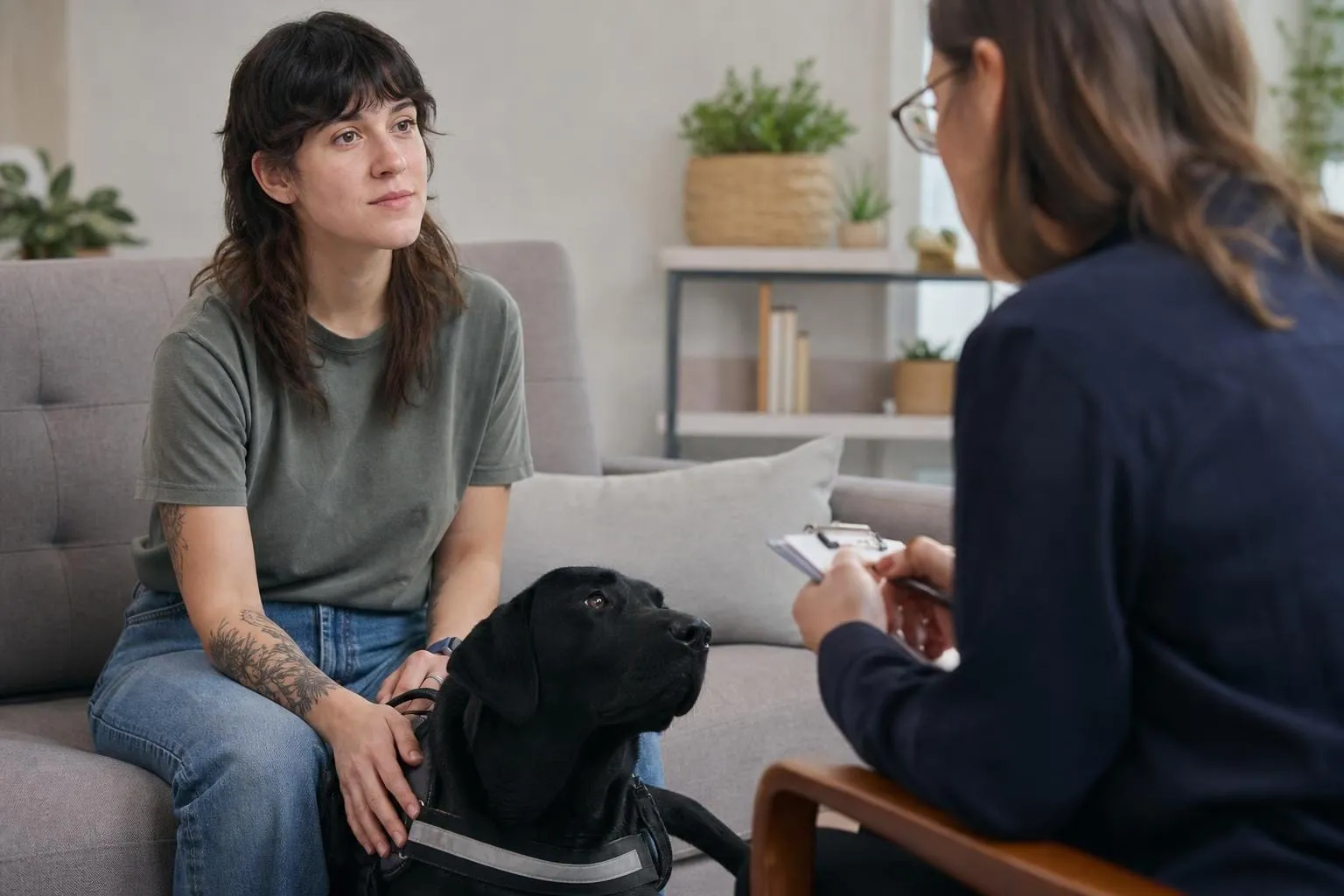
California allows licensed mental health professionals to conduct PSD evaluations via telehealth (phone or video). This is how most people pursuing how to get a psychiatric service dog letter while living in California actually complete the process, especially those in rural areas or with conditions that make in-person visits difficult.
A legitimate telehealth evaluation should:
Be conducted by a provider licensed in California
Include a clinical interview about your symptoms, functioning, and the dog’s trained tasks
Result in a letter on professional letterhead with full provider credentials
Feel like a real clinical appointment, not a 5-minute checkbox exercise
If a provider asks no clinical questions and promises a letter in minutes, that is a red flag.
Because fake letters are common, many landlords have become sophisticated at verification. Here’s what they typically do:
License check: They look for the provider’s name, license type, license number, state, and expiration date, then confirm it in a public licensing database
Letter format: They verify it’s on professional letterhead, signed, dated within the last year, and includes contact information
Timeliness: Stale or expired letters trigger pushback. Keep your documentation current.
Follow-up calls: Some landlords call the provider’s office to confirm the letter is legitimate. They cannot ask about your diagnosis, only whether the letter was issued.
A landlord can ask for documentation. A landlord cannot ask what your specific diagnosis is, demand details about your treatment, or require your dog to demonstrate tasks. If you want to understand whether a landlord can deny an assistance animal request and when, that’s covered separately.
The Department of Transportation requires airlines to allow handlers to complete a Service Animal Transportation Form before flying with a service dog. The form asks you to attest that the dog is trained, vaccinated, and housebroken. Airlines may require this form 48 hours before departure.
A PSD letter is not always required for flights (the DOT form is the primary document), but having one adds credibility and can resolve disputes at the gate. ESAs are not covered by this process.
If you’re considering the full process of getting a psychiatric service dog, training costs vary widely:
Training Path | Estimated Cost |
|---|---|
Pre-trained PSD from an organization | $15,000 to $30,000 |
Professional trainer for your own dog | $3,000 to $10,000 |
Owner-training (resources, equipment, supplies) | $1,000 to $3,000 |
Owner-training is legal in California and throughout the U.S. No certification, registration, or professional trainer stamp is required by law. The dog simply needs to be trained to perform at least one task related to your disability and behave appropriately in public.
There is no official government registry for service dogs or emotional support animals in the United States. Not at the federal level, not in California, not anywhere. Any website claiming to “register” or “certify” your service dog through an official government database is misleading you.
That said, voluntary registries do exist and can serve a practical purpose. A registration ID, certificate, or vest can reduce day-to-day confrontations with business owners, landlords, or airline staff who don’t understand ADA law. These items are friction-reducing tools, not legal documents. They confer no additional legal rights. Learn how to spot fake ESA letters and understand what actually carries legal weight.
Red flags for California residents:
“Get your ESA letter today!” with no mention of the 30-day rule. If a site promises an instant California ESA letter, it’s either breaking AB 468 or it doesn’t understand the law.
No clinical evaluation. A legitimate letter requires a real conversation with a licensed provider. If you just fill out a form and receive a letter without speaking to anyone, the letter is likely worthless.
No verifiable license information. The letter should include the provider’s name, license type, license number, and California jurisdiction. If any of these are missing, landlords will reject it.
Provider not licensed in California. Out-of-state clinicians generally cannot issue ESA documentation for California residents under AB 468. For PSD letters, a California license isn’t technically required by statute, but using an out-of-state provider invites pushback.
“Official registration” bundled with the letter. If a site sells a “registration” as though it’s legally required alongside a letter, that’s a sign they’re prioritizing upsells over accuracy.
Practitioners on Reddit consistently warn that the biggest tell is price combined with speed. A $50 letter that arrives in 10 minutes with no conversation is almost certainly not legitimate in California.
Bringing it all together, here’s the actual process:
Step 1: Confirm you have a qualifying condition. You need a DSM-5-recognized psychiatric condition that substantially limits your daily life. If you’re already seeing a therapist or psychiatrist, you may already have this documentation.
Step 2: Ensure your dog is task-trained (or in training). Your dog must be trained to perform at least one specific task that mitigates your disability. Owner-training counts.
Step 3: Connect with a California-licensed mental health professional. This can be your existing provider or a new one. Telehealth evaluations are valid and widely used.
Step 4: Complete a clinical evaluation. The provider will assess your condition, discuss how your dog’s tasks relate to your disability, and determine whether a PSD letter is clinically appropriate.
Step 5: Receive your PSD letter. Because the 30-day rule does not apply to PSD letters, you can receive your documentation after the evaluation without a mandated waiting period.
Step 6: Keep your documentation current. Landlords check dates. Renew your letter annually or whenever you change providers.
To begin the process today, review the PSD housing letter requirements and understand exactly what your letter should contain.
No. California’s AB 468 and its 30-day therapeutic relationship requirement apply specifically to ESA letters. PSD letters are documentation for service animals under the ADA and are not subject to this waiting period. A qualified California-licensed provider can issue a PSD letter after a proper clinical evaluation.
Yes. California permits licensed mental health professionals to conduct PSD evaluations via phone or video call. The provider must be licensed in California (or at minimum licensed to practice in the state), and the evaluation should be a genuine clinical appointment, not a quick form submission.
A PSD letter documents that you have a psychiatric disability and that your dog is task-trained to mitigate it. It grants public access rights (ADA), housing rights (FHA and FEHA), and air travel rights (ACAA). An ESA letter only covers housing and requires no training. After HUD’s May 2026 guidance, PSD letters provide significantly stronger federal housing protection.
Landlords must provide reasonable accommodations for psychiatric service dogs under both the Fair Housing Act and California’s FEHA. They cannot charge pet fees or apply breed/weight restrictions. They can request documentation (your PSD letter) and verify the provider’s license. They cannot ask about your specific diagnosis.
No. There is no official or required registration for service dogs in the United States. Voluntary registration, ID cards, and vests can reduce friction in daily interactions but do not confer any legal rights beyond what the ADA and state law already provide.
PSD letter costs vary by provider. Telehealth evaluations for PSD letters typically range from $100 to $250. This is separate from the cost of training the dog itself, which can range from $1,000 (owner-training) to $30,000 (pre-trained dog from an organization).
Your dog must be trained to perform at least one task directly related to your psychiatric disability. Examples include deep pressure therapy, nightmare interruption, room searches, medication reminders, anxiety grounding, creating physical barriers in crowds, and guiding you to exits during sensory overload.
Psychiatric service dogs are fully protected under the new HUD guidance because they meet the trained-task requirement. The change primarily affects ESA owners at the federal level. In California, state FEHA protections still cover ESAs independently, but a PSD letter remains the stronger, more portable document for anyone who qualifies.

Copyright © 2020 USA Service Dog. All rights reserved.