
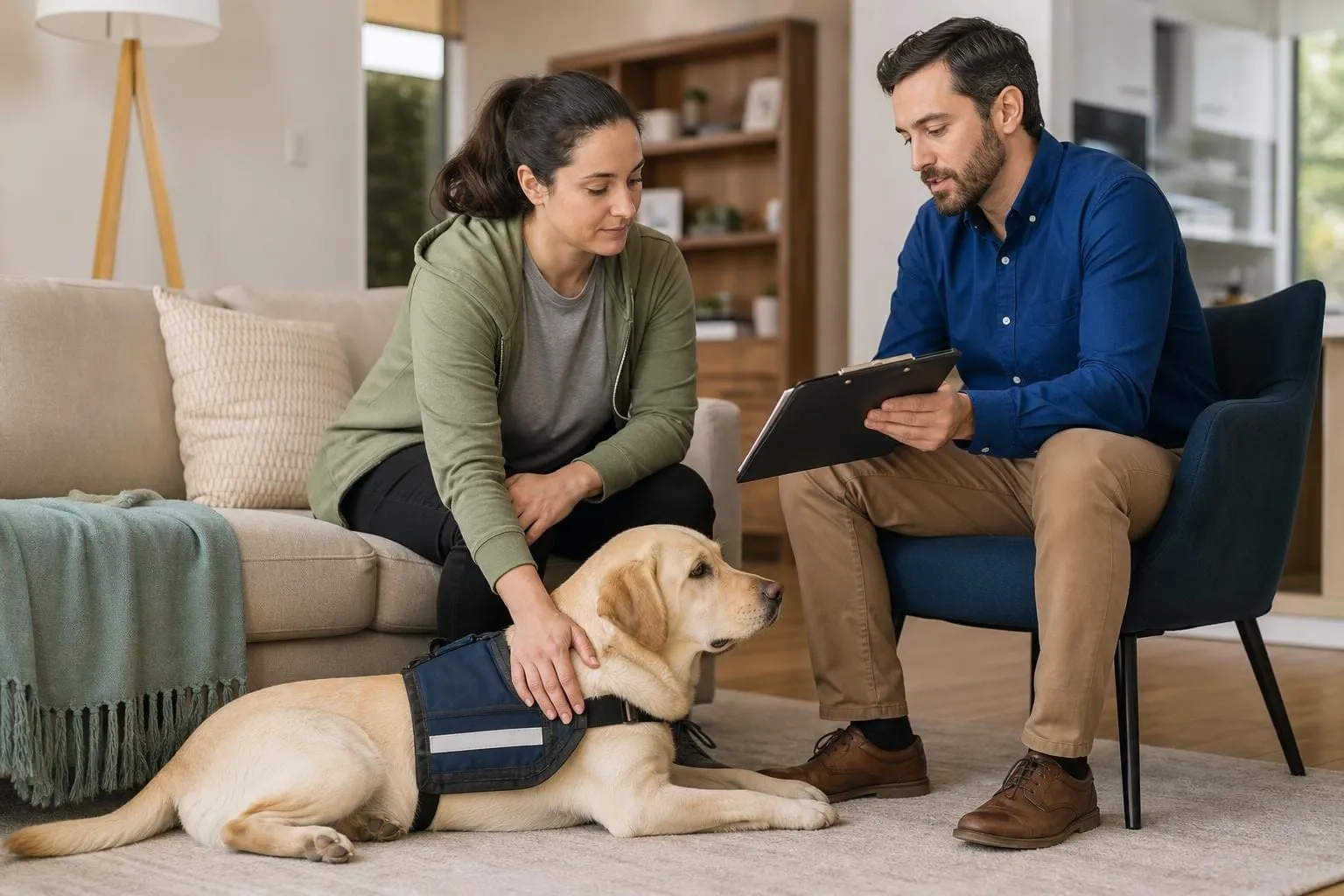
A service dog letter for a landlord is a document from a licensed healthcare provider confirming your disability and your need for a service dog. For task-trained service dogs, this letter is legally optional under the Fair Housing Act but practically valuable when renting. For emotional support animals, a letter is typically required. A valid letter must include the provider’s credentials, a statement of disability (without naming the diagnosis), and a statement connecting the animal to your disability-related need. The legal ground shifted in 2025 and 2026 with HUD guidance changes, making proper documentation more important than ever.
A service dog letter for a landlord is a document written by a licensed healthcare provider that confirms two things: you have a disability as defined by the Fair Housing Act, and your service dog is needed because of that disability.
Here is the part that surprises most people: if your dog is a fully trained service dog, you are not legally required to provide this letter. Under the FHA and ADA, a landlord can only ask two questions: (1) Is the animal required because of a disability? and (2) What task or work has it been trained to perform? No paperwork is mandatory.
So why bother with a letter at all?
Because in practice, having one makes the process smoother. Housing providers can request reliable documentation to confirm a tenant’s disability and need for a service animal, and a well-written letter preempts disputes before they start. It reduces friction during the application process, gives your landlord something concrete to file, and protects you if questions come up later.
For emotional support animals (ESAs), the situation is different. ESA owners should submit a letter from a licensed healthcare professional. Landlords are entitled to see a valid ESA letter before accommodating an ESA in a no-pets building. If you are unsure whether your animal qualifies as a service dog or ESA, understanding service animal vs. ESA differences is the critical first step.
Need an ESA or PSD letter? See how the process works →
Before looking at a service dog letter for a landlord example, it helps to speak the same language as the law. These are the terms that come up repeatedly in housing accommodation requests.
Service dog. Under the ADA, a service dog is a dog individually trained to perform specific tasks for a person with a disability. Guiding a blind person, alerting to seizures, interrupting panic attacks, and retrieving dropped items are all examples of trained tasks.
Emotional support animal (ESA). An ESA provides comfort and companionship through its presence. No task training is required. ESAs have housing protections under the FHA but not public access rights under the ADA.
Psychiatric service dog (PSD). A subset of service dog, trained to perform tasks specifically related to a psychiatric disability. A PSD that performs deep pressure therapy during a panic attack or alerts its handler to dissociative episodes is task-trained and has the same legal status as any other service dog. Research confirms service dogs provide measurable benefits for PTSD and other psychiatric conditions, which is precisely why PSDs exist as a recognized category.
Reasonable accommodation. A change to a housing provider’s rules, policies, or practices that gives a person with a disability equal opportunity to use and enjoy their home. Waiving a no-pets policy for an assistance animal is the most common example.
Fair Housing Act (FHA). The federal law prohibiting housing discrimination on the basis of race, color, religion, sex, familial status, national origin, and disability. It is the legal foundation for assistance animal housing rights.
Assistance animal. The FHA’s umbrella term that covers both service dogs and emotional support animals. If your animal falls under this umbrella, your landlord must consider a reasonable accommodation request.
LMHP (Licensed Mental Health Professional). The type of provider qualified to write ESA and PSD letters. This includes licensed psychologists, psychiatrists, clinical social workers, licensed professional counselors, and similar professionals. The specific credentials matter, as explored in what credentials clinicians list on ESA letters.
HUD. The U.S. Department of Housing and Urban Development. HUD oversees federal fair housing enforcement and issues guidance that shapes how landlords handle accommodation requests.
Interactive process. The back-and-forth communication between a tenant and landlord to work out a reasonable accommodation. This is not a one-sided demand. It is a conversation, and both parties are expected to participate in good faith.
Whether you are writing a letter for a service dog, a psychiatric service dog, or an emotional support animal, the core elements are the same. A service dog letter for a landlord example that would hold up under scrutiny needs to contain all of the following.
Provider’s full name, license type, license number, and state of licensure. This is how a landlord verifies the letter is real. A letter from “Dr. Smith” with no license number is essentially worthless.
Professional letterhead with contact information. The letter should be printed on (or formatted to match) the provider’s official letterhead, including their office address, phone number, and email.
Statement that you are their patient/client. The provider must confirm an established clinical relationship with you.
Statement that you have a disability as defined by the FHA. This means a physical or mental impairment that substantially limits one or more major life activities or bodily functions. The letter should say this clearly.
Statement connecting the animal to the disability. The provider should state that the service dog or assistance animal is needed to alleviate one or more symptoms of the disability, or that it performs tasks related to the disability.
Date and provider’s signature. Both are essential. An undated letter raises immediate red flags.
The #1-ranking nonprofit resource for service dog letters, Psychiatric Service Dog Partners, recommends the following wording as a starting point for housing letters:
“[Client’s full name] is my client, whom I am treating for a physical or mental impairment that substantially limits one or more major life activities or bodily functions. I support their use of a dog as an assistance animal.”
This language, placed on the provider’s letterhead with their license information and signature, covers the legal bases without overreaching.
This is just as important as what goes in. A valid service dog letter for a landlord should never contain:
Your specific diagnosis. Psychiatric Service Dog Partners, a widely cited nonprofit in the service dog community, specifically advises against including a diagnosis because “it is unnecessary and can invite discrimination or uncomfortable conversation.” The FHA does not require it.
Detailed medical records or treatment history. Your landlord has no right to this information.
Opinions about the dog’s training status. PSD letters sometimes explicitly state that the healthcare provider is not giving an opinion about the handler’s training or the dog’s readiness for public access. That assessment falls to the trainer, not the clinician.
If you want a fuller picture of qualifying disabilities, common conditions a service dog can help with provides a useful overview without the clinical detail that should stay out of your letter.
Most guides on this topic blur two distinct documents together. Knowing the difference matters.
This is a letter or written request from you (the tenant) to your landlord or property manager. It says, essentially: “I have a disability, I need a reasonable accommodation to keep my service dog/assistance animal, and I am providing documentation from my healthcare provider.”
This letter should include:
Your name and unit/property address
A clear statement that you are requesting a reasonable accommodation under the FHA
A reference to the enclosed provider letter
Your contact information for follow-up
This is the letter from your licensed healthcare professional. It is the documentation that backs up your request. It contains all the elements listed in the section above (license info, disability statement, animal-need statement, signature, date).
Both documents work together. You write the first one. Your provider writes the second. Submitting both at once gives your landlord everything they need to process the request.
Psychiatric Service Dog Partners recommends that service dog users bring the exact text of the letter they want written to their provider’s office and ask the provider to put that text on their letterhead and sign it. The reasoning: “Many providers inadvertently make little alterations, which can lead to a big legal difference.” Giving your provider a clean template to work from reduces the risk of a well-meaning but legally problematic revision.
These three letter types serve different purposes. The table below breaks it down.
Feature | Service Dog Letter | ESA Letter | PSD Letter |
|---|---|---|---|
Who writes it | Any licensed healthcare provider | Licensed mental health professional | Licensed mental health professional |
What it confirms | Disability + task-trained animal | Disability + emotional support need | Psychiatric disability + task-trained animal |
Legally required for housing? | No (but useful) | Yes, typically | No (but useful) |
Governing law | ADA + FHA | FHA | ADA + FHA |
Animal must be task-trained? | Yes | No | Yes |
Post-2026 HUD enforcement | Largely unaffected | Reduced federal enforcement for untrained animals | Largely unaffected |
The bottom row of that table is critical. After the May 2026 HUD enforcement memo, the distinction between a task-trained animal and an untrained companion animal carries more practical weight than ever. More on that below.
Learn what evidence HUD requires for assistance animals →
Understanding the landlord’s side helps you prepare a stronger accommodation request.
Ask the two ADA questions for service dogs: Is this animal required because of a disability? What task or work has it been trained to perform?
Request documentation (a letter from your healthcare provider) if the disability or need is not obvious.
Verify the provider’s credentials by looking them up on their state licensing board’s database.
Contact the provider’s office (with your permission) to confirm the letter was issued.
Deny the request if the documentation is clearly fraudulent, the animal poses a direct threat, or the animal would cause substantial physical damage that cannot be reduced through reasonable measures.
Ask about your specific diagnosis or treatment details.
Require medical records.
Demand a demonstration of the dog’s tasks.
Require registration, certification, a vest, or an ID card. None of these are legally required.
Charge pet deposits or pet rent for a legitimate assistance animal. (The ESA letter and pet fee question is one of the most common points of confusion for renters.)
Ignore or indefinitely delay the request. Ten business days has become the industry standard response window, and indefinite delay is treated the same as denial under fair housing law.
Landlords who wrongfully deny a service dog or ESA accommodation face serious consequences. Federal civil penalties start at up to $25,068 for a first violation, climb to $62,669 for a second violation within five years, and can reach $125,337 for a third violation within seven years. In one real case, a Colorado couple was awarded $50,000 after their HOA refused their emotional support animal. And businesses beyond housing face consequences too, as demonstrated when a Days Inn denied a veteran access with his service animal.
Having a good service dog letter for a landlord example in hand is only half the battle. How you submit it matters.
Step 1: Prepare the provider letter. Bring the template text to your provider’s office. Ask them to put it on their letterhead, review it, and sign it. Make sure it contains every required element outlined above.
Step 2: Write your accommodation request. Draft a brief, professional letter to your landlord or property management company. State that you are requesting a reasonable accommodation under the Fair Housing Act. Reference the enclosed provider letter.
Step 3: Submit everything in writing. Email is usually best because it creates a timestamp. If you submit by mail, use certified mail with a return receipt. Keep copies of everything.
Step 4: Track the response window. Your landlord should respond within 10 business days. Mark the date on your calendar.
Step 5: Follow up if needed. If you have not heard back within the response window, send a polite follow-up in writing. Reference your original request date and ask for a status update.
Step 6: Know your escalation path if denied. If your landlord denies the request or refuses to engage:
File a complaint with HUD (you can do this online at HUD.gov)
Contact your state’s fair housing agency
Consult a disability rights attorney
Note that 52.61% of all fair housing complaints involve disability discrimination, so enforcement agencies are familiar with these cases
Federal law sets the floor, but some states build higher walls.
California has some of the strictest rules in the country. AB 468, effective since 2022, requires that anyone providing support animal documentation must hold an active license in California, have an established relationship with the client (commonly 30 days minimum), and disclose specific information in the letter itself. California Health and Safety Code Section 365.7 was one of the first service animal fraud laws in the country. If you live in California and need a letter quickly, plan ahead. The 30-day provider relationship requirement cannot be skipped.
Arkansas, California, Iowa, Louisiana, and Montana all require an established provider relationship before a letter can be issued. The specific timeframe varies, but the principle is the same: no “instant” letters from providers who have never treated you.
As of 2026, 35 states have laws banning the fraudulent representation of pets as service animals. These laws target intentional misrepresentation, not legitimate accommodation requests. If your letter is real and your need is genuine, these laws protect you by weeding out fraud.
For a state-by-state breakdown, ESA laws by state covers what varies and what stays consistent across state lines.
The legal ground under assistance animal accommodations shifted twice in less than a year. If your service dog letter for a landlord example is based on advice from 2023 or earlier, it may not account for these changes.
HUD pulled its 2013 and 2020 guidance documents that had spelled out how housing providers should handle assistance animal requests. This created confusion, but it did not change the Fair Housing Act itself. All core protections remain: the right to reasonable accommodations in no-pets housing, freedom from pet fees for legitimate assistance animals, and protection from disability-based housing discrimination.
On May 22, 2026, HUD issued an enforcement memo that stops federal fair housing enforcement for disabled people with untrained emotional support animals. This is significant. It means that if your animal is an ESA (not task-trained), HUD will not pursue your complaint at the federal level.
However, this does not erase your rights. Courts still consider provider documentation relevant in private lawsuits. State fair housing agencies in states with their own laws continue to operate under their own standards. And a letter from a true treating provider remains far more useful and legally defensible than a boilerplate letter purchased from an online source.
If your dog is task-trained (a service dog or psychiatric service dog), you are largely unaffected by the May 2026 memo. Your FHA protections remain intact, and your documentation still serves its purpose.
If your animal is an ESA, proper documentation quality matters more than ever. A legitimate letter from a licensed provider who actually treats you is now the difference between having a viable legal claim and having nothing to fall back on.
Check what HUD currently requires for assistance animal documentation →
OurPetPolicy, a property management screening service, flags between 50% and 70% of submitted ESA letters as fraudulent. That number is staggering, and it is the reason landlords are increasingly skeptical of the letters they receive.
Here is what makes a letter look fake:
Missing license number or unverifiable license. If the provider’s license cannot be confirmed through a state licensing board search, the letter will not hold up.
No letterhead or generic template. A letter that looks like it was generated by a website rather than written by a real provider raises immediate suspicion.
No real clinical evaluation was performed. If you paid for a letter without ever speaking to a healthcare provider, the letter is almost certainly inadequate.
“Instant approval” or “guaranteed approval” language. Any service that promises a letter before evaluating you is selling paper, not providing healthcare.
Registration or certification sold as a substitute for a clinical letter. No registry replaces a provider’s clinical documentation. No certification card carries legal weight under the ADA or FHA.
To protect yourself from scams, learn how to identify fake ESA letters before paying for any service.
Practitioners on Reddit’s r/service_dogs community frequently warn that online “registries” and “certifications” have no legal standing under the ADA. The consistent advice from that community: get a letter from a real provider who actually knows your medical history.
If you are a healthcare provider being asked to write a service dog letter for a landlord, or if you are a tenant trying to educate your provider about what is needed, here is the short version.
Do:
Write on your professional letterhead
Include your full name, license type, license number, and state of licensure
Confirm the patient has a disability as defined by the FHA
State that the assistance animal is needed to alleviate symptoms of the disability
Sign and date the letter
Do not:
Include the patient’s specific diagnosis
Provide detailed treatment notes or medical history
Offer opinions about the animal’s training status
Use vague or hedging language (“may benefit from” is weaker than “is needed for”)
Remember: You are not certifying the dog. You are confirming the disability and the disability-related need. The dog’s training is not your professional domain, and your letter should not venture into it.
For a fully trained service dog, no. The FHA and ADA do not require a letter. Your landlord can only ask the two standard questions about disability-related need and trained tasks. That said, a letter from your healthcare provider is practically useful because it documents your accommodation request in writing and reduces the chance of disputes.
A service dog letter confirms a disability and the need for a task-trained dog. It is optional for housing. An ESA letter confirms a disability and the need for an emotional support animal that provides comfort through its presence (no task training required). An ESA letter is typically required for housing accommodations in no-pets buildings.
No. A landlord can ask whether your animal is needed because of a disability, but they cannot ask you to identify or describe your specific diagnosis. Your provider’s letter should confirm you have a disability under the FHA without naming it.
The industry standard is 10 business days. While no federal statute sets an exact deadline, indefinite delay is treated the same as denial under fair housing law. If your landlord has not responded within 10 business days, follow up in writing.
No. Under the FHA, landlords cannot charge pet deposits, pet rent, or pet fees for legitimate assistance animals, whether service dogs or ESAs. They can hold you financially responsible for any damage the animal causes, but the standard pet fee structure does not apply.
Mostly no. The May 2026 enforcement memo limits HUD’s pursuit of complaints involving untrained emotional support animals. Task-trained service dogs and psychiatric service dogs are not the target of this memo. Your FHA protections as a service dog handler remain fully intact.
First, ask for the denial in writing with specific reasons. Then file a complaint with HUD, contact your state’s fair housing enforcement agency, or consult a disability rights attorney. Given that over half of all fair housing complaints involve disability discrimination, enforcement agencies take these claims seriously.
It depends entirely on the provider behind the letter. A letter from a licensed mental health professional who conducts a real clinical evaluation via telehealth can be valid. A letter from an unverifiable source with no real evaluation is not. States like California require a 30-day established relationship before a letter can be issued, which rules out “instant” online letters in those jurisdictions.
Get connected with a licensed provider for your ESA or PSD letter →

Copyright © 2020 USA Service Dog. All rights reserved.