You can legally train your own dog to be a service dog in the United States without any certification, professional trainer, or government registry. The ADA only requires that the dog be individually trained to perform a specific task related to your disability. The process typically takes about two years and costs anywhere from $0 to $7,000 for owner-trainers. This guide defines every term you’ll encounter and walks through each stage of the training journey.
Training your own dog to be a service dog is one of the most empowering things a person with a disability can do. It’s also one of the most confusing. The process is loaded with jargon, conflicting advice, and a patchwork of federal and state laws that even experienced handlers struggle to untangle.
This guide takes a different approach. Instead of burying you in a wall of steps, it works as a glossary and reference, defining every term you’ll encounter from the moment you decide to train your dog through your first trip to the grocery store together. Each entry explains what a concept means, why it matters, and how it fits into the bigger picture of learning how to train your dog to be a service dog.
If you’re exploring whether your dog qualifies for service work, understanding common conditions a service dog can help with is a solid starting point.
Before you spend a single minute on training, you need to understand the legal framework. Every ranking page on this topic covers the law first for good reason: the legal definitions determine whether your dog qualifies, what rights you have, and what you don’t need to waste money on.
Under the Americans with Disabilities Act, a service dog is a dog that has been individually trained to perform specific tasks for a person with a disability. The key word is “trained.” A dog that simply makes you feel better by being present does not meet this definition. It is the trained task, directly tied to a documented disability, that creates the legal status.
This matters because the ADA definition is what gives your dog the right to accompany you into restaurants, stores, hospitals, and other public places. No other federal law provides that level of access for an animal.
An emotional support animal provides comfort through companionship but is not required to perform any specific trained task. ESAs do not have public access rights under the ADA. However, the Fair Housing Act protects ESA owners in rental housing, meaning landlords generally cannot deny you housing or charge pet fees for a legitimate ESA with proper documentation.
The confusion between ESAs and service dogs causes real problems. If you’re uncertain about where your dog falls, read more about the differences between these categories.
A psychiatric service dog is a service dog trained to perform tasks specifically related to a psychiatric disability such as PTSD, severe anxiety, major depression, or bipolar disorder. PSDs have full public access rights, just like any other service dog. What separates a PSD from an ESA is task training.
Research published in the National Institutes of Health found that the most common tasks psychiatric service dogs performed included reduction of anxiety through tactile stimulation (94% of handlers), nudging or pawing to bring the handler back to the present (71%), and interrupting undesirable behavior (51%). This is the fastest-growing segment of service dog work, and multiple studies confirm the value of service dogs for PTSD specifically.
The organization Psychiatric Service Dog Partners actually recommends that PSDs be owner-trained because the dog needs to build a deep bond with its specific handler to recognize departures from that person’s baseline emotional or physiological state. They also recommend working with a professional trainer regardless of your experience level.
A therapy dog is trained to provide comfort to people in settings like hospitals, nursing homes, and schools. Therapy dogs are not service dogs. They don’t have public access rights, and their handler is typically not the person receiving the therapeutic benefit. This distinction matters because many people confuse therapy dogs with service dogs or ESAs.
The ADA is the federal civil rights law that protects people with disabilities. Title II covers state and local government entities, and Title III covers public accommodations (businesses open to the public). Under both, trained service dogs must be permitted to accompany their handlers. The ADA does not require service dogs to wear vests, carry ID cards, or be registered in any database.
The FHA requires housing providers to make reasonable accommodations for people with disabilities, including allowing both service dogs and ESAs regardless of pet policies. Unlike the ADA, the FHA covers ESAs as well. A landlord can request documentation from a licensed healthcare provider but cannot demand specific training records or registration paperwork.
If you’re navigating housing with a service dog or ESA, this guide on landlord documentation requests breaks down what they can and cannot ask.
When your dog’s service role isn’t immediately obvious, a business employee is permitted to ask exactly two questions: (1) Is this a service animal required because of a disability? and (2) What task has the dog been trained to perform? That’s it. They cannot ask about the nature of your disability, request medical documentation, or demand proof of training or certification. Knowing this rule is essential for every handler learning how to train their dog to be a service dog, because you will encounter these situations repeatedly.
For a real-world example of what happens when businesses overstep, read about how a Days Inn denied a veteran access with his service animal.
As of 2025, roughly 34 states have enacted laws making it a criminal or civil offense to misrepresent a pet as a service animal. Penalties vary but commonly include fines up to $1,000, community service, and in some states, the possibility of jail time for repeat offenders. This is worth knowing not because it applies to you (if you’re genuinely training a service dog), but because it reinforces why proper training matters. It also explains why businesses are increasingly skeptical, which makes your preparation even more important.
Here’s a detail that trips up many new handlers: the ADA does not grant public access rights to service dogs in training. A dog must already be trained to qualify for federal protection. However, almost every U.S. state has its own law covering SDiTs in some form, granting varying levels of public access during the training period. Currently, Hawaii is the only state that does not cover service animals in training under its public accommodation law.
State protections are expanding. Minnesota, for instance, passed a new law effective August 1, 2025, ensuring people with service dogs in training have full and equal access to all housing accommodations. Always check your specific state’s SDiT laws before taking your dog-in-training into public spaces.
Not every dog can do this work. That’s not a feel-good disclaimer. It’s a statistical reality that should shape your expectations from day one.
Before investing months of training, evaluate your dog’s temperament. A service dog must be calm, confident, and unflappable, remaining composed even in stressful, unpredictable environments. The dog should show curiosity without overexcitement, recover quickly from startling events, and show no fear-based aggression. Several standardized temperament tests exist, including the Volhard Puppy Aptitude Test for puppies and the ATTS (American Temperament Test Society) evaluation for adult dogs.
Beyond temperament, a service dog candidate needs to be in excellent physical health, free from conditions that would limit working ability such as hip dysplasia or chronic pain. Most dogs begin service training in puppyhood, though adult dogs can succeed if they have the right disposition. The dog should also demonstrate eagerness to learn and responsiveness to training cues. If basic obedience feels like pulling teeth, service work will be a much steeper climb.
Labrador Retrievers, Golden Retrievers, German Shepherd Dogs, Saint Bernards, Collies, and Cocker Spaniels are the most commonly used breeds for service work. But the ADA does not restrict service dogs by breed. Any breed can serve if the individual dog is properly trained. That said, breed tendencies matter. A breed known for high prey drive, noise sensitivity, or stubbornness will present more challenges, not necessarily disqualifying ones, but challenges you should factor in honestly.
To better understand the range of work service dogs perform, this overview of types of service dogs covers the major categories.
This is the reality check that most guides skip entirely. The service dog industry has a washout rate of approximately 50%. Even Canine Companions International, which breeds dogs specifically for service work, reports that only 35% to 40% of their dogs graduate to become full-fledged service dogs.
For owner-trainers working with a pet they already love, this statistic is uncomfortable but important. A handler writing about her experience self-training a PTSD service dog for BuzzFeed emphasized the importance of having a “washing plan” in case your dog doesn’t fit well as a service animal. Her entire process took about three years.
Having a backup plan isn’t pessimism. It’s responsible planning.
This is the core of learning how to train your dog to be a service dog. The stages build on each other, and skipping ahead is one of the most common reasons dogs wash out.
Every service dog begins with rock-solid obedience. This means reliable responses to sit, down, stay, come, heel, and leave it, not just in your living room, but eventually everywhere. The dog should walk on a loose leash without pulling, hold a down-stay for extended periods (30 minutes or more), and respond to cues the first time, not the third.
Basic obedience typically takes three to six months of consistent daily practice. If you’re starting with a puppy, this phase overlaps with housetraining and bite inhibition work.
Socialization means systematically exposing your dog to the environments, sounds, surfaces, people, and other animals it will encounter during service work. This includes elevators, automatic doors, crowds, shopping carts, wheelchairs, loud restaurants, children, and unusual flooring. The goal is neutral confidence, not excitement, not fear, just calm acceptance.
For puppies, the critical socialization window closes around 14 to 16 weeks, but socialization should continue throughout the dog’s life. Under-socialization is one of the top reasons service dogs fail public access testing.
Positive reinforcement means rewarding desired behavior (with treats, toys, praise, or play) rather than punishing unwanted behavior. This is the training method recommended by virtually every major service dog organization, including Assistance Dogs International (ADI) and the International Association of Assistance Dog Partners (IAADP). Punishment-based methods create anxiety and unpredictability, which are the opposite of what you need in a working dog.
Shaping is a specific positive reinforcement technique where you reward successive approximations of a desired behavior. Instead of luring or physically positioning the dog, you wait for the dog to offer small steps toward the target behavior and reward each step. For example, teaching a dog to open a cabinet door might start with rewarding the dog for looking at the handle, then touching it, then mouthing it, then pulling it. Shaping produces dogs that actively problem-solve, which is critical for complex service tasks.
Task training is what legally transforms your dog from a well-behaved pet into a service dog. Each task must directly relate to your specific disability. This is non-negotiable under the ADA.
Medical Alert Tasks: The dog detects changes in the handler’s body (blood sugar levels, heart rate, onset of a seizure) and alerts them, often by pawing, nudging, or a trained behavior like fetching medication.
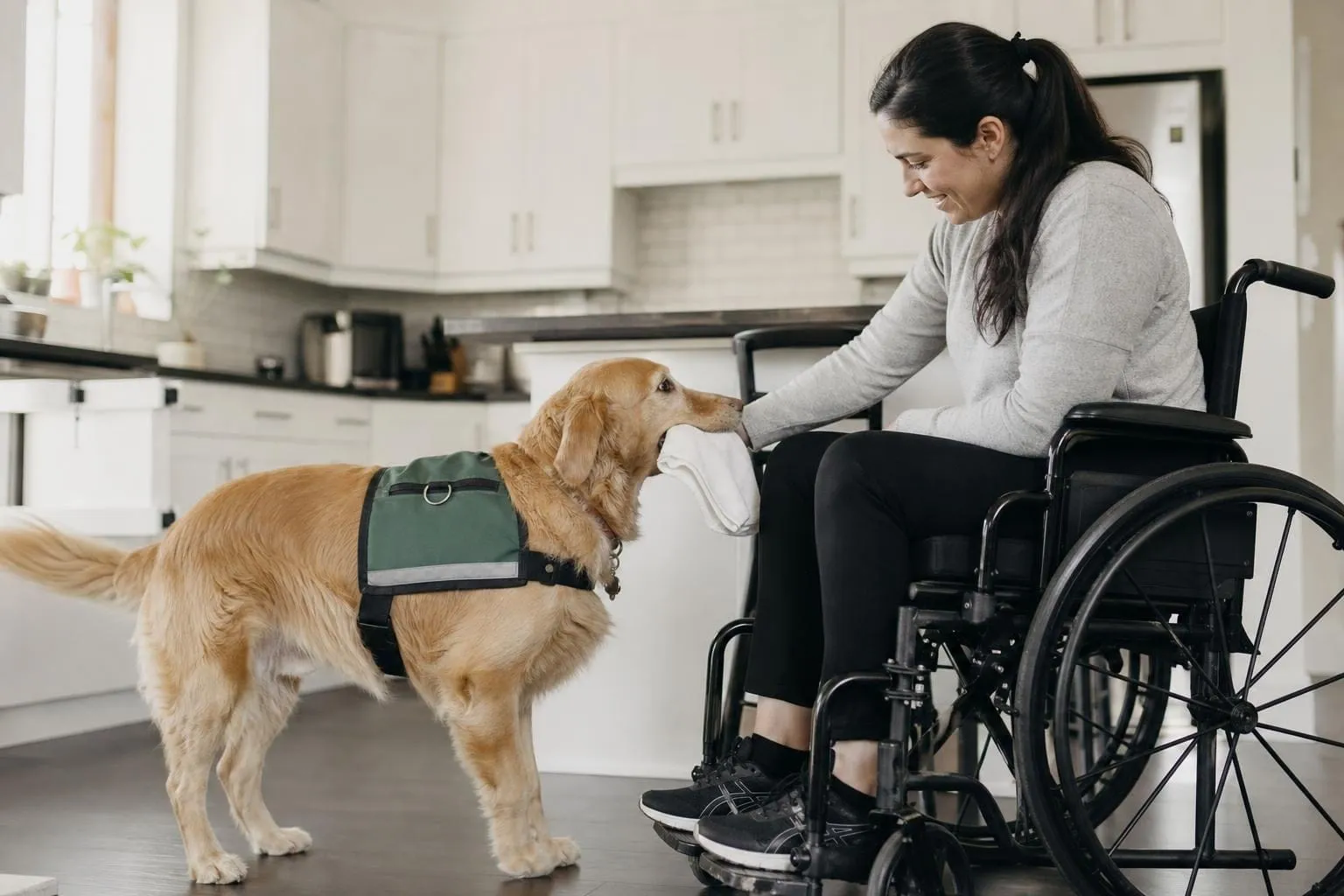
Mobility Assistance Tasks: Opening doors, picking up dropped items, turning light switches on or off, pressing elevator buttons, or providing balance and stability while walking. Dogs performing heavy mobility work typically need to weigh at least 55 pounds and have healthy joints.
Psychiatric Assistance Tasks: Deep pressure therapy (DPT) to calm anxiety attacks, “blocking” to create physical space between the handler and others in crowds, interrupting self-harm behaviors, performing grounding routines, or waking a handler from nightmares. NIH research found that deep pressure stimulation was used by 45% of psychiatric service dog handlers, while blocking contact from other people was reported by 42%.
Hearing Alert Tasks: Alerting a deaf or hard-of-hearing handler to sounds like a doorbell, smoke alarm, alarm clock, or someone calling their name. The dog typically makes physical contact with the handler and then leads them to the sound source.
Task training can begin once your dog has a strong obedience foundation and good socialization. Most tasks take weeks to months of consistent practice to become reliable.
Proofing means testing trained behaviors under increasingly challenging conditions: new locations, distractions, different weather, fatigue, and around other animals. A dog that performs a perfect “down-stay” at home but falls apart at a busy coffee shop hasn’t been adequately proofed. This stage is often underestimated by owner-trainers and is where many dogs reveal temperament limitations.
Public access training teaches the dog to behave appropriately in all public settings. The dog must ignore food on the ground, walk calmly past other dogs, remain settled under a table at a restaurant, ride in elevators and on escalators, and stay focused on the handler despite distractions. Public access training overlaps heavily with proofing and typically spans several months of gradually increasing exposure.
The Public Access Test is an evaluation, typically conducted by a professional trainer or organization, that measures whether a service dog team (handler and dog together) meets community standards for behavior in public. The IAADP has developed Minimum Training Standards for Public Access, and most certification programs require a passing score of 80% or higher.
The PAT is not legally required by the ADA. You do not need to pass one for your dog to qualify as a service dog. But it serves as the de facto industry standard, and passing one gives you confidence (and documentation) that your dog is ready for real-world work. Many experienced owner-trainers recommend taking it simply as a benchmark.
In the United States, you are legally allowed to train your own service dog. The ADA does not specify who must train the dog. Owner-trained service dogs have the same legal status as program-trained dogs, provided the dog actually performs trained tasks for a disability. This is why owner-training is so common, it puts the process in the handler’s hands and dramatically reduces costs.
That said, “legal” and “easy” are different things. Practitioners on Reddit’s r/service_dogs community frequently emphasize that owner-training requires a level of commitment most people underestimate. A podcast from Idaho Elite K9 Training put it well: service dog training isn’t just about the dog. It requires significant commitment from handlers too, ensuring they can maintain the training for the lifetime of their service partner.
A program-trained service dog is trained by a professional organization and then matched with a handler. Programs like Canine Companions, Guide Dogs for the Blind, and NEADS World Class Service Dogs handle breeding, puppy raising, and advanced training. Wait times are often one to three years, and costs to the organization can exceed $50,000 per dog, though many programs provide dogs at no cost to the recipient.
Hybrid training combines owner-training with professional guidance. You do the daily work with your dog, but a professional trainer provides assessments, troubleshoots problems, and helps with advanced task training. This is arguably the most practical approach for most people, and it’s what organizations like Psychiatric Service Dog Partners specifically recommend.
Cost is one of the biggest factors in deciding how to train your dog to be a service dog. Here’s how the numbers break down:
Training Path | Typical Cost Range |
|---|---|
Self-training (owner-trained) | $0 to $7,000 |
Hybrid (owner + professional guidance) | $7,000 to $15,000 |
Full professional / program-trained | $10,000 to $50,000+ |
Professional trainer hourly rate | $150 to $250 per hour |
Typical owner-train budget with a coach | $2,000 to $8,000 over 18 to 24 months |
These numbers come from multiple cost analyses across the industry. The self-training range is so wide because it depends on whether you hire any professional help, how much gear you buy, and whether you already have a suitable dog. The “free” end assumes you already own a healthy, temperamentally suitable dog and do all training yourself using free online resources.
For those considering the psychiatric service dog route specifically, this PSD cost guide provides a focused breakdown.
Most experts agree that fully training a service dog takes about two years. This includes a minimum of 120 hours of training, with at least 30 of those hours spent in public settings. Some handlers, particularly those training for complex psychiatric tasks, report the process taking closer to two and a half to three years.
Don’t rush it. A dog that’s pushed into public access work before it’s ready will develop stress behaviors that are extremely difficult to undo.
While the ADA does not require any documentation, maintaining a detailed training log is one of the smartest things an owner-trainer can do. Record what skills you worked on, where, for how long, and what the dog’s performance looked like. If your right to public access is ever questioned, your training documentation is what you’ll lean on. It also helps you track progress, identify plateaus, and prepare for a Public Access Test if you choose to take one.
Federal law does not require your service dog to wear a vest, harness, or any identifying gear. Period. However, a vest serves an obvious practical purpose: it signals to the public that your dog is working, which reduces unwanted interactions, questions, and confrontations. Many handlers consider a vest essential for day-to-day quality of life, even though it provides no extra legal rights.
If you’re weighing your options, this article on choosing a vest or ID to reduce confrontation covers the practical considerations.
Like vests, ID cards are not legally required. No business can demand you show one. But many handlers carry an ID card because it provides a quick, non-verbal way to communicate their dog’s status, especially in situations where explaining the ADA feels exhausting or triggering. An ID card won’t give you any rights you don’t already have, but it can make interactions smoother.
There is no government registry for service dogs in the United States. Any registry you encounter is private and voluntary. Registration does not change your legal status or grant additional rights under the ADA.
That said, many handlers choose voluntary registration for the same practical reasons they choose vests and ID cards: to have something concrete to show during interactions with landlords, hotel staff, or business managers who don’t fully understand ADA law. The key is understanding that registration is a convenience tool, not a legal requirement.
During the training period, many handlers use “In Training” patches on their dog’s vest to communicate that the dog is still learning. This serves two purposes: it sets appropriate expectations with the public, and in states with SDiT public access laws, it helps identify the dog’s status. Just remember that SDiT access rights vary by state and do not exist at the federal level.
Once your dog is fully trained, you have the right under the ADA to bring your service dog into virtually any place the public is allowed: restaurants, stores, hotels, hospitals, theaters, government buildings, taxis, and rideshares. Businesses cannot charge extra fees, require you to sit in a designated area, or ask you to leave because another patron is uncomfortable or allergic.
A business can ask you to remove your service dog in only two situations: if the dog is out of control and you don’t take effective action to control it, or if the dog is not housebroken. That’s the complete list. A dog that is barking excessively, lunging at people, or eliminating indoors can be legally asked to leave, and this is why thorough training matters so much. The business must still offer you the option to return without the dog.
Good handler etiquette isn’t a legal requirement, but it protects your access and the access of every handler who comes after you. Keep your dog well-groomed and clean. Don’t let your dog sniff merchandise or other people. Keep the dog tucked under your chair at restaurants, not in the aisle. Carry cleanup supplies. And understand that even though you shouldn’t have to, politely answering the two legal questions builds goodwill.
For more on how the public should interact with service dog teams, this article on etiquette for approaching a service dog is a useful resource to share with friends and family.
Intelligent disobedience is when a service dog deliberately refuses a handler’s command because following it would put the handler in danger. The classic example is a guide dog refusing to lead its handler into an intersection when a car is approaching, even though the handler gave the “forward” command. This is considered one of the most advanced training achievements and is particularly relevant for mobility and guide dog work.
Understanding how to train your dog to be a service dog means accepting that this is a long, demanding process with no guaranteed outcome. The average timeline is two years. The washout rate hovers around 50%. A PMC study on handler expectations versus reality found that people on waitlists for service dogs were more likely to anticipate physical benefits, while people who already had service dogs largely described psychosocial benefits. The same study noted that some drawbacks, such as public discrimination and the constant burden of educating strangers, were largely unanticipated by those on the waitlist.
None of this means you shouldn’t try. Owner-trained service dogs change lives every day. But going in with realistic expectations, a backup plan for your dog if it washes out, and a commitment to doing the work properly will serve you far better than enthusiasm alone.
If you’re ready to begin the process, consider starting with a professional temperament evaluation of your dog, connecting with a trainer experienced in service dog work, and joining an online community of owner-trainers who can provide support and accountability along the way.
No. There is no mandatory certification, registration, or government registry for service dogs in the United States. Federal law requires only that the dog be individually trained to perform a task related to your disability. Voluntary registration and ID products exist as practical tools to reduce friction in daily life, but they are not legally required.
Yes. The ADA does not restrict service dogs by breed. While Labrador Retrievers, Golden Retrievers, and German Shepherds are the most common choices, any breed can qualify if the individual dog has the right temperament, health, and training. What matters is the dog’s ability to perform the trained task reliably in public.
Most experts estimate about two years for a fully trained service dog, with a minimum of 120 hours of training including at least 30 hours in public settings. Some handlers, particularly those training for complex psychiatric tasks, report timelines closer to three years. Rushing the process increases the risk of washout.
Owner-training typically costs between $0 and $7,000, depending on whether you hire professional help, how much gear you purchase, and whether you already have a suitable dog. A hybrid approach with periodic professional guidance usually runs $2,000 to $8,000 over 18 to 24 months.
A service dog is trained to perform specific tasks for a person with a disability and has public access rights under the ADA. An emotional support animal provides comfort through its presence but performs no trained tasks and does not have public access rights. Both are protected under the Fair Housing Act for housing purposes. For a more detailed comparison, read about the key differences.
Not under federal law. The ADA does not cover service dogs in training. However, nearly every state has its own SDiT law granting some level of public access during the training period. Hawaii is the only state without SDiT coverage. Check your state’s specific regulations before taking your dog-in-training into public spaces.
Psychiatric service dogs can be trained for tasks including deep pressure therapy during anxiety attacks, interrupting self-harm or dissociative episodes, providing grounding through tactile stimulation, blocking contact from strangers in crowds, waking handlers from nightmares, and reminding handlers to take medication. The task must be trained (not just naturally occurring) and must relate directly to a diagnosed psychiatric disability.
About half of all service dog candidates wash out, meaning they fail during training or within the first year after deployment. If your dog washes out, it simply remains your pet or can be rehomed. Having a plan for this possibility before you start training is strongly recommended. Some dogs that wash out of one type of service work may succeed in another, so discuss options with a professional trainer before giving up entirely.

Copyright © 2020 USA Service Dog. All rights reserved.