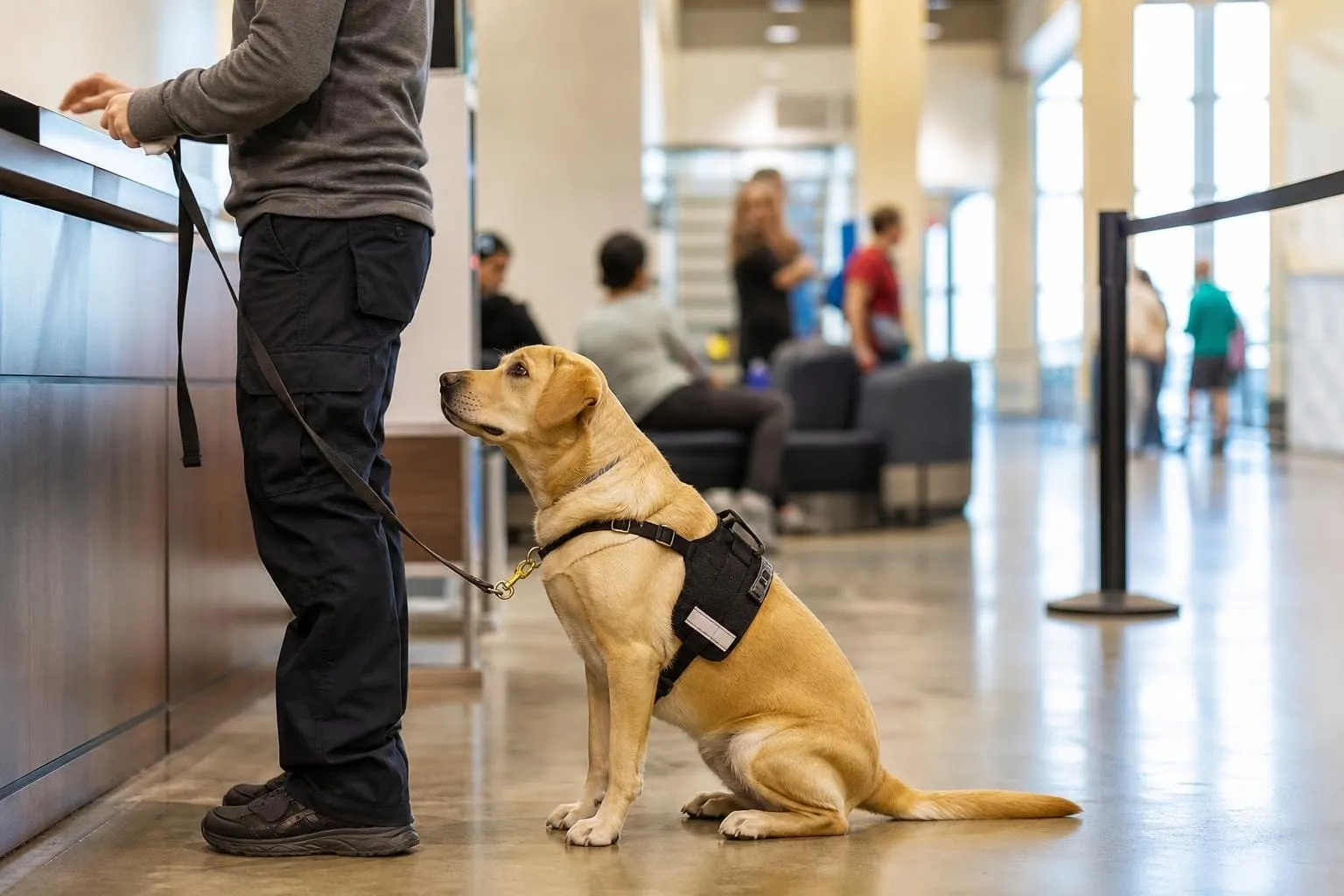
The public access test (PAT) is a voluntary behavioral evaluation that measures whether a service dog can work safely and calmly in public settings. It is not required by the ADA or any federal law, but it is widely considered the gold standard for proving a service dog team is ready for real-world access. The test evaluates both the dog’s behavior and the handler’s ability to manage the dog across roughly 10 to 12 real-world scenarios, from navigating crowds to ignoring food on the floor.
The public access test for service dogs is a structured evaluation designed to confirm that a service dog can behave safely, calmly, and unobtrusively in public spaces. Originally developed by Assistance Dogs International (ADI) in the mid-1990s, the test measures everything from how a dog exits a vehicle to how it settles quietly under a restaurant table. It also evaluates the handler, checking whether the person can maintain control, recover a dropped leash, and handle access challenges with composure.
Here is the critical point that confuses many people: the public access test is voluntary under the ADA. No federal law requires a service dog to pass this or any other test. But functionally, the behavioral standards the PAT measures are the same standards that determine whether a business can legally ask a service dog to leave. A dog that can’t pass the test is a dog that’s more likely to lose access in practice.
If you’re training a service dog or considering registration and ID options, understanding the PAT is an essential step.
The PAT traces back to Assistance Dogs International, the largest coalition of nonprofit service dog programs in the world. ADI developed the test as an internal standard for its member programs. Before any team (handler plus dog) could “graduate” from an ADI-accredited program, they had to pass this evaluation.
For years, ADI made their PAT publicly available online, and it became the reference point for independent trainers and owner-trainers alike. In 2017, ADI removed the test from their public website. The reasons were never fully explained, but the term “public access test” and its associated expectations had already become standard vocabulary in the service dog community.
Other organizations stepped in. Psychiatric Service Dog Partners (PSDP) published a free, updated public access test in 2022 specifically designed for psychiatric service dog teams, though it applies broadly. The International Association of Assistance Dog Partners (IAADP) also contributed consumer-focused standards that shaped how many trainers build their own PAT versions.
One lesser-known fact: “Public Access Test” is actually a registered U.S. trademark (Class 041, dog training). This has contributed to naming confusion, particularly when the AKC started calling their Urban Canine Good Citizen test a “Public Access Test,” a move that drew significant pushback from the assistance dog community.
No. The Department of Justice has been explicit on this point: “Covered entities may not require documentation, such as proof that the animal has been certified, trained, or licensed as a service animal.” There is no government-approved test, form, vest, ID card, or certificate that a service dog must carry.
Under the ADA, a business employee may only ask two questions when it’s not obvious that an animal is a service dog:
Is this a service animal required because of a disability?
What work or task has the dog been trained to perform?
That’s it. They cannot ask for proof of training, demand a demonstration, or request certification paperwork. You can learn more about what businesses can legally ask in our detailed guide.
Here is the nuance that most articles miss. While no law requires passing a PAT, the ADA does allow businesses to remove a service dog that is “out of control” and the handler does not take effective action to control it, or if the dog is not housebroken. The specific behaviors that cause a PAT failure (lunging, barking, eliminating indoors, ignoring the handler) are the same behaviors that trigger lawful removal under the ADA.
So the public access test doesn’t grant rights. But a dog that can’t meet its behavioral standards is far more likely to face real access problems. When a Days Inn denied a veteran access with his service animal, it was a clear violation. But when a dog genuinely misbehaves in public, the legal protections weaken considerably.
One Canadian guide dog handler captured the frustration well in a CBC interview: “They really don’t have the right training or temperament to be in public. They misbehave, they growl and their humans let them do things that a guide dog handler never would. It happens everywhere now.”
The PAT is not a trick competition or an obedience trial. It measures whether a service dog team can function safely and unobtrusively in everyday public situations. Importantly, it evaluates both the dog and the handler as a working unit.
Here are the core components, synthesized from ADI, IAADP, PSDP, and widely used trainer versions:
Controlled vehicle unload. The dog stays seated or in a down position until given a release command. No bolting from the car, no straining against the leash, no excessive excitement.
Approaching a building. The dog maintains a heel position without forging ahead or lagging behind. The dog should not show fear of traffic or environmental noises.
Controlled entry through doorways. The dog waits for the handler’s cue before crossing any threshold, whether entering a store, an elevator, or a building. This prevents the dog from pulling the handler off balance.
Heeling through crowds and aisles. The dog stays at the handler’s side regardless of distractions, navigating tight spaces without bumping into people or displays.
Ignoring food on the floor. The dog passes dropped food, open food displays, and retail products without sniffing, lunging, or breaking focus.
Sit, down, and stay on cue. The dog responds reliably to basic obedience commands in a public environment, not just at home.
Restaurant etiquette. The dog lies quietly under the table or beside the handler’s chair, staying out of the path of servers and other diners. This is one of the most commonly failed stations.
Reaction to distractions. Evaluators introduce sudden noises (a dropped clipboard, a shopping cart), unusual movements, children, and sometimes other dogs to test the dog’s composure.
Recall and leash recovery. The handler demonstrates the ability to call the dog back and to recover control if the leash is accidentally dropped.
Stranger greeting. The dog remains calm and neutral when strangers approach the handler. No jumping, no excessive friendliness, no avoidance.
Building exit. The dog exits calmly, matching the handler’s pace, without pulling toward the door.
Team relationship. Evaluators look for a positive, relaxed dynamic between handler and dog. There should be visible positive reinforcement and mutual trust.
This is the part most articles skip. The PAT also specifically evaluates whether the handler can:
Safely load and unload the dog from a vehicle
Enter a public place without losing control
Recover the leash if accidentally dropped
Cope calmly with access challenges (for example, if an employee questions the handler’s right to bring the dog inside)
A dog can be perfectly trained and still fail because the handler isn’t managing the team effectively. Understanding proper etiquette around service dogs matters for both handlers and the public.
Task performance is not typically scored during the PAT. The test doesn’t check whether the dog can alert to seizures, retrieve dropped items, or perform psychiatric intervention tasks. It only evaluates public behavior. Task training is a separate consideration. If you’re curious about what tasks qualify a psychiatric service dog, that’s covered separately.
Most PAT versions use a grading scale:
A = Always
M = Most of the time
S = Some of the time
N = Never
The team must score at least 80% “Yes” answers on pass/fail items. On behavioral frequency items, the team needs to score “Always” or “Most of the time.” Some items are marked as mandatory, meaning anything less than a perfect score on those items results in automatic failure.
This is where it gets interesting, and where most competing articles offer no data.
Owner-trained service dog teams pass on their first attempt roughly 50% to 70% of the time. That means a third or more of owner-trained teams need additional work before they’re truly ready for public access.
Program-trained service dogs (placed by ADI-accredited organizations) pass at 95% or higher, because those dogs are extensively pre-tested before placement.
These numbers should be encouraging, not discouraging. A first-time failure is a training signal, not a permanent verdict. Most trainers recommend four to twelve weeks of focused work on the specific failure points before retesting.
Certain behaviors cause an instant, non-negotiable failure regardless of how well the team performs elsewhere:
Any aggressive behavior: growling, biting, raising hackles, showing teeth
Eliminating indoors: urinating or defecating inside a building
Uncontrollable behavior: a dog the handler simply cannot manage
Guarding behavior: resource guarding of food, possessions, territory, or the handler
Practitioners on Reddit’s r/service_dogs frequently discuss what causes teams to stumble. The most common failure points are:
Food motivation: lunging at or fixating on dropped food
Dog reactivity: barking, pulling, or fixating on other dogs
Failure to settle: inability to lie quietly under a restaurant table for an extended period
These aren’t character flaws. They’re training gaps that can be addressed with targeted work. Understanding these common pitfalls early in service dog training helps handlers prepare more effectively.
There is no single authority that controls who can give a PAT. The test can be administered in several ways:
ADI-accredited programs. Every ADI member program is required to administer a public access test before graduating and credentialing a team. This is the most formal version of the test. The evaluation creates a level playing field, since it does not matter whether the team includes a guide dog, hearing dog, or other type of service dog.
Independent professional trainers. Most certified service dog trainers can administer a PAT using the ADI standard, the IAADP framework, or a comparable version they’ve developed. This is the most common option for owner-trainers who want a professional evaluation.
Self-administration. Handlers can self-test using freely published PATs. The PSDP test is the most widely recommended free option, designed for psychiatric service dog teams but applicable to all service dog types. It includes detailed scoring criteria and a list of unacceptable behaviors.
Important caveat: Self-testing provides no third-party verification. It’s a valid self-assessment tool, but it carries no external credibility. Practitioners on Reddit’s r/service_dogs consistently note that passing a self-administered PAT doesn’t get any organization to vouch for your dog. The community frequently cautions that private registry sites selling “PAT certificates” provide no legal standing either.
This comparison causes enormous confusion. The AKC Canine Good Citizen (CGC) test is a 10-station behavioral assessment for any pet dog. The public access test is specifically designed for service dog teams in real-world public access scenarios. They overlap, but they are not interchangeable.
Feature | AKC Canine Good Citizen (CGC) | Public Access Test (PAT) |
|---|---|---|
Designed for | Any pet dog | Service dog teams |
Number of stations | 10 | 10 to 12+ |
Restaurant settle test | No | Yes |
Store/aisle navigation | No | Yes |
Food distraction test | No | Yes |
Prolonged public work | No | Yes |
Handler evaluation | Minimal | Extensive |
Evaluates disability-related teamwork | No | Yes |
Passing grants service dog status | No | No (voluntary standard) |
Passing the CGC, or even the Urban CGC, does not make a dog a service dog. A key distinction is that the handler must have a qualifying disability and the dog must be trained to perform specific tasks related to that disability.
The naming controversy matters here. When AKC renamed their Urban CGC to include the words “Public Access Test,” the assistance dog community pushed back hard. PSDP publicly stated: “We genuinely fear that if the test is called a ‘Public Access Test,’ no disclaimer will be enough to dissuade consumers or business owners from wrongly assuming that completing the test grants people public access everywhere with their dogs.”
This confusion feeds directly into the broader problem of distinguishing service animals from emotional support animals, a distinction many people still get wrong.
The IAADP established minimum training standards that most of the service dog community treats as the baseline for readiness. These benchmarks connect directly to PAT preparation:
120 hours of training over a period of six months or more
At least 30 of those hours in public settings
Formal training before the age of six months is not recommended and does not count toward IAADP’s minimums
The dog should respond to commands at least 90% of the time on the first ask (per ADI standards)
The dog must be trained to perform at least three disability-related tasks
That works out to roughly five hours per week of dedicated training. In practice, most trainers say the full process takes closer to two years. The 120-hour benchmark is a floor, not a ceiling.
Most trainers and handler communities treat PAT readiness as the final milestone before considering a service dog “graduated” from training. PSDP’s test, for example, is designed to be administered toward the end of a team’s initial one to three years of training.
If you’re exploring training options, our guide on how to train your dog to be a service dog covers the full process from foundation skills through public access readiness.
The public access test is relevant only to service dogs. It does not apply to emotional support animals or therapy dogs, because those categories do not have public access rights under the ADA.
Service dogs are individually trained to perform specific tasks for a person with a disability. They have broad public access rights under the ADA.
Emotional support animals (ESAs) provide comfort through companionship but are not trained to perform specific tasks. They have housing protections under the Fair Housing Act, but no right to enter restaurants, stores, or other public accommodations.
Therapy dogs are trained to provide comfort to others (in hospitals, schools, nursing homes) and work under their handler’s direction in specific settings. They have no individual public access rights.
A 2023 University of Kentucky thesis highlighted the growing problem: “The presence of fake service animals in public spaces is increasing every day. These mislabeled dogs pose a great danger to working service dogs and the rights of the handlers.” The thesis argued that requiring a public access test before any future registration system would help ensure behavioral standards, an idea that has growing support among trainers and handlers alike.
Understanding these distinctions matters. If you’re unsure whether your situation calls for a service dog letter or an ESA letter, the differences are significant in terms of both rights and responsibilities.
The service dog community is nearly unanimous on this point: even though no law demands it, every service dog team should work toward passing a public access test. Here’s why.
It protects other people. A dog that passes a PAT is demonstrably safe around strangers, children, other animals, and unexpected situations. Public safety is the first thing the test measures.
It protects the handler. A well-behaved service dog faces fewer access challenges, fewer confrontations, and fewer situations where a business might attempt removal. A vest or ID card that reduces confrontation helps, but nothing replaces solid behavior.
It protects the broader service dog community. Every poorly behaved dog in a “service dog” vest makes life harder for legitimate handlers. PAT-level behavior is the behavioral baseline that earns public trust.
It gives the handler honest feedback. As one Cooperative Paws trainer noted, many people assume certification is a legal requirement or that there’s a government-mandated test. There isn’t. But working through a PAT gives handlers an objective, structured way to assess whether their dog is genuinely ready, or whether more training is needed.
Yes. Self-testing using a published PAT (such as the one from Psychiatric Service Dog Partners) is common and considered a valid self-assessment tool. However, self-testing carries no third-party verification. If you want external validation, hiring a professional trainer to administer the test is the better option.
Failure is a training signal, not a permanent verdict. Most trainers recommend four to twelve weeks of focused work on the specific areas where the team struggled, followed by a retest. Roughly 30% to 50% of owner-trained teams need a second attempt, which is completely normal.
No legally meaningful certification for service dogs exists in the United States. The ADA does not recognize any certification, registration, or testing requirement. Passing a PAT proves your dog meets a behavioral standard, but it does not create a legal credential. Be cautious of fake certification scams that claim otherwise.
No. The test evaluates behavior, not documentation or equipment. That said, many handlers choose to use vests and ID cards during everyday public access because they reduce questions and confrontations, not because they’re legally required.
Explore service dog gear and credential bundles to find options that fit your needs.
No. The CGC is a general behavior test for any pet dog. The PAT adds service-dog-specific scenarios like restaurant settling, food distraction tests, store navigation, and handler evaluation. Passing the CGC is a good foundation, but it does not demonstrate public access readiness for a service dog.
Most PAT evaluations take between 45 minutes and two hours, depending on the version used and the number of real-world locations involved. Some evaluators conduct the test across multiple environments (parking lot, store, restaurant) in a single session.
Most trainers recommend waiting until the dog is at least 18 to 24 months old. IAADP specifies that formal training before six months of age doesn’t count toward their minimum training standards. Since the PAT is typically administered at the end of one to three years of training, most dogs are well into adulthood before they’re tested.
No. The public access test applies only to service dogs. Emotional support animals do not have public access rights under the ADA, so the behavioral standard the PAT measures is not relevant to their role. ESAs are protected under the Fair Housing Act for housing purposes, which involves different documentation requirements entirely.

Copyright © 2020 USA Service Dog. All rights reserved.