Florida service dog laws provide stronger protections than the federal ADA baseline, covering public access, housing, and employment through three core statutes: §413.08 (service animals), §413.081 (animal protection), and §760.27 (emotional support animals in housing). Florida uniquely grants full public access rights to service animals in training and explicitly recognizes miniature horses alongside dogs. Misrepresenting a pet as a service animal is a criminal offense carrying up to 60 days in jail and mandatory community service.
Florida is one of the most protective states in the country when it comes to service animal rights. The state goes beyond what the Americans with Disabilities Act requires at the federal level, adding criminal penalties for access denials, extending public access to service animals still in training, and maintaining a standalone ESA housing statute that has become even more important since HUD withdrew its national guidance in September 2025.
This guide breaks down every key term, statute, and right under Florida service dog laws, written for handlers, landlords, business owners, and condo boards who need fast, accurate answers.
Need to understand the basics first? See our overview of service animal vs. ESA differences.
Note: This article provides educational information, not legal advice. Consult a Florida attorney for specific disputes or situations.
Three Florida statutes form the backbone of service dog law in the state. Knowing which statute controls which situation is the single most important thing for anyone navigating these rules.
F.S. §413.08 is the primary service animal statute. It covers public access rights, housing accommodations, employment protections, trainer access, and criminal penalties for misrepresentation.
F.S. §413.081 protects service animals themselves from harm. Injuring or killing a service animal is a third-degree felony in Florida, carrying up to five years in prison.
F.S. §760.27 governs emotional support animals in housing specifically. Enacted July 1, 2020, it establishes documentation requirements, prohibited landlord practices, and fraud penalties.
Under §413.08(1)(d), a “service animal” is an animal trained to do work or perform tasks for an individual with a disability. This includes physical, sensory, psychiatric, intellectual, or other mental disabilities. For public accommodations, only dogs and miniature horses qualify.
The statute explicitly states that the crime-deterrent effect of an animal’s presence and the provision of emotional support, well-being, comfort, or companionship do not constitute “work or tasks.” This is the bright line separating service animals from emotional support animals.
Florida law defines this as a person with a physical or mental impairment that substantially limits one or more major life activities. The definition aligns with the federal ADA standard. You can explore the most common qualifying conditions to understand what types of disabilities are typically involved.
Under §413.08(2), this term covers hotels, restaurants, grocery stores, theaters, public transit, and essentially everywhere the public is invited. If a business is open to the general public, it’s a public accommodation under Florida law.
This matters in practice. In 2023, Publix made news when it began displaying prominent signs reminding shoppers that only service animals are allowed in its stores, a direct reference to §413.08 rather than just ADA guidelines. Winn-Dixie and other Florida grocery chains follow the same statutory framework.
When a handler enters a business with a service dog, staff may ask only two questions:
Is this a service animal required because of a disability?
What task has the animal been trained to perform?
That’s it. Businesses cannot ask about the nature of the disability, demand documentation, require the dog to demonstrate its task, or ask for certification. This rule comes from both the ADA and Florida’s §413.08, and violating it by demanding more can expose a business to penalties.
In one real-world example, an Uber driver was suspended for refusing to accept a service animal, illustrating how the access rule extends to transportation services.
Florida explicitly includes miniature horses as service animals alongside dogs. This is worth highlighting because the federal ADA treats miniature horses under a separate “reasonable modification” standard rather than as a defined service animal. Florida’s statute is more straightforward: if a miniature horse is trained to perform tasks for a person with a disability, it’s a service animal with full public access rights.
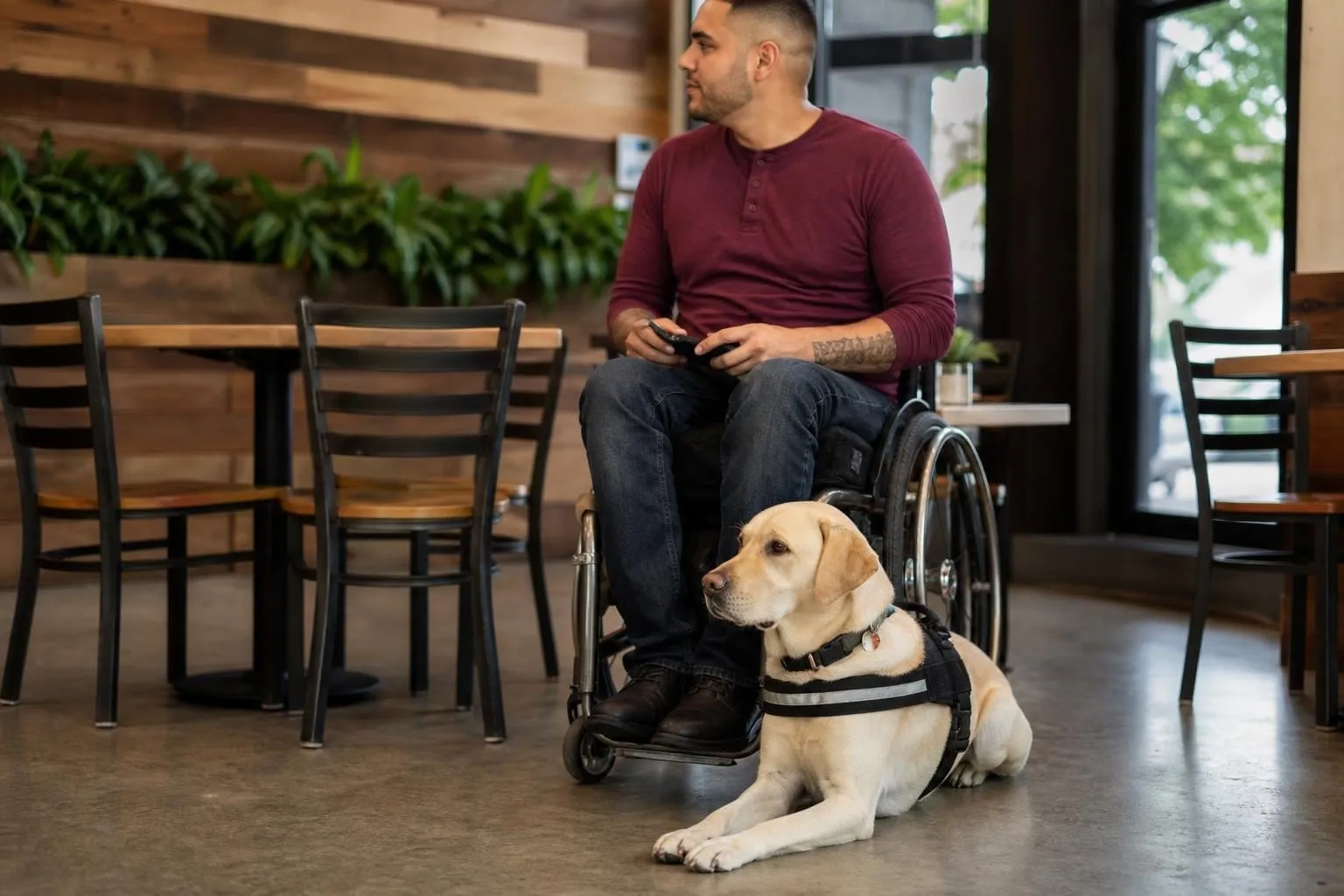
A psychiatric service dog is a service dog trained to perform specific tasks related to a psychiatric disability, such as interrupting self-harm behaviors, performing deep pressure therapy during panic attacks, or reminding a handler to take medication. Under Florida law, a PSD has the same public access rights as any other service dog.
The critical distinction: a PSD performs trained tasks. An emotional support animal provides comfort through presence alone. Florida treats them under entirely different statutes. For a deeper look at what qualifies, see our guide on tasks that qualify a psychiatric service dog.
This is one of the most important Florida-specific protections. Under §413.08(8), any trainer of a service animal, while engaged in training, has the same rights and privileges with respect to access to public facilities as a person with a disability using a service animal. The federal ADA does not grant public access rights to service animals in training, so this is a meaningful expansion of protection that only applies within Florida’s borders.
The only valid basis for removing a service animal from a public place is if the animal poses a direct threat, meaning it is out of control and the handler cannot regain control, or it is not housebroken. Allergies, fear of dogs, and general discomfort among other patrons are not valid reasons for removal.
Florida law does not require service dogs to be registered, certified, or identified by a vest, special harness, or leash. No business may demand proof of a dog’s status beyond the two permitted questions. Self-trained service dogs are fully recognized, as the law focuses on whether the animal is trained to perform a task, not who did the training or whether any organization issued a certificate.
That said, many handlers choose to use identification gear voluntarily because it reduces day-to-day confrontations. A visible vest or ID card signals to businesses and bystanders that the dog is working, which can prevent awkward encounters before they start.
Interested in reducing public access friction? Browse service dog vests and ID options designed to make outings smoother.
Under §760.27, an emotional support animal is an animal that does not require training to do work, perform tasks, or provide assistance. Instead, it provides therapeutic emotional support by virtue of its presence, alleviating one or more identified symptoms or effects of a person’s disability.
The key word is “presence.” An ESA does not need to be trained to do anything specific. This is exactly why ESAs receive narrower legal protections than service dogs. They are protected in housing under Florida and federal law, but they have no public access rights. Outside of a person’s home, an ESA is legally considered a pet.
This is the legal mechanism that protects ESA owners in housing. A “reasonable accommodation” is a change to a housing provider’s rules, policies, or practices that allows a person with a disability equal opportunity to use and enjoy their home. Waiving a no-pet policy for an ESA or service dog is the most common example.
Florida law requires ESA documentation to come from a licensed health care professional who has personal knowledge of the patient. Under §760.27, the clinician must have actually evaluated the person, not just processed an online questionnaire. The letter must be on professional letterhead and include the clinician’s license information.
Landlords are permitted to verify the clinician’s license. They are not permitted to request a specific form, a notarized statement, or medical records. They also cannot deny a request solely because the tenant didn’t use the landlord’s preferred process. For a full breakdown of what belongs in a valid letter, see our guide on required ESA letter elements.
This is the anti-fraud mechanism baked into §760.27. The licensed mental health professional must have personal knowledge of the patient’s disability. A clinician who has never evaluated you cannot write a valid ESA letter under Florida law. This requirement is why “instant” ESA letters from unknown providers raise red flags. Learn how to spot fake ESA letter scams before paying for one.
Under Florida law, this means any person or entity covered by the Fair Housing Act or Section 504 of the Rehabilitation Act. That includes landlords, property management companies, condo associations, and HOAs.
Not every housing situation is covered. The Fair Housing Act exempts owner-occupied buildings with four or fewer units, single-family homes rented without a broker (if the owner owns no more than three such homes), religious organizations, and private clubs. These exemptions are narrow and rarely apply to the typical Florida rental or condo situation.
A no-pet policy cannot be enforced against a service animal or an ESA with proper documentation. This applies to apartments, condos, single-family rentals, and HOA-governed communities. The animal is not a “pet” under the law; it is an accommodation for a disability.
Landlords and HOAs cannot charge pet deposits, pet fees, or pet rent for service animals or ESAs. This is true under both the federal Fair Housing Act and Florida’s §760.27. If the animal causes property damage, the handler remains financially liable for repairs, but an upfront deposit specifically for the animal is prohibited.
Practitioners on forums like BiggerPockets report that this is one of the most common points of confusion among Florida landlords. Multiple threads show landlords citing §413.08 while trying to figure out whether they can charge fees. The answer is consistently no.
For more on this topic, see our detailed guide on whether ESA letters waive pet fees.
Breed restrictions, weight limits, and species restrictions do not apply to service animals or ESAs with valid documentation. Many Florida condominiums and HOAs attempt to restrict the size, weight, breed, or number of assistance animals, or dictate where the owner can walk the animal on association property. These restrictions are generally unenforceable when the animal qualifies as a service animal or ESA under Florida law.
In one notable case, a Colorado couple was awarded $50,000 after their HOA refused to accommodate an emotional support animal. While that case was outside Florida, it illustrates the financial exposure HOAs face when they deny valid accommodation requests.
Under §760.27, landlords can request:
An ESA letter from a licensed health care professional
Proof of the clinician’s professional licensure
Proof of current vaccinations for the animal
Landlords cannot request:
Details about the diagnosis or severity of the tenant’s disability
Medical records related to the disability
A specific form or notarized statement
Registration or certification documentation
Handlers remain liable for any property damage caused by their service animal or ESA. The law waives pet fees, not damage responsibility. If a dog destroys carpet or a door frame, the landlord can charge for repairs through normal damage liability channels.
Florida’s condo density makes this a particularly contentious area. Association boards must evaluate ESA and service animal accommodation requests under the same §760.27 framework that applies to traditional landlords. They cannot impose blanket pet bans that override valid accommodations. With HUD’s September 2025 guidance withdrawal (covered below), Florida’s §760.27 is now the clearest written roadmap a Florida board has for evaluating these requests.
On September 17, 2025, the U.S. Department of Housing and Urban Development formally withdrew two key guidance documents that housing providers had relied on for years to evaluate requests for service and assistance animals. These included FHEO-2020-01 and related companion guidance.
What this means in practice: the federal Fair Housing Act and its reasonable accommodation obligations remain fully in effect. Nothing about the underlying law changed. But the detailed procedural roadmap that many landlords and property managers followed is gone.
For Florida specifically, the impact is smaller than in states without their own ESA statute. Florida Statute §760.27 was never dependent on the HUD guidance. It is a standalone state law that continues to govern every ESA request in the state. If anything, §760.27’s detailed documentation requirements, personal knowledge rule, and fraud penalties now stand as the most specific written framework available to Florida housing providers.
Most competing guides haven’t incorporated this development yet, but it matters. If you’re a Florida landlord or condo board member, your primary reference point is §760.27, not withdrawn federal guidance.
Service dogs are permitted at Walt Disney World, Universal Studios Orlando, SeaWorld, and all other Florida theme parks and attractions that qualify as public accommodations. Handlers are subject to the same two-question rule. The dog must be under the handler’s control at all times and housebroken.
Emotional support animals do not have public access rights in Florida, so they are not permitted at theme parks, regardless of documentation.
Florida courts have prosecuted service animal fraud cases under §413.08(9) regularly, often in tourist-corridor venues like theme parks, beaches, and restaurants, where misrepresentation peaks during busy seasons. Review our article on the penalties for misrepresenting a pet as a service animal for real-world examples.
Florida takes service animal fraud and interference seriously. Here is every penalty across the three governing statutes, compiled in one place.
A person who knowingly and willfully misrepresents themselves as using a service animal commits a second-degree misdemeanor. The penalty: up to $500 fine, up to 60 days in jail, and 30 hours of mandatory community service for an organization serving individuals with disabilities.
Fraudulently misrepresenting an animal as an emotional support animal, or providing fraudulent ESA documentation, is also a second-degree misdemeanor under Florida Statute §817.265. The penalties mirror service dog fraud: up to 60 days in jail, a $500 fine, and 30 hours of community service.
Denying public accommodation to a service dog handler is itself a second-degree misdemeanor. A business owner, manager, or employee who refuses entry to a person with a legitimate service animal can face up to $500 in fines and 60 days in jail. In one documented case, a Days Inn denied a veteran access with his service animal, highlighting how real these confrontations are.
Recklessly interfering with the use of a service animal is a second-degree misdemeanor on the first offense. Recklessly causing injury to a service animal escalates to a first-degree misdemeanor, punishable by up to one year in jail and a $1,000 fine.
Intentionally injuring or killing a service animal, or permitting a dog you control to do so, is a third-degree felony. The maximum penalty is five years in prison and a $5,000 fine. Convicted individuals must also pay full restitution covering the value of the service animal, replacement and training costs, veterinary and medical expenses, and the handler’s lost wages.
Offense | Statute | Classification | Max Fine | Max Jail | Other |
|---|---|---|---|---|---|
Service dog fraud | §413.08(9) | 2nd-degree misdemeanor | $500 | 60 days | 30 hrs community service |
Denying handler access | §413.08(4) | 2nd-degree misdemeanor | $500 | 60 days | 30 hrs community service |
Reckless interference with service animal | §413.081(1) | 2nd-degree misdemeanor | $500 | 60 days | — |
Reckless injury to service animal | §413.081(2) | 1st-degree misdemeanor | $1,000 | 1 year | — |
Intentional injury or killing of service animal | §413.081(3) | 3rd-degree felony | $5,000 | 5 years | Full restitution |
ESA documentation fraud | §817.265 | 2nd-degree misdemeanor | $500 | 60 days | 30 hrs community service |
The ADA governs public access rights nationwide. Only dogs (and miniature horses under a separate reasonable modification analysis) qualify as service animals under federal law. Florida’s §413.08 matches and in some cases exceeds ADA protections, particularly regarding service animals in training and criminal penalties for access denials.
The FHA governs housing nationwide and is broader than the ADA. Under the FHA, any animal can qualify as an assistance animal (including ESAs of any species) if it alleviates symptoms of a disability. Florida’s §760.27 adds state-level specificity, particularly around documentation requirements and fraud penalties.
After the Department of Transportation’s 2021 rule changes, airlines are only required to accommodate trained service dogs. ESAs no longer have cabin access rights on commercial flights. Handlers must complete DOT-approved forms. Florida law does not override federal airline regulations.
No. Florida law does not require registration, certification, or any form of official documentation for service dogs. No government registry exists for service animals in the United States. Some handlers voluntarily carry identification or use a registry for convenience, but it is never legally required.
No. Under both the ADA and Florida’s §413.08, businesses are limited to two questions: whether the animal is a service animal required because of a disability, and what task it has been trained to perform. They cannot ask for papers or a demonstration.
No. Emotional support animals are protected in housing under §760.27 and the Fair Housing Act, but they have no right to enter restaurants, stores, theme parks, or other public accommodations. Outside of housing, an ESA is legally a pet under Florida law.
An HOA can only deny an ESA accommodation request if the animal poses a direct threat to others’ safety, would cause significant property damage that cannot be mitigated, or if the documentation is fraudulent. Blanket no-pet rules, breed restrictions, and weight limits do not apply to valid ESA accommodations.
Yes. Florida law focuses on whether the animal is trained to perform a task for a person with a disability. It does not require professional training, a training program certificate, or any specific training methodology. For guidance on the process, see our article on how to train your dog to be a service dog.
HUD withdrew two key guidance documents that housing providers used to evaluate assistance animal requests. The Fair Housing Act itself remains unchanged, and Florida’s §760.27 was never dependent on that guidance. For Florida landlords and condo boards, §760.27 remains the controlling framework.
Yes. Service dogs are permitted at all Florida theme parks and attractions. They must be under the handler’s control and housebroken at all times. ESAs are not permitted.
Don’t pet, feed, or distract a working service dog without the handler’s permission. The dog is performing a job, and interference can be dangerous for the handler. Read our full guide on etiquette for approaching a service dog.
Understanding Florida service dog laws protects handlers, keeps businesses compliant, and helps landlords process accommodation requests correctly. Whether you’re a handler asserting your rights or a property manager evaluating a request, the statutes above are your roadmap.
Looking for documentation or identification gear? Explore service dog registration and ID options to find what works for your situation.

Copyright © 2020 USA Service Dog. All rights reserved.